
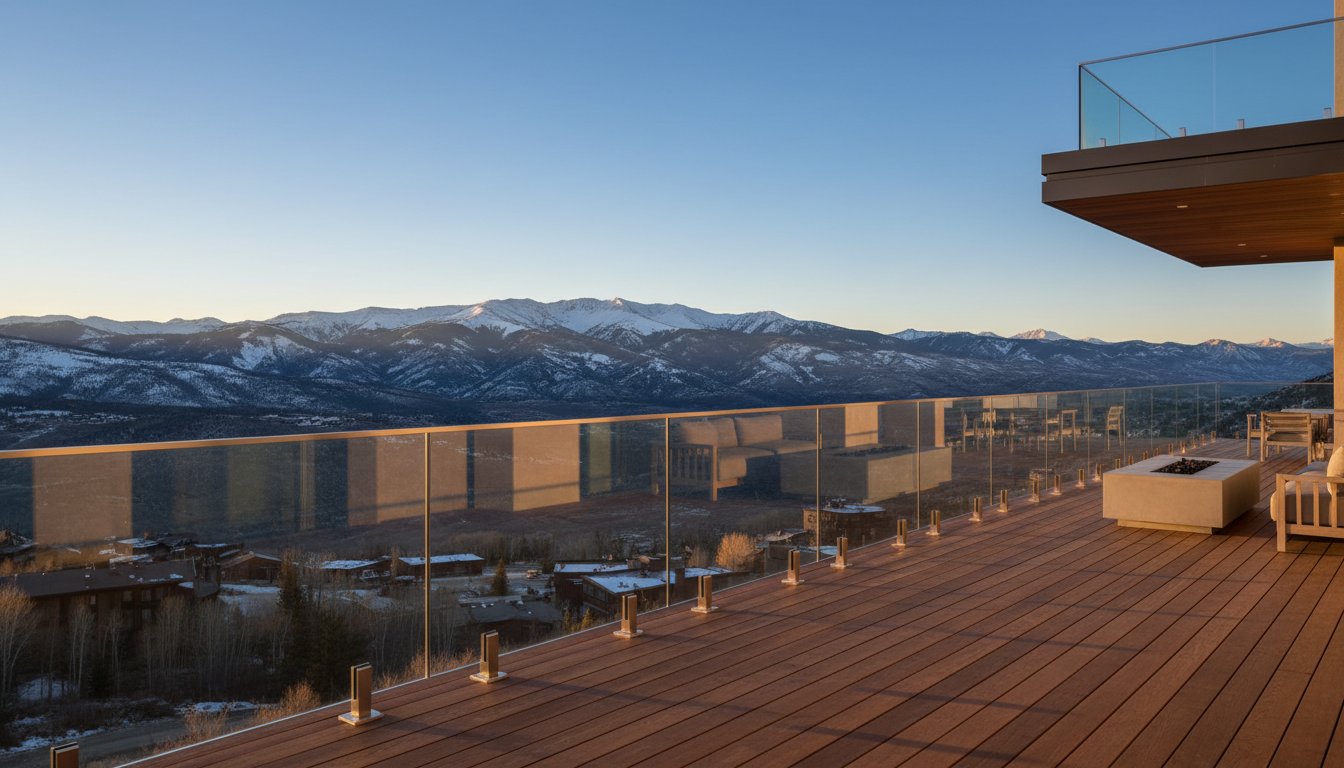
A panoramic view of the Wasatch Range is the most valuable asset of any Park City residence, yet many homeowners inadvertently compromise this luxury with heavy, opaque barriers. You likely believe that every architectural detail should serve the dual purpose of uncompromising safety and aesthetic excellence, especially when facing the extreme alpine climate of Northern Utah. It’s natural to feel concerned about the structural resilience of transparent materials during a heavy winter or the potential for inflated local labor rates often seen in high-end mountain markets. Understanding how much do glass railings cost in Park City is the first step toward reclaiming your horizon without sacrificing durability.
This 2026 guide provides a definitive framework for your investment, focusing on the intersection of engineering precision and timeless design. We’ll explore how structural glazing complies with strict Summit County building codes and why custom-engineered systems offer a superior return on investment compared to generic hardware kits. You’ll gain a clear perspective on material specifications, from heat-strengthened laminates to corrosion-resistant mounting, ensuring your balcony remains a secure sanctuary for years to come.
Key Takeaways
- Understand the 2026 investment landscape for premium installations, where projects typically range from $250 to $650 per linear foot due to specialized mountain requirements.
- Discover how much do glass railings cost in Park City by evaluating the structural differences between framed and frameless systems and their impact on your architectural vision.
- Learn how to navigate specific local variables, including high-altitude wind load engineering and stringent building code compliance for 42-inch safety heights.
- Compare the lifecycle value of structural glass against traditional materials, focusing on how specialized glazing withstands Park City’s intense freeze-thaw cycles.
- Explore how advanced 3D laser measuring and bespoke fabrication eliminate installation delays, ensuring a seamless fit for complex mountain topography.
The Baseline: Average Cost of Glass Railings in Park City (2026)
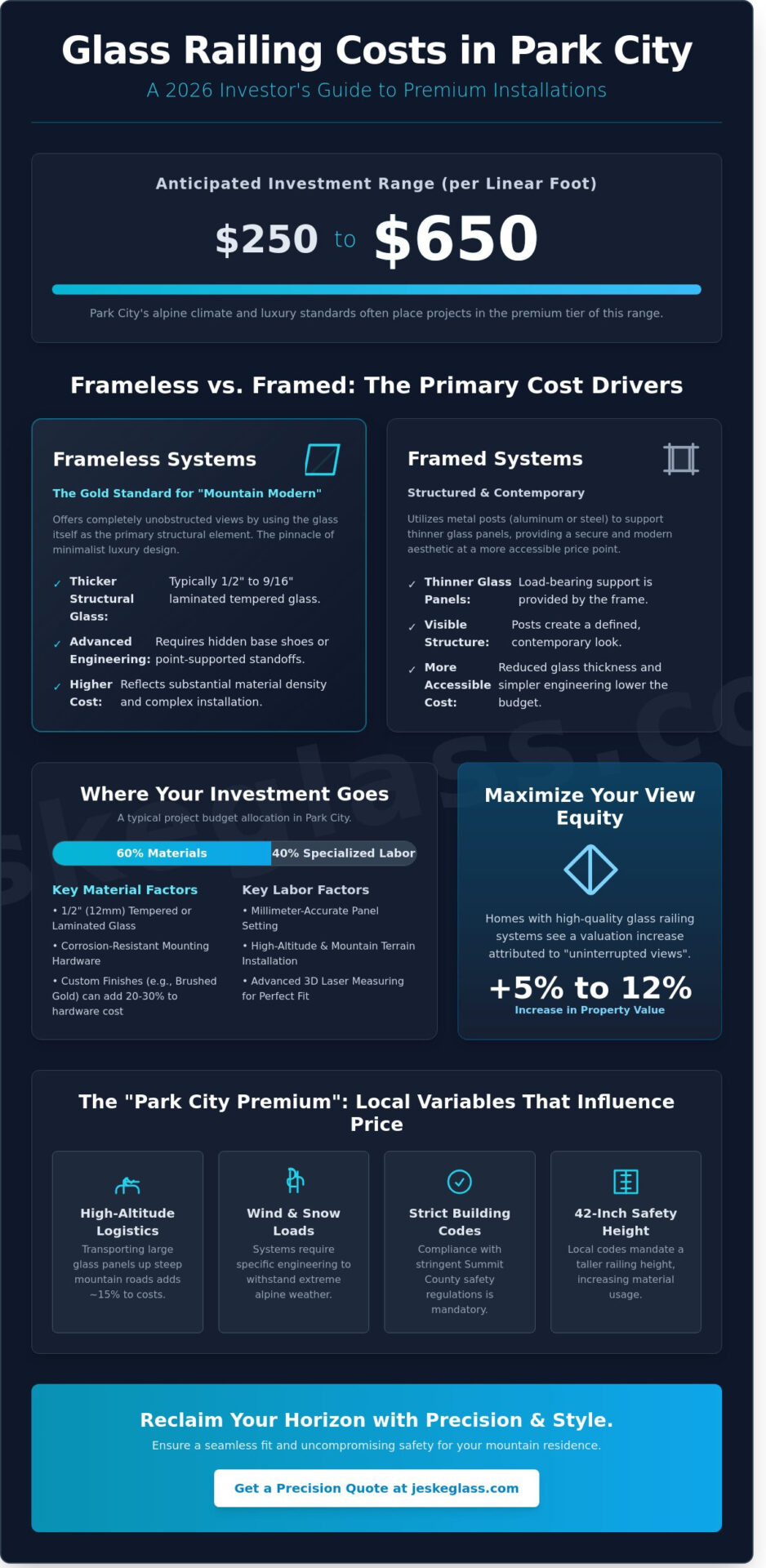
Determining how much do glass railings cost in Park City requires an understanding of the intersection between high-end engineering and alpine aesthetics. As of 2026, homeowners in the Utah mountain region should anticipate a price range of $250 to $650 per linear foot for professional installation. This investment reflects more than just a safety barrier. It’s a structural commitment to transparency and architectural continuity. Park City projects frequently gravitate toward the premium tier of this range because the local environment demands materials that can withstand significant thermal expansion and heavy snow loads without compromising the visual experience.
The concept of View Equity is a primary driver for these costs. In luxury markets like Deer Valley or Old Town, the value of a property is inextricably linked to its connection with the surrounding landscape. Traditional wood or metal balusters create visual noise that interrupts the panorama. By installing glass, owners preserve the sightlines that define their home’s character. Real estate data from 2025 suggests that homes featuring high-quality glass systems can see a valuation increase of 5% to 12% specifically attributed to the “uninterrupted view” factor. This makes the initial expenditure a strategic move for long-term resale value.
Distinguishing between systems is vital for budget planning. A basic framed system utilizes thinner glass panels held by aluminum or steel posts, providing a structured, contemporary look. In contrast, high-end frameless designs rely on heavy structural glass and hidden base shoes or point-supported standoffs. These frameless systems represent the pinnacle of modern design, offering a weightless appearance that requires advanced engineering and more substantial material thickness.
Linear Foot vs. Total Project Cost
While the linear foot rate is a helpful baseline, it’s rarely the final word for custom Utah residences. Project scale significantly influences the final quote. A small 20-foot balcony often carries a higher per-foot cost due to the fixed expenses of mobilization and site preparation. Conversely, a 100-foot deck project may benefit from economies of scale, though the complexity of the terrain often offsets these savings. The “Park City Premium” is a reality of local construction. Transporting oversized glass panels up steep mountain roads and managing installations at high altitudes adds roughly 15% to logistical costs compared to projects in the Salt Lake Valley.
Materials vs. Labor: Where the Budget Goes
A typical budget for a glass railing project follows a 60% materials and 40% specialized labor breakdown. Safety is the most significant material factor. Modern builds prioritize tempered glass safety standards to ensure every panel can resist impact and extreme weather. In Park City, 1/2-inch (12mm) tempered or laminated glass is the standard for structural integrity. Labor costs reflect the precision required. Setting a 200-pound glass panel with millimeter accuracy doesn’t allow for error. Hardware finishes also impact the final invoice. While matte black is a timeless choice, custom options like brushed gold or PVD-coated finishes can increase the hardware portion of the budget by 20% to 30%.
Frameless vs. Framed: The Primary Cost Drivers
Choosing between a framed and a frameless system isn’t merely a stylistic preference; it’s a structural decision that defines the engineering scope of your project. When homeowners ask how much do glass railings cost in Park City, the answer often hinges on the thickness of the glass and the complexity of the mounting hardware. Framed systems utilize thinner glass panels because the metal posts provide the necessary load-bearing support. Conversely, frameless designs require the glass itself to act as the primary structural element. This necessitates substantial upgrades in material density and tempering processes to ensure safety and longevity in high-elevation environments where wind and snow loads are constant factors.
The Premium of Frameless Glass
Frameless systems are the gold standard for ‘Mountain Modern’ estates in neighborhoods like Promontory or The Colony. To achieve this level of transparency, the glass must be significantly thicker, typically 1/2 inch or 9/16 inch laminated tempered glass. Engineering glass to act as its own support requires a deep understanding of structural glazing. In Park City, where winter conditions are rigorous, the pressure exerted on a balcony railing is a critical safety consideration. Laminated glass, consisting of two layers bonded by a clear interlayer, ensures that even if a panel breaks, it remains safely in place. Customization also drives the price. Park City’s rugged terrain often requires complex, non-rectangular cuts to follow the natural slope of a staircase or deck. These bespoke geometries require CNC precision and specialized handling, which elevates the final investment compared to standard modular systems.
Hardware and Mounting Options
The hardware you select serves as the bridge between the architecture and the glass. Several mounting styles dictate the final aesthetic and the total project cost:
- Standoff pins: These offer a minimalist, floating aesthetic by securing the glass to the side of the fascia. This method is often more accessible than base shoe systems.
- Base shoe systems: These provide the most seamless ‘invisible’ look by securing the glass in a heavy-duty aluminum channel. This requires meticulous floor preparation to ensure a level finish.
- Talon spigots: These heavy-duty clamps offer a robust, modern accent. They provide a compromise between the transparency of a base shoe and the industrial feel of a framed system.
In Utah’s climate, material choice is vital. We recommend Grade 316 stainless steel or anodized aluminum to resist the corrosive effects of winter de-icing salts and heavy snowmelt. Aluminum is naturally corrosion-resistant and can be powder-coated to match window mullions, while Grade 316 stainless steel provides a polished finish that withstands the harsh UV rays found at 7,000 feet. Understanding these technical nuances is the first step in calculating how much do glass railings cost in Park City for a specific architectural plan. If you’re refining your project’s specifications, exploring the technical possibilities of structural glazing can help align your vision with your budget.
Glass vs. Traditional Railings: A Long-Term Value Analysis
When evaluating the architectural landscape of a luxury mountain home, the financial decision often hinges on the distinction between initial expenditure and total cost of ownership. Homeowners frequently ask how much do glass railings cost in Park City compared to traditional materials like cedar, wrought iron, or cable systems. While the upfront investment for a structural glass system is typically 30% to 60% higher than timber alternatives, the lifecycle economics favor the transparency of glass. Wood railings require a rigorous maintenance schedule every 24 months to combat the high-altitude UV radiation and moisture. Over a ten-year period, these recurring costs for sanding, staining, and repair often exceed the original price of a premium glass installation.
Safety concerns regarding the perceived fragility of glass are a common misconception. Modern installations utilize heavy-duty tempered or laminated safety glass, often 1/2-inch to 3/4-inch thick. This material is engineered to withstand significant impacts and extreme wind loads common in the Wasatch Range. Unlike wood, which can rot and compromise structural integrity, or iron, which is prone to oxidation, glass remains chemically inert. It doesn’t warp, fade, or degrade when exposed to the intense freeze-thaw cycles that define the Park City climate.
The Maintenance Advantage
The harsh Utah environment is relentless on porous materials. Exterior wood railings in the valley often succumb to splintering and silvering within just three seasons. Glass eliminates the labor-intensive staining cycle entirely. Maintenance is reduced to a simple cleaning with a squeegee and deionized water to remove occasional dust or rain spots. When comparing glass to cable railings, the benefits extend to safety and function. Cable systems require periodic tensioning to prevent sagging, which can create hazardous gaps. A solid glass barrier provides a continuous shield, ensuring that pets and small children remain safe on elevated decks without any risk of slipping through horizontal openings.
Investment Return in the Park City Market
In high-stakes real estate markets like Deer Valley or Canyons Village, the view is the primary commodity. Architectural choices that preserve these vistas directly impact property valuation. Appraisers often note that unobstructed sightlines can increase a home’s marketability and final sale price by significant margins. Luxury buyers in the 2026 market prioritize turnkey features that don’t demand immediate renovation or high-effort upkeep. By choosing a partner like Custom Glass Utah, homeowners ensure that their railing system meets the highest standards of precision craftsmanship. This commitment to quality transforms a safety necessity into a permanent design asset that justifies the question of how much do glass railings cost in Park City through sheer equity growth and aesthetic longevity.
The Park City Factor: Local Variables That Influence Price
The architectural landscape of the Wasatch Range demands more than standard off-the-shelf solutions. When homeowners ask how much do glass railings cost in Park City, they’re often accounting for the rigorous engineering required by high-altitude environments. A balcony at 7,000 feet experiences different physical stresses than one at sea level. Wind gusts in Summit County can exceed 90 miles per hour during winter storms; this necessitates thicker glass panels and reinforced mounting hardware that can withstand significant lateral pressure.
Precision is the hallmark of premium mountain architecture. In “Mountain Modern” designs, where glass meets heavy timber and natural stone, there’s no room for error. We utilize 3D laser measuring technology to capture the exact geometry of a site before production begins. This process ensures that every glass panel aligns perfectly with custom-milled beams or uneven stone masonry. While this level of digital scanning adds to the initial technical cost, it eliminates the expensive delays and structural compromises associated with manual measurements.
Navigating Utah Building Codes
Safety regulations in Summit County are stringent, particularly regarding fall protection. Residential codes require a minimum railing height of 42 inches for most elevated surfaces. Beyond height, the glass must meet specific load-bearing requirements to ensure it doesn’t fail under the weight of heavy snow accumulation or human impact. Choosing the correct material is the most critical decision in the planning phase. Understanding the differences between annealed glass vs tempered glass is essential, as only tempered or laminated safety glass meets the legal standards for permit approval in Utah. Additionally, commercial-grade projects often require integrated handrails to meet specific accessibility and safety benchmarks.
Terrain and Accessibility Challenges
The geography of Park City directly impacts labor logistics. Many exclusive residences are perched on steep slopes or located at the end of narrow, winding mountain roads. These conditions require specialized equipment for delivery and installation. If a project involves retrofitting glass onto an existing deck, the cost often includes structural reinforcement. We must verify that the original frame can support the weight of heavy glass panels, which can weigh over 100 pounds each. Integrating these transparent barriers with traditional timber frames requires a master’s touch to maintain the home’s aesthetic integrity while ensuring a rock-solid connection.
To understand how these local variables apply to your specific architectural vision, consult with the experts at Jeske Glass for a technical assessment.
Maximizing Your Budget with Jeske Glass Precision
Understanding how much do glass railings cost in Park City requires looking beyond the initial line item to the long-term value of engineering precision. In high-end mountain architecture, the most significant hidden costs don’t come from the materials themselves, but from installation delays and the re-ordering of incorrectly sized panels. A single measurement error of even three millimeters can render a custom tempered glass sheet useless, forcing a full replacement and stalling the project for weeks. Jeske Glass eliminates these inefficiencies through a technical workflow that prioritizes accuracy from the first site visit.
The Power of 3D Laser Precision
Standard tape measurements often fail to account for the subtle shifts and settled stonework common in Utah’s mountain terrain. We bridge the human error gap by utilizing advanced 3D laser scanning to create a digital twin of your space. This digital templating ensures that every piece of hardware aligns perfectly with your existing architecture, whether it’s anchoring into natural stone or structural steel. This level of detail is backed by the Jeske commitment to excellence, drawing on 70+ years of collective experience to solve complex spatial challenges before the glass ever reaches the furnace. Our bespoke fabrication process means your railing is designed for a perfect fit, reducing labor hours and ensuring the structural integrity of the system remains uncompromised.
Choosing a local partner in the Salt Lake and Park City area provides a layer of security that national suppliers cannot match. Local expertise means we understand the specific snow load requirements and thermal expansion variables unique to the Wasatch Back. It also ensures that your warranty is supported by a team capable of arriving on-site within 24 to 48 hours should any adjustments be necessary after the initial installation. This proximity is a vital component of protecting your investment over the decades.
Requesting Your Custom Estimate
Moving from a ballpark figure to a technical reality starts with a structured consultation. To provide the most accurate assessment of how much do glass railings cost in Park City for your specific home, we recommend having the following information ready:
- Approximate linear footage of the areas requiring railings.
- Photos of the current site or architectural renderings for new builds.
- The desired mounting style, such as base shoe, standoff pins, or talon grips.
- Projected construction timelines and site accessibility details.
The transition from 3D measurement to final installation typically follows a streamlined four to six-week cycle, depending on the complexity of the glass fabrication. Our team coordinates directly with your general contractor to ensure the mounting surfaces are prepared to our exact specifications, preventing costly mid-project modifications. When you are ready to define the transparency and safety of your mountain home, the next step is a professional evaluation of your site’s unique requirements.
Get a free custom estimate for your Park City glass railing project to begin the process of elevating your property with architectural-grade glass solutions.
Elevating Your Park City Architectural Vision with Precision Glass
Investing in glass railings is more than a simple home upgrade; it’s a commitment to architectural transparency and enduring value. While the initial investment reflects the premium nature of the materials, 2026 market trends show that homeowners prioritize the unobstructed views and structural safety these systems provide. Determining how much do glass railings cost in Park City requires a detailed look at your specific site conditions, including the unique wind loads and elevation challenges of the Wasatch Back. Choosing high-quality tempered glass ensures your property maintains its aesthetic appeal while meeting rigorous safety standards.
Jeske Glass brings 70+ years of combined local expertise to every project, ensuring your Mountain Modern vision is realized with engineering excellence. We utilize Advanced 3D Laser Measuring to guarantee a perfect fit, eliminating the margin for error in complex custom installations. Our team focuses on the intersection of light, space, and safety, delivering a result that remains functional and beautiful for decades. Whether you’re planning a new build or a sophisticated renovation, our specialists are ready to transform your property into a masterpiece of modern design.
Request Your Free Park City Glass Railing Estimate
Your home deserves a perspective that’s as clear and expansive as the mountains surrounding it.
Frequently Asked Questions
Is glass railing more expensive than cable railing in Utah?
Glass railing systems typically command a higher price point than cable alternatives; initial material costs often sit 30% higher due to the premium nature of the glass panels. While cable requires frequent tensioning maintenance, the structural glass we install provides a permanent architectural statement. This investment reflects the superior transparency and wind protection that cable systems can’t offer in mountain environments.
How do glass railings hold up against heavy Park City snow loads?
Our engineered glass systems are specifically designed to withstand the 50 pounds per linear foot lateral load required by the International Building Code. In the Park City climate, we account for snow drift pressures that can exceed standard residential requirements. The smooth surface of the tempered glass allows snow to slide off easily, preventing the weight accumulation often seen on traditional balusters.
Do I need a handrail with a frameless glass system to meet code?
You generally need a top rail or handrail to comply with the 2021 International Building Code unless the system uses laminated, heat-strengthened glass. If a panel breaks, the top rail must remain in place to provide fall protection for occupants. We integrate slim, minimalist metal caps that preserve the visual transparency while ensuring your project meets every safety regulation in Summit County.
What is the difference between tempered and laminated glass for railings?
Tempered glass is heat-treated to be four times stronger than standard glass, while laminated glass consists of two layers bonded by a clear interlayer. If tempered glass breaks, it shatters into small cubes; laminated glass remains adhered to the interlayer, maintaining its structural integrity. For high-elevation decks, laminated options provide an extra layer of security that aligns with the highest architectural standards.
How much value does a glass railing add to a Park City home?
High-end glass installations can increase a property’s resale value by providing unobstructed views of the Wasatch Range. Real estate data indicates that premium deck upgrades in luxury markets often see a 70% return on investment at the time of sale. When considering how much do glass railings cost in Park City, owners should view the expense as a capital improvement that distinguishes the home in a competitive market.
Can glass railings be installed on existing wood decks?
Installation on existing timber structures is possible, but the deck’s rim joists usually require structural reinforcement to handle the concentrated torque of glass base shoes. We evaluate the existing framing to ensure it can support the 200-pound concentrated load required by safety codes. This technical preparation ensures the architectural glass remains stable and secure for decades without compromising the original deck’s integrity.
How often do glass railings need to be cleaned in a mountain environment?
Most Park City homeowners schedule professional cleaning two to four times annually to remove mineral deposits and seasonal pollen. The low-porosity surface of our premium glass resists environmental staining better than wood or metal. Using a specialized hydrophobic coating can reduce cleaning frequency by 50%, allowing the transparency of the installation to remain the focal point of your outdoor space.
Does Jeske Glass provide the hardware or do I need to buy it separately?
Jeske Glass provides the complete architectural solution, including all high-grade stainless steel or aluminum hardware required for the installation. We don’t require clients to source individual components because our engineering process relies on the precise compatibility of our tested systems. This integrated approach ensures that every bracket and base shoe meets our rigorous standards for both aesthetics and structural safety.