The most durable glass on the market might be the very thing compromising the architectural integrity of your Park City estate. While safety glass is a necessity, the cooling process used for tempered panels often introduces a 0.003-inch surface deviation known as roller wave, which creates subtle, frustrating distortions in your view of the Wasatch Range. For designers who demand absolute optical perfection, annealed glass offers a level of flatness and clarity that high-heat treatments simply cannot replicate.
You’ve likely felt the frustration of trying to reconcile strict Utah building codes with your desire for a seamless connection to the outdoors. It’s a common challenge for the 45% of local luxury builds that prioritize floor-to-ceiling transparency. This guide provides the technical clarity you need to specify the right materials with confidence. We’ll explore the strategic applications of annealed glass, explain exactly where safety requirements dictate a different path, and show you how to preserve the visual purity of your next mountain project. You’ll gain a professional perspective on balancing structural necessity with the uncompromising aesthetic standards of premium architecture.
Key Takeaways
- Understand the technical cooling process within the lehr that eliminates thermal stress to ensure structural stability in high-end glass fabrication.
- Learn the critical safety and strength distinctions between annealed glass and tempered alternatives to select the ideal material for your Utah residence.
- Discover why this specific glass type is the premier choice for achieving flawless, distortion-free reflections in custom mirrors and luxury cabinetry.
- Explore how the integration of 3D laser measuring and artisan precision transforms architectural visions into perfectly fitted, bespoke glass installations.
Understanding Annealed Glass in Park City Architecture
Annealed glass serves as the essential canvas for the sophisticated glazing solutions found throughout Park City luxury estates. Often referred to as float glass, this material undergoes a meticulous thermal treatment that defines its structural integrity. The industry identifies it as the baseline for every custom fabrication project in Utah Valley. Designers favor it for its 90% light transmission and distortion-free surfaces. It’s the primary choice when unobstructed mountain views are a project’s highest priority.
The term “annealing” describes the controlled cooling of the glass to eliminate internal thermal stresses. Without this step, the material remains volatile and prone to failure during the cutting phase. Understanding How the Annealing Process Works reveals why this stage is critical for long-term safety. By lowering the temperature slowly through the specific annealing point, manufacturers prevent the microscopic fractures that lead to spontaneous breakage. This stability allows us to transform raw sheets into the bespoke architectural elements our clients expect.
The Fundamental Properties of Float Glass
Modern production involves floating molten glass at approximately 1,000°C over a bath of liquid tin. This creates perfectly parallel surfaces and a uniform finish. For high-end residential builds in the Utah Valley area, we typically specify thicknesses ranging from 6mm for standard partitions to 19mm for heavy structural accents. This slow cooling ensures the glass doesn’t “freeze” in a state of tension. It results in a stable product ready for the precision of a master glazier’s diamond-tipped tools.
Annealed vs. Non-Annealed: Why It Matters
In high-altitude environments like Park City, where external temperatures can drop 40 degrees in less than six hours, thermal stability is non-negotiable. Properly annealed glass handles these fluctuations without the risk of stress-induced cracking. It also offers superior workability. This allows for the 0.2mm tolerances required in custom edge polishing and drilling. Non-annealed glass remains too brittle for the intricate modifications needed in modern architectural designs. It lacks the internal balance required to survive the rigorous cutting process without shattering into jagged shards.
- Clarity: Maintains the highest levels of transparency for scenic vistas.
- Precision: Allows for exact custom dimensions in complex window schedules.
- Reliability: Reduces the risk of spontaneous breakage caused by manufacturing impurities.
The Science of Stress Relief: How the Annealing Process Works
The creation of annealed glass begins in the lehr, a specialized tunnel kiln that manages thermal transition with mathematical precision. During fabrication, glass is heated until it reaches a state of flow. It then enters the lehr to undergo a slow, regulated cooling cycle. This process prevents the internal stresses that occur when the exterior cools faster than the core. If the temperature drops too quickly, the glass becomes brittle and prone to spontaneous fracture. The lehr process serves as the definitive step that transforms a molten mass into a durable architectural component.
The “annealing point” is the specific temperature, usually between 850 and 900 degrees Fahrenheit (454 to 482 degrees Celsius) for standard soda-lime glass, where the material is soft enough for internal stresses to relax but firm enough to maintain its shape. Precision at this stage is the secret to glass that doesn’t warp or distort. Proper cooling ensures the finished pane offers the optical clarity required for high-end residential and commercial installations.
Controlled Cooling and Molecular Stability
At the molecular level, slow cooling allows atoms to settle into a stable, uniform lattice. This uniformity is vital for structural integrity. Without this balance, glass develops microscopic weak points that compromise its longevity. While this process creates a reliable product, designers must still adhere to the Safety Standard for Architectural Glazing Materials to ensure the glass is used appropriately in specific zones. Uniform temperature during the cooling phase is what guarantees the glass remains predictable under pressure.
Fabrication Versatility: Cutting, Drilling, and Edging
The primary advantage of annealed glass lies in its post-production flexibility. Unlike tempered glass, which shatters into thousands of fragments if cut, annealed sheets can be scored, snapped, and drilled on-site. This allows for a level of customization that’s essential for complex architectural projects where dimensions might shift slightly during construction.
- On-site cutting allows for 100% precision in fitting mirrors into existing frames.
- Edge polishing creates a sophisticated, jewel-like finish for modern partitions.
- Drilling permits the integration of minimalist hardware and point-fixings.
Jeske Glass leverages this adaptability to create bespoke mirrors and partitions that meet the exacting standards of modern interior designers. This versatility ensures that every installation feels like a permanent, integrated part of the architecture. For those seeking a blend of tradition and technical excellence, exploring custom glass solutions reveals how these material properties translate into timeless design.
Annealed vs. Tempered Glass: Safety Standards for Utah Residences
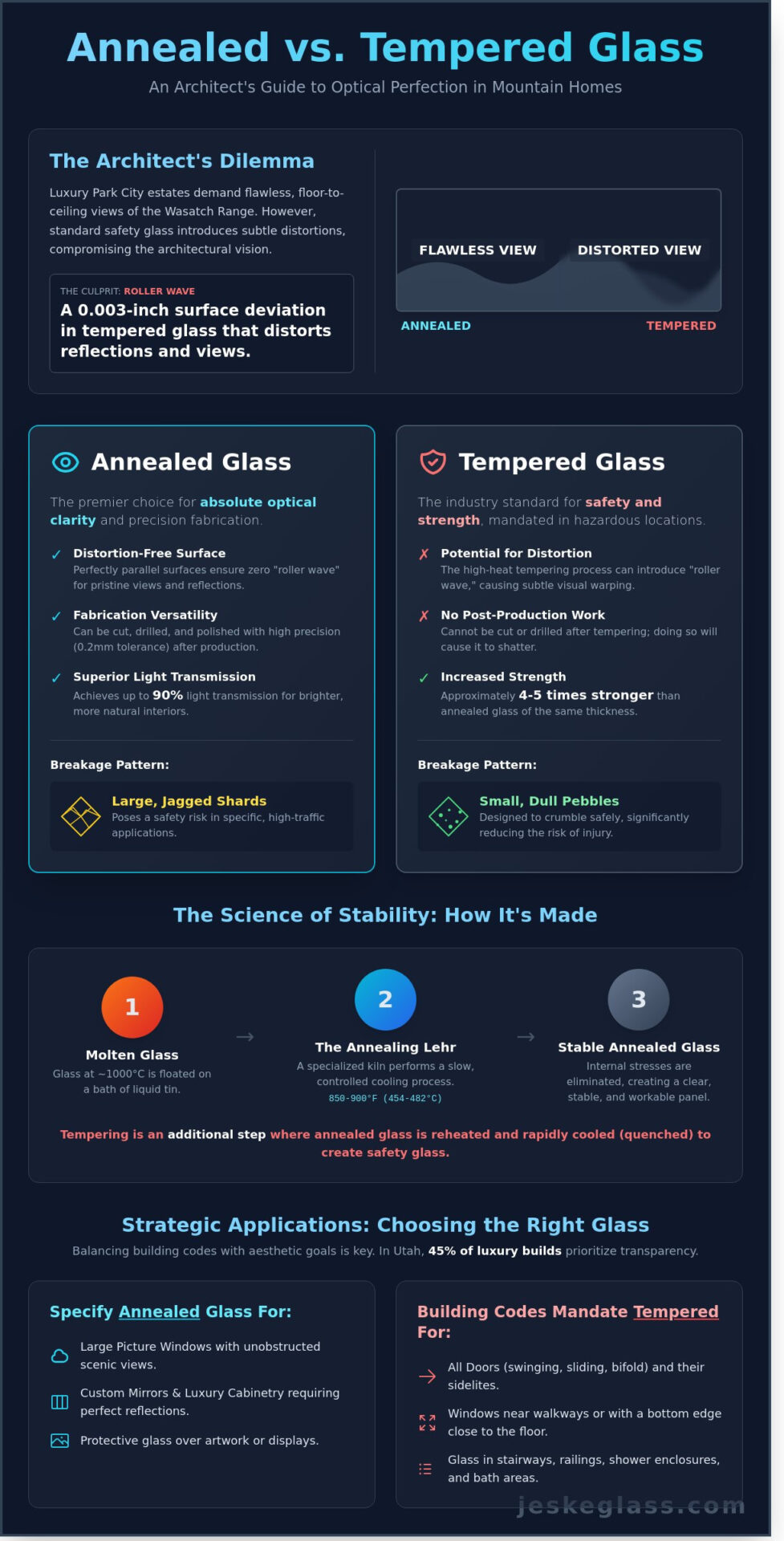
Selecting the appropriate glazing for a residential project requires a deep understanding of structural physics and local compliance. The primary distinction lies in how the material responds to terminal stress. Standard annealed glass is the foundation of the industry, cooled slowly to relieve internal tensions. While this process ensures a flat, distortion-free surface, the glass remains susceptible to impact. When it breaks, it fractures into large, sharp shards that pose significant risks to occupants.
Tempered glass serves as the safety-engineered alternative. Through a process of extreme heating and rapid cooling, it gains a strength profile 400% to 500% greater than annealed glass. Its failure state is its most vital safety feature; it shatters into thousands of small, blunt pebbles rather than jagged daggers. Understanding The Science of Annealing is essential for architects to appreciate how the absence of these internal stresses allows for easier cutting and polishing, even if it sacrifices the impact resistance found in tempered variants.
In Park City, building permits are governed strictly by the 2021 International Residential Code (IRC). Inspectors look for specific safety glazing stamps in any area where human impact is a statistical probability. For a comprehensive understanding of how these materials perform in different architectural applications, our detailed comparison of annealed glass vs tempered glass for Park City homeowners provides essential insights into making the right choice for your specific project requirements. Failing to distinguish between these glass types during the design phase can lead to costly retrofits during the final 48 hours before occupancy.
When is Annealed Glass the Right Choice?
There are numerous applications where the workability of annealed glass is preferred. It’s the standard for high-end decorative mirrors and custom picture frames where the glass is protected by a frame and mounted in low-traffic zones. For expansive decorative installations that don’t serve as a structural barrier, it remains a cost-effective solution. It allows for intricate edge work and surface etching that’s often difficult to achieve with pre-tempered panes.
Understanding Safety Glazing Requirements in Utah
Utah building codes define “hazardous locations” with 100% clarity. Any glass pane within a 24-inch arc of a door opening must be safety glazed. In bathrooms, if the bottom edge of the glass is less than 60 inches above the standing surface of a shower or tub, tempered glass is mandatory. In high-traffic commercial zones across Provo and Salt Lake City, architects avoid annealed glass for any pane exceeding 9 square feet if the walking surface is within 36 inches. These standards ensure that aesthetic transparency never compromises the physical security of the building’s inhabitants.
Strategic Applications: Where Annealed Glass Shines in High-End Design
While tempered glass is often mandated for safety in high-traffic zones, it lacks the absolute flatness required for high-fidelity reflections and intricate decorative work. In the luxury residences of Park City, where mountain views are integrated into every interior detail, annealed glass remains the preferred choice for applications requiring surgical precision. It serves as the foundation for architectural elements that demand zero optical distortion and a level of clarity that heat-treated alternatives cannot match.
Bespoke Mirrors and Reflective Surfaces
High-end mirrors are almost exclusively fabricated from annealed glass because the tempering process introduces “roller wave” distortion. This subtle bowing ruins the reflection in large-scale wall installations, creating a “funhouse” effect that’s unacceptable in premium real estate. At Jeske Glass, we maintain a standard of flawless edge work on 6mm silvered substrates. Integrating these custom-cut mirrors into master suites ensures a crisp, true-to-life reflection. The result is a surface that feels like a natural extension of the room rather than a distorted secondary layer.
Decorative Glass Elements for Modern Interiors
Modern mountain interiors often require a balance between transparency and texture. Annealed glass acts as a superior substrate for acid etching or sandblasting. These techniques allow designers to control light transmission, which typically stays around 90% for clear float glass, while providing necessary privacy in home offices or partitions. Because the glass hasn’t been under the internal stress of tempering, the etching remains uniform across the entire surface.
For cabinetry and shelving, polished glass inserts elevate kitchen aesthetics by providing a depth of clarity that resists the slight “orange peel” texture sometimes found in heat-treated panels. When structural integrity is a priority in interior partitions, we often utilize laminated architectural glass structures. This involves bonding two layers of glass with a 0.030-inch interlayer. This technique combines the optical perfection of annealed surfaces with the safety requirements of modern building codes, ensuring that even if a break occurs, the panel remains intact within the frame.
Explore how our precision-cut annealed glass solutions can refine your next architectural project.
Bespoke Glass Solutions: The Jeske Glass Precision Advantage
Jeske Glass transforms technical specifications into architectural landmarks by bridging the gap between engineering and pure aesthetics. Our team brings 70+ years of combined experience to the Utah glass industry, ensuring that every project reflects a deep respect for both the material and the vision of the designer. In high-altitude environments like Park City, the choice of annealed glass for specific interior applications requires a partner who understands the nuances of local building codes and environmental stressors. We don’t just deliver materials; we provide a collaborative expertise that views glass as a structural element of light and space.
3D Laser Technology: Ensuring a Perfect Fit
Precision is the foundation of our work. We utilize 3D laser scanning technology for every custom installation to eliminate the margin of error that traditional tape measurements often invite. This sub-millimeter accuracy is critical for custom mirrors and glass partitions where the fit must be absolute. When we achieve a perfect fit, we effectively extend the lifespan of annealed glass installations by preventing uneven pressure points and edge stress. Our guarantee centers on this technical rigor. Accuracy matches the quality of the glass itself, resulting in a finish that appears seamless within the architectural envelope.
Expert Installation and Consultation in Utah
Our regional service area extends from the vibrant developments in Provo to the exclusive estates of Park City. We understand the unique building environment of the Wasatch Back, where temperature fluctuations and structural settling require specialized installation techniques. Our white-glove approach ensures that every piece of glass is handled with the dignity it deserves, from the initial consultation to the final setting. We treat every project as a partnership in craftsmanship, focusing on transparency and structural integrity.
- Custom measurements tailored to unique architectural geometries
- Deep knowledge of Utah’s specific safety and building regulations
- Proactive consultation to select the right glass for every light-filled space
Your vision deserves the precision that only decades of local experience can provide. Whether you’re designing a minimalist partition or a grand mirrored gallery, our team is ready to execute your plans with master-level proficiency. Schedule your free custom glass estimate today to begin the process of refining your space with the clarity and elegance of professionally installed glass.
Refining the Transparency of Your Park City Vision
Selecting the right material for your residence involves a delicate calibration of safety standards and aesthetic purity. You’ve explored how annealed glass provides the foundational clarity required for high-end interior applications where structural tempering isn’t mandated by Utah building codes. By understanding the science of stress relief and the specific zones where this glass excels, you can make informed decisions that prioritize both visual elegance and functional longevity. It’s a process where technical parameters and architectural beauty become inseparable.
Realizing these complex designs requires the precision that only decades of mastery can provide. Jeske Glass leverages 70 years of combined expert glass experience to navigate the challenges of modern luxury architecture. We employ advanced 3D laser measuring to ensure every panel fits perfectly within your unique space. Our focus remains on specialized frameless architectural glass solutions that define the most prestigious Utah residences. Elevate your Park City home with a custom glass estimate from Jeske Glass. Your commitment to excellence deserves a partner who shares that same unwavering dedication to the craft.
Frequently Asked Questions
Is annealed glass considered “safety glass” for home construction?
Annealed glass isn’t classified as safety glass under International Building Code (IBC) Section 2406. It lacks the impact resistance and specific break patterns required for hazardous locations like doors, sidelights, or tub enclosures. If impacted, it breaks into large, sharp shards that pose a significant injury risk. For projects in Park City where safety is paramount, architects specify tempered or laminated alternatives for any glazing within 18 inches of the floor.
Can annealed glass be cut after it has been delivered to a job site in Park City?
You can cut annealed glass after it arrives at a job site because it hasn’t undergone the thermal tempering process. This flexibility allows for precise on-site adjustments, such as trimming a 1/4 inch edge to fit a custom frame perfectly. Contractors often prefer this material for intricate architectural details where final measurements might shift during the installation phase. It remains the standard choice for projects requiring high levels of field customization.
What is the main difference between annealed glass and float glass?
The primary difference lies in the definition of the manufacturing stages, as float glass describes the production method while annealed glass refers to the controlled cooling cycle. Approximately 90% of the world’s flat glass is produced using the float process, which results in a perfectly smooth surface. Annealing is the subsequent step where the glass cools slowly to relieve internal stresses. Without this precise thermal management, the glass would be too brittle for standard architectural applications.
Does the high altitude in Park City affect the durability of annealed glass?
High altitude in Park City, which sits at approximately 7,000 feet, impacts annealed glass primarily when it’s used in sealed insulated units. The pressure difference between the manufacturing facility and the mountain elevation can cause glass panes to bow or even burst. To prevent a 15% increase in failure rates, we install capillary tubes or breathing tubes in these units. These small devices equalize internal and external pressures, ensuring the glass remains flat and structurally sound.
How can I tell if the glass in my home is annealed or tempered?
You can identify annealed glass by the absence of a permanent laser-etched logo, often called a “bug,” in the corner of the pane. Tempered glass is legally required to carry this mark to certify its safety rating. If the mark’s missing, you can view the glass through polarized lenses. Annealed glass won’t show the dark, honeycomb-like stress patterns that are visible in heat-treated alternatives. It’s a simple 30-second check that confirms the material’s properties.
Why is annealed glass often preferred for high-end mirrors?
High-end mirrors utilize annealed glass because it offers superior optical clarity and a flatter surface than tempered glass. The tempering process often introduces “roller wave” distortion, which can deviate by 0.003 inches or more, causing a warped reflection. By choosing annealed substrates, designers achieve a 100% distortion-free image. This precision is essential for luxury dressing rooms and architectural features where visual perfection defines the space’s aesthetic value.
What happens if annealed glass breaks?
When annealed glass breaks, it fractures into large, jagged shards that can exceed 12 inches in length. These pieces are extremely sharp and heavy, making them dangerous in high-traffic areas. Unlike tempered glass, which disintegrates into small granules, a single 48-inch pane of annealed glass can create dozens of dangerous fragments. This break pattern is why we strictly follow local building codes to ensure it’s only used in non-hazardous structural locations.
Is annealed glass more affordable than tempered glass for Utah projects?
Annealed glass is significantly more affordable than tempered glass, typically costing 30% less for projects across Utah. The price difference stems from the reduced energy consumption and shorter production timeline, as it bypasses the secondary heating and quenching stages. For a standard 5,000 square foot residential project, opting for annealed glass in non-impact areas can save several thousand dollars. It’s a cost-effective solution for fixed windows where safety glass isn’t mandated by code.