
A backlit LED mirror is an architectural fixture, not a simple piece of decor. It demands the same level of engineering precision as a custom glass partition or a structural grid shower. You understand that the difference between a high-end spa aesthetic and a cluttered renovation often comes down to what you cannot see. The fear of exposed wiring or structural failure on drywall is a legitimate concern for any homeowner or developer aiming for perfection.
By following this guide, you’ll master the technical nuances of a professional backlit LED mirror installation, ensuring a flush, floating appearance that adheres to Utah’s 2026 standards and the latest NEC requirements. We’ll examine the specific mounting tolerances, GFCI protections for damp locations, and the calibration of light temperatures to transform your space into a true wellness retreat. This approach ensures your investment provides both lasting structural safety and the serene atmosphere of a premium sanctuary.
Key Takeaways
- Learn the structural distinctions between backlit and edge-lit designs and why recessed junction boxes are essential for achieving a perfectly flush, architectural finish.
- Discover the necessity of low-iron glass to eliminate the common “green glass” tint, ensuring that your lighting remains true to color and high in clarity.
- Master the critical technical requirements for a professional backlit LED mirror installation, from identifying load-bearing points to implementing structural blocking.
- Gain insight into the 2026 Utah electrical code amendments to guarantee your installation meets the highest safety standards for damp environments.
- Explore how custom-fabricated mirrored lighting can be integrated into home gyms and foyers to enhance both spatial depth and atmospheric quality.
Understanding the Anatomy of a High-End Backlit LED Mirror
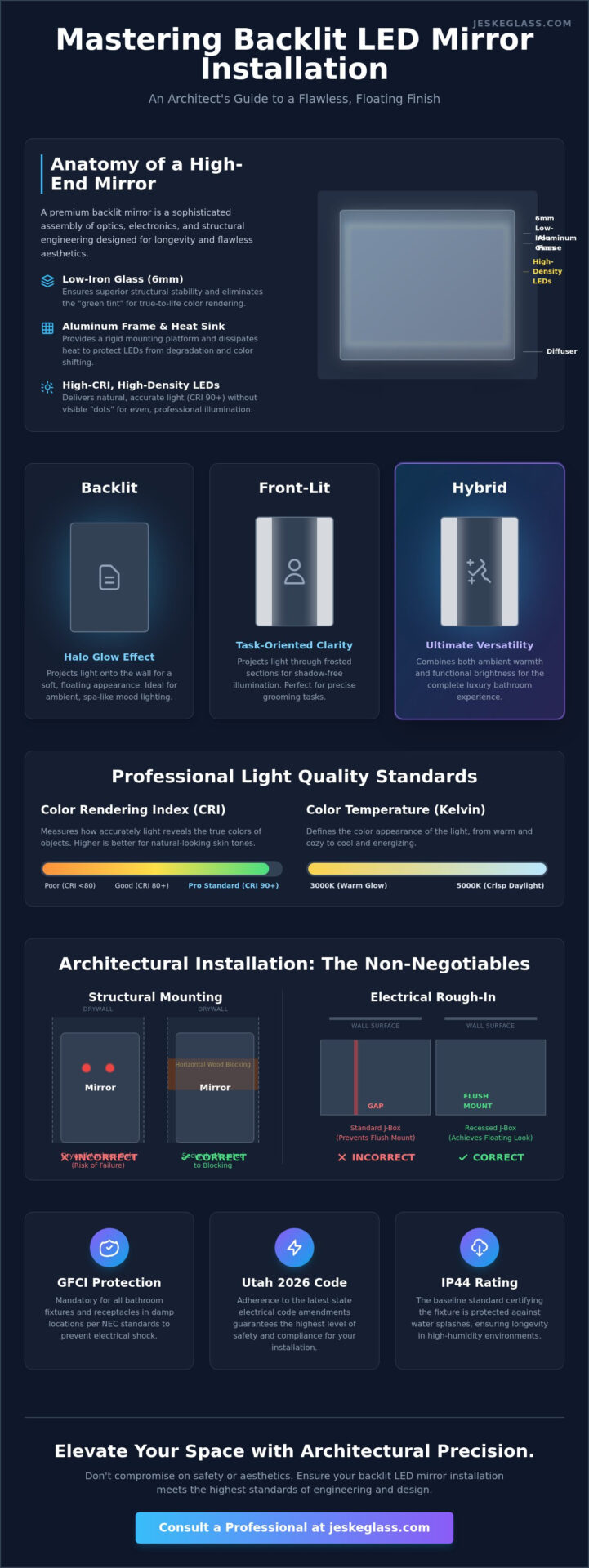
A premium mirror is more than a reflective surface; it’s a sophisticated integration of optics, structural engineering, and electronics. A successful backlit LED mirror installation begins with the realization that the unit is a complex architectural assembly. The core components include high-clarity glass, a rigid internal housing, and a specialized diffuser. While standard mirrors rely solely on the silvering for performance, an illuminated unit must manage light refraction and heat dissipation simultaneously to maintain its aesthetic and functional integrity over time.
Glass thickness is a critical variable that many off-the-shelf products overlook. We typically utilize 6mm glass for its superior structural stability and its ability to resist the subtle warping that thinner sheets might experience when integrated with heavy mounting hardware. Behind this glass, a professional-grade aluminum frame serves a dual purpose. It provides a stable mounting platform and acts as a heat sink. This thermal management is vital because excessive heat can degrade the diodes, leading to color shifts or premature failure. Without a high-quality frame to dissipate energy, the longevity of the light source is significantly compromised.
Backlit vs. Front-Lit: Which is Right for Your Space?
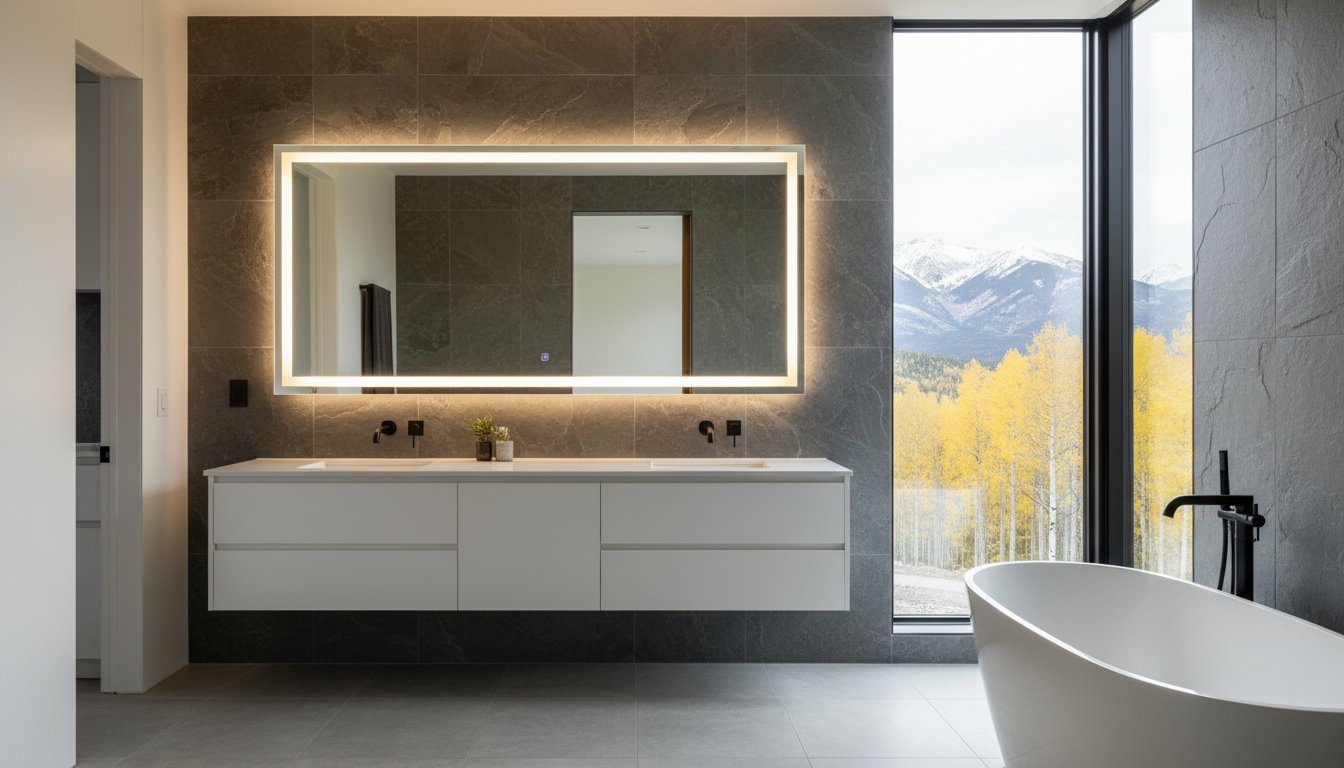
Backlit designs project light toward the wall, creating a soft, halo-like glow that emphasizes the mirror’s floating appearance. This is ideal for establishing a spa-like mood or highlighting textured stone backsplashes in a modern Utah residence. Conversely, front-lit mirrors feature frosted sections where light passes directly through the glass, providing the shadow-free illumination necessary for precise grooming. For the ultimate luxury bathroom experience, many designers choose a hybrid approach that offers both ambient warmth and functional clarity through integrated controls.
The Importance of High-CRI LED Components
The quality of light is defined by the Color Rendering Index (CRI). A CRI of 90 or higher is the professional standard, ensuring that skin tones and textures appear natural rather than washed out. Understanding how LED lights work within these fixtures reveals why component selection is so impactful. By using high-density LED strips and professional-grade diffusers, we eliminate the unsightly “dotted” effect where individual diodes are visible. Choosing between a warm 3000K glow and a crisp 5000K daylight temperature allows the installation to harmonize perfectly with the existing architectural lighting and natural desert hues of your home.
Essential Technical Requirements for a Flawless Installation
A successful backlit LED mirror installation begins long before the glass arrives on site. It requires a meticulous assessment of the building’s infrastructure to ensure the final result is both aesthetically pleasing and structurally sound. In Utah’s high-end residential market, we often see a shift toward heavier, oversized custom pieces that demand more than simple drywall anchors. Identifying the exact location of vertical studs is the first step; however, for a truly seamless architectural fit, we recommend installing horizontal wood blocking during the framing phase. This provides a continuous, secure surface for mounting hardware at any height, regardless of the mirror’s final dimensions.
Precision in electrical rough-in is equally vital for a professional result. A standard protruding junction box will prevent the mirror from sitting flush against the wall, ruining the “floating” illusion. Instead, a recessed junction box should be positioned exactly where the mirror’s internal housing allows for cable management. This level of foresight ensures that no wires are pinched and the silhouette remains clean from every angle. Adhering to the National Electrical Code (NEC) safety standards is non-negotiable in Utah, particularly with the latest requirements for GFCI protection on all bathroom receptacles and fixtures.
Safety in moisture-rich environments is governed by strict technical benchmarks. An IP44 rating signifies that the fixture is protected against solid objects larger than 1mm and splashing water from any direction, making it the baseline standard for bathroom safety. Integrating these safety protocols into the planning phase prevents long-term corrosion of the LED components and ensures the structural integrity of the mounting surface remains intact despite high humidity levels.
Electrical Planning and Hardwiring Standards
Hardwiring is the only acceptable method for achieving a high-end finish. It eliminates visible cords and allows for sophisticated integration with your home’s existing ecosystem. Modern installations often connect to wall-mounted dimmers or smart home controllers, allowing the user to adjust the ambiance based on the time of day. For expansive projects involving multiple large-scale mirrors, a dedicated circuit may be necessary to handle the cumulative load without flickering or circuit overloads.
Weight Distribution and Mounting Hardware
Calculating the load-bearing capacity of your wall is a prerequisite for safety. A custom mirror can easily exceed fifty pounds, placing significant stress on the substrate. We utilize Z-bars or French cleats to distribute this weight evenly across multiple studs. When performing a custom mirror installation over delicate tile or stone, we use diamond-tipped bits and specialized spacers to prevent cracking, ensuring the hardware remains invisible while providing maximum stability and a perfectly flush mount.
Professional Custom Installation vs. Off-the-Shelf LED Kits
Choosing between a mass-produced kit and a bespoke backlit LED mirror installation involves more than just a comparison of initial costs. Most off-the-shelf products utilize standard clear glass, which contains high levels of iron oxide. This results in a noticeable green tint, particularly along the edges where the light is meant to glow. For luxury applications, we insist on low-iron glass. It provides an ultra-clear, neutral reflection that doesn’t distort the principles of effective lighting design. When you invest in a custom piece, you’re securing a structural element designed to withstand the unique humidity profiles of a high-end bathroom environment.
Longevity often hinges on the components hidden behind the glass. Consumer-grade kits frequently use inexpensive power supplies that are prone to humming or failure within a few years. In contrast, professional-grade drivers are engineered for stable voltage and thermal resilience. This ensures your lighting remains consistent from the moment of installation through years of daily use. Protecting your investment means choosing materials that won’t require replacement after the first season of heavy use. Cheap drivers can also cause flickering, which disrupts the serene atmosphere you’ve worked hard to create. A professional installation avoids these common pitfalls by integrating industrial-strength electronics into the architectural design.
The Jeske Glass Difference: 3D Laser Precision
In many Salt Lake City or Park City luxury builds, walls are rarely perfectly plumb. A standard mirror leaves unsightly gaps that ruin the architectural intent. We utilize 3D laser measuring to capture the exact contours of your space. This technology allows us to fabricate glass that fits with sub-millimeter accuracy, even in complex inset applications or against uneven stone surfaces. It’s this commitment to precision that separates a standard remodel from a true architectural statement.
Superior Glass Fabrication and Silvering
Edge protection is the silent savior of high-end mirrors. Standard kits often suffer from “black edge” corrosion because the silvering is exposed to moisture. Our custom fabrication process involves sealing the edges to prevent oxidation. Additionally, we evaluate the safety requirements of each project, often recommending tempered glass vs. annealed glass based on the mirror’s size and proximity to shower spray. This ensures that your installation is as safe as it is beautiful, meeting all local Utah safety standards without compromising on the visual lightness of the design.
The Step-by-Step Professional Installation Workflow
Executing a flawless backlit LED mirror installation requires a disciplined, four-phase approach that bridges the gap between electrical engineering and architectural design. This workflow ensures that every component, from the structural mounting bracket to the delicate LED diodes, performs at its peak. In high-end Utah homes, where stone surfaces and custom millwork are the norm, skipping a single step in this sequence can lead to visible gaps or electrical inconsistencies that compromise the entire aesthetic. A master craftsman understands that the beauty of the final product is a direct result of the hidden precision during the process.
Phase 1 & 2: Preparation and Fabrication
The process begins with precise site marking and electrical verification. We identify the exact location for the recessed driver box to ensure the mirror sits perfectly flush against the wall. This is a critical departure from standard methods that often leave a slight, unsightly protrusion. Once the site is prepared, the focus shifts to custom fabrication. Every sheet of glass undergoes a rigorous inspection for clarity and edge-polish perfection. Before the mirror even leaves the shop, we pre-test the LED strips for color consistency and lumen output. This prevents the frustration of discovering a minor diode variance after the unit has been securely mounted.
Our preparation checklist includes:
- Marking the wall for recessed electrical housing to maintain a zero-clearance profile.
- Verifying that the wall substrate is reinforced with blocking to support the weight of the custom glass.
- Inspecting the edge-polish quality to ensure the light diffuses evenly without refracting off imperfections.
- Pre-testing the LED components for 100% color uniformity across the entire strip.
Phase 3 & 4: Mounting and Final Calibration
Phase three focuses on structural permanence. We level the mounting brackets with sub-millimeter accuracy, accounting for the natural settles often found in Park City mountain homes. Once the bracket is secure, we make the permanent hardwired connection. This isn’t a simple plug-and-play task; it involves verifying the integrity of the dedicated circuit and ensuring the dimming range is smooth and flicker-free. A high-end installation must respond instantly and elegantly to smart home commands or wall dimmers.
The final phase involves light diffusion testing and environmental sealing. We examine the light throw against the wall to ensure the glow is uniform, with no dark spots or hot zones. Finally, we clean the surface and apply a specialized seal to the edges. This prevents moisture ingress, which is the primary cause of silvering degradation in humid bathroom environments. To see how these technical steps translate into a finished masterpiece, you can explore our custom projects and discover the difference that professional craftsmanship makes to your home’s value.
Elevating Your Utah Home with Bespoke Mirrored Lighting
A sophisticated backlit LED mirror installation serves as the final, luminous touch in a well-considered architectural plan. While the technical standards we’ve discussed ensure structural safety, the true value lies in how these fixtures transform the atmosphere of a home. Proper lighting isn’t merely functional; it’s psychological. Soft, indirect illumination reduces glare and mimics natural light, which can significantly lower stress levels during morning routines. In the context of Utah’s unique geography, where natural light shifts dramatically between the bright summer sun and the muted tones of winter, having a perfectly calibrated light source is essential for maintaining a sense of wellness.
Design trends in 2026 show a shift toward using mirrored lighting in unexpected areas of the home. We’re seeing a rise in dramatic entryway installations where integrated motion sensors activate a warm halo of light as guests arrive. This creates an immediate sense of luxury and hospitality that standard overhead fixtures simply can’t replicate. In commercial spaces across Provo and Salt Lake City, luxury retail environments use these mirrors to create depth and a premium fitting room experience that encourages confidence and enhances the customer journey.
Beyond the Bathroom: Creative LED Mirror Applications
The versatility of custom glass allows for expansive home gyms in Salt Lake City that feel like professional wellness centers. By utilizing full-wall mirrored surfaces with integrated backlighting, you can eliminate harsh shadows that often plague basement workout spaces. This creates an airy, expansive feel that motivates performance while maintaining a clean, minimalist aesthetic. Whether it’s a hospitality project in the heart of the city or a private residence in the mountains, the objective remains the same: to blend visual freedom with physical protection through expert craftsmanship.
Longevity and Maintenance of Your Custom Mirror
Maintaining the pristine clarity of your investment requires a gentle, professional touch. You should avoid ammonia-based cleaners, as these harsh chemicals can seep behind the edges and damage the silvering over time. Instead, use a soft, lint-free microfiber cloth and a mild, non-abrasive solution to keep the surface clear. While the glass itself is enduring, professional LED drivers typically have an expected lifespan of 50,000 hours. Because our installations utilize modular components, replacing a driver after a decade of use is a straightforward task that doesn’t require removing the entire fixture. If you’re ready to bring this level of precision to your next project, get your free custom glass estimate from the Jeske Glass experts today and begin the journey toward a more luminous home.
Transforming Your Vision into a Permanent Architectural Statement
A flawless backlit LED mirror installation represents the perfect intersection of electrical engineering and master glass fabrication. We’ve explored how the success of these fixtures depends on invisible details: the recessed junction boxes, the low-iron glass clarity, and the structural blocking that ensures long-term safety. These elements don’t occur by chance. They’re the result of a commitment to precision that elevates a simple renovation into a true architectural sanctuary.
With 70+ years of combined experience and advanced 3D laser measuring technology, Jeske Glass stands as Utah’s premier expert in luxury glass fabrication. We understand the specific demands of Park City mountain builds and Salt Lake City modern estates. We invite you to Request a Free Estimate for Your Custom LED Mirror Project to ensure your next design is executed with uncompromising quality. Partner with a team that views every mirror not just as a product, but as a structural masterpiece. Your home deserves a reflection that is as enduring as it is beautiful.
Frequently Asked Questions
Do backlit LED mirrors provide enough light for applying makeup?
Backlit mirrors primarily offer an ambient glow, but they are highly effective for grooming when combined with high-lumen output and a high CRI of 90 or above. For those requiring precision, we often recommend hybrid models that feature frosted front-lit sections. This specific configuration eliminates the harsh shadows caused by overhead fixtures, providing the clear, even illumination necessary for accurate color rendering and daily skincare routines.
Can an LED mirror be installed on a tiled bathroom wall?
You can certainly install these fixtures on tiled surfaces, provided the correct tools are used. A professional backlit LED mirror installation on tile requires diamond-tipped drill bits to prevent cracking and specialized anchors to secure the weight into the substrate. This ensures the mirror remains perfectly level and sits flush against the tile, maintaining the sophisticated floating aesthetic without compromising the integrity of your stonework.
Do I need a licensed electrician for my backlit mirror installation?
Hiring a licensed electrician is strongly recommended and often mandatory under Utah building codes for hardwired installations. A professional ensures that the recessed junction box is correctly positioned and that the fixture is integrated into a GFCI-protected circuit. This adherence to NEC safety standards protects your home from electrical faults and ensures that the dimming controls function seamlessly within your existing smart home ecosystem.
How long do the LEDs in a custom bathroom mirror typically last?
Professional-grade LEDs are engineered for longevity, typically offering an operational lifespan of 50,000 hours. If used for eight hours daily, your mirror’s light source will remain vibrant for over 17 years. Unlike consumer kits, our custom projects utilize industrial-strength drivers and aluminum frames that dissipate heat effectively, preventing the diodes from dimming or shifting in color temperature over time.
Can backlit mirrors be used with a standard wall dimmer switch?
Most custom units are fully compatible with wall dimmers, provided they are equipped with a dimmable driver. We typically specify TRIAC or 0-10V dimmable power supplies to ensure the light transition is smooth and flicker-free. This technical integration allows you to adjust the atmosphere of your bathroom from a bright, functional workspace to a serene, dimly lit sanctuary with a simple adjustment.
Are LED mirrors safe to use in high-humidity bathroom environments?
These mirrors are entirely safe for bathroom use when they carry a minimum IP44 rating. This rating indicates the internal electronics are protected against moisture and splashing water from any direction. To further enhance durability in Utah’s climate, our fabrication process includes specialized edge-sealing. This prevents the silvering from oxidizing or developing “black edge” corrosion when exposed to steam over several years.
What happens if a single LED bulb in the strip burns out?
Modern mirrors use integrated LED strips rather than individual bulbs. If one diode fails, the rest of the strip usually continues to function. If a large segment fails, it is often a sign of a driver issue rather than a diode problem. Because we prioritize modular design, the internal power supply or the LED strip can be replaced by a technician without the need to replace the entire mirror assembly.
How do I choose the right size LED mirror for my vanity?
The ideal mirror should be approximately four to six inches narrower than your vanity to create a balanced, architectural frame. For a double vanity, you may choose one expansive mirror or two separate units centered over each sink. We recommend positioning the center of the glass at eye level, typically 60 to 64 inches from the floor, to ensure the light throw is perfectly calibrated for every user.