
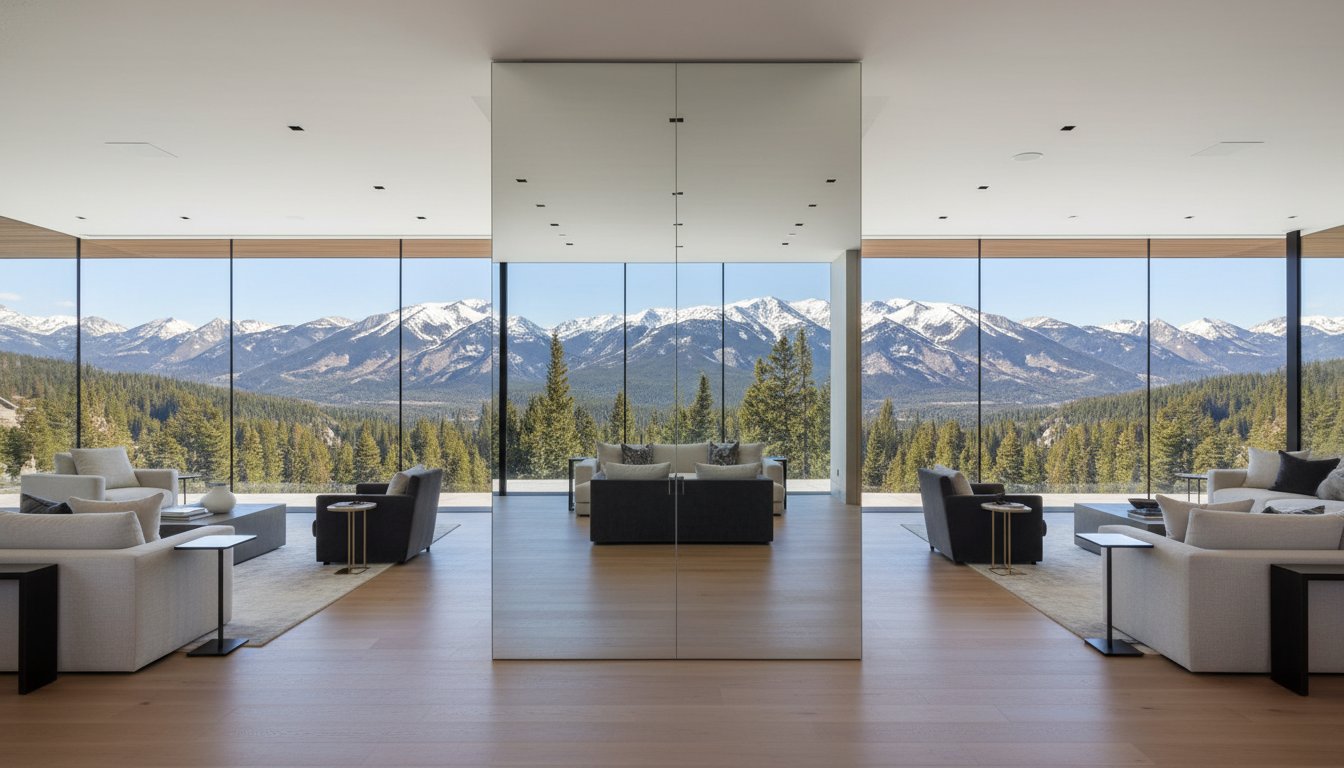
What if your interior walls did not just define your home’s boundaries but instead acted as a canvas for the Wasatch Range? Many homeowners in our region understand that the true value of a mountain residence lies in its connection to the outdoors, yet interior spaces can often feel isolated from the light and scale of the landscape. Integrating floor to ceiling mirrors Park City allows you to treat glass as a structural element that amplifies natural light while pulling the alpine scenery deep into your living environment.
It is natural to have concerns regarding the logistics of transporting oversized glass to remote locations or ensuring a perfectly flush fit against the unique contours of mountain architecture. You deserve a result where the reflection is seamless and the installation adheres to the rigorous 2021 International Building Code standards for safety glazing. This guide explores how professional, white-glove execution transforms large-scale mirrors into permanent architectural features that feel like part of the home’s original design. We will examine the technical requirements for durability, the necessity of building permits for wall alterations, and the specific design strategies that turn simple glass into a sophisticated reflection of your surroundings.
Key Takeaways
- Understand how floor-to-ceiling mirrors function as architectural apertures that bridge the gap between your interior and the vast alpine landscape.
- Learn about the technical necessity of high-definition glass and 3D precision measurements to achieve a distortion-free reflection on complex mountain walls.
- Discover the diverse design potential for floor to ceiling mirrors Park City in high-traffic areas like great rooms and private home wellness centers.
- Identify the specific logistical and environmental factors, such as high elevation and pressure changes, that necessitate professional local installation.
- Explore how bespoke fabrication ensures your large-scale glass installations meet rigorous safety standards while maintaining a minimalist, modern aesthetic.
The Role of Floor to Ceiling Mirrors in Park City Architecture
In the high-altitude environments of Utah, architecture must do more than provide shelter; it must engage directly with the surrounding topography. Floor to ceiling mirrors Park City have evolved beyond simple vanity pieces to become essential structural design elements. By definition, these large-scale reflective surfaces are integrated into the wall’s substrate, often replacing traditional drywall or stone to create a continuous visual plane. This approach aligns perfectly with the Mountain Modern aesthetic, where the warmth of reclaimed timber and the ruggedness of local stone find a necessary counterpoint in the clarity of expansive glass.
To understand how these installations function as more than just furniture, one can look at the history and principles of mirrors, which demonstrates how light manipulation has long been used to alter human perception of space. In a mountain estate, mirrors bridge the gap between interior comfort and the vast, often intimidating outdoors. They pull the silhouettes of the Wasatch Range inside. This allows the landscape to become a permanent, shifting wallpaper that changes with the seasons, ensuring the home feels like an extension of the peaks rather than a fortress against them.
Amplifying Natural Alpine Light
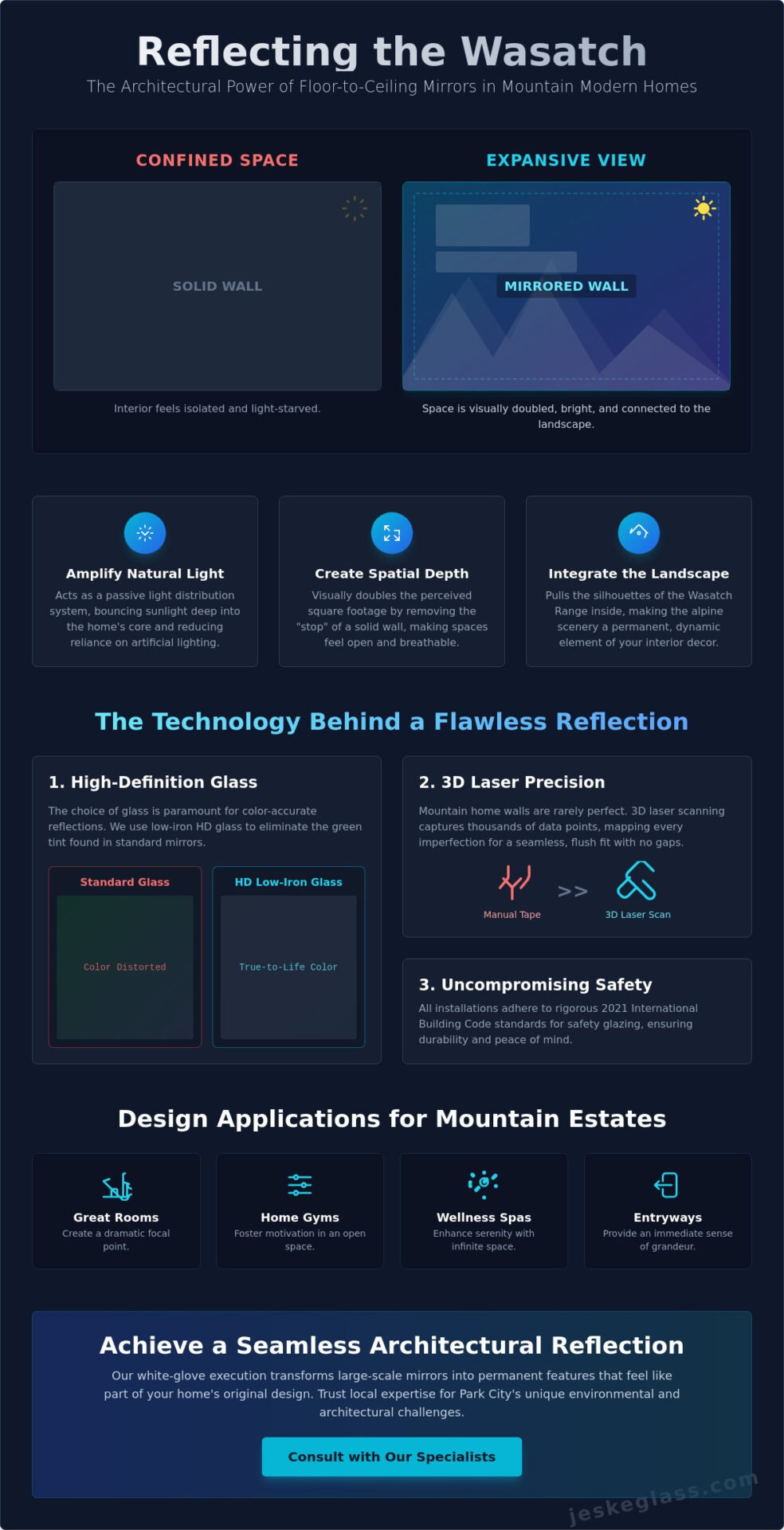
Park City’s geography often results in deep floor plans where natural light struggles to reach the central core of the home. Strategic placement of mirrors opposite floor-to-ceiling windows acts as a passive light distribution system. During the winter months, when the sun sits low on the horizon, these reflective surfaces capture and bounce limited UV rays throughout the room. It’s a method that reduces the reliance on artificial lighting and maintains a vibrant atmosphere even on the shortest days of the year.
Creating Spatial Depth in Mountain Estates
While many Park City homes are expansive, others, such as historic Old Town chalets, require clever engineering to feel breathable. A floor-to-ceiling installation visually doubles the square footage by removing the perceived “stop” of a solid wall. This is particularly effective in several key areas:
- Basement-level home gyms where natural light is scarce and motivation depends on an open environment.
- Private wellness spas and yoga studios that require a sense of infinite space for meditation.
- Narrow entryways that benefit from an immediate sense of arrival and grandeur.
The psychological impact is significant. Open, reflective spaces reduce the “closed-in” feeling common in heavily insulated mountain structures, fostering a sense of visual freedom and mental clarity for the inhabitants.
Technical Excellence: Fabrication and 3D Precision
Achieving a flawless architectural reflection requires more than a simple sheet of silvered glass. When specifying floor to ceiling mirrors Park City, the choice of substrate is paramount. High-definition (HD) glass is the industry standard for luxury mountain residences, as it utilizes low-iron content to eliminate the subtle green tint common in mass-produced alternatives. This clarity ensures that the reflection of the snow-capped mountains remains color-accurate and crisp. As noted in The Role of Mirrors in Interior Design, the quality of the glass directly impacts its ability to manipulate light and create a believable illusion of depth within a room.
3D Laser Measuring for a Flawless Fit
In the context of Park City’s unique architecture, standard tape measurements are insufficient. Mountain homes, often featuring heavy timber and stone, frequently experience slight settling or have walls that are not perfectly plumb. This is where 3D laser measuring becomes a critical advantage. This technology captures thousands of data points to map every imperfection in the wall surface, allowing for a mirror that sits perfectly flush with no unsightly gaps at the floor or ceiling junctions. It’s a level of precision that manual methods simply cannot replicate, especially when dealing with complex angles in modern chalet designs.
Safety is a regulatory requirement that we treat with the utmost gravity. According to the 2021 International Building Code (IBC) and International Residential Code (IRC) adopted in Park City, safety glazing is mandatory for mirrors exceeding 9 square feet when the bottom edge is less than 18 inches from the floor. We utilize tempered or laminated glass to meet these hazardous location requirements, ensuring that your architectural vision remains as durable as it is beautiful. Proper backing and specialized adhesives are also employed to prevent silvering oxidation, which can be a concern in high-altitude environments with fluctuating humidity and pressure.
Custom Edge Work and Finishes
The final aesthetic character of the installation is defined by the edge work and mounting style. While the glass itself provides the reflection, the edges provide the frame for the view. We offer several sophisticated options to match your interior design:
- Flat Polished Edges: Ideal for a minimalist, frameless look that allows the mirror to blend seamlessly into the wall.
- Beveled Edges: These add a touch of classic elegance by catching and refracting light at the perimeter of the panel.
- Antique Mirror Finishes: A specialized treatment that softens the reflection, perfect for creating a sophisticated mountain lodge feel.
- Recessed Mounting: This allows the glass to sit within a pre-constructed wall pocket for a completely flush, integrated appearance.
Choosing the right combination of glass thickness and finish is essential for long-term durability and visual impact. If you are considering a unique application for your residence, our team can help you explore custom projects tailored to your home’s specific geometry.
Design Applications: Beyond the Master Bathroom
While the utility of a vanity mirror is undeniable, the true architectural potential of floor to ceiling mirrors Park City is realized within the home’s primary social and wellness spaces. In these environments, mirrors cease to be mere accessories and become active participants in the room’s layout. Large-scale reflective surfaces can be used to create sophisticated “hidden doors,” where a mirrored panel on a heavy-duty pivot hinge conceals a private study or a temperature-controlled wine cellar. This maintains a continuous visual line across a hallway, preserving the home’s minimalist flow while adding a layer of functional mystery.
Foyers in mountain homes often present a design challenge due to their narrow, linear configurations. By lining a primary wall with floor-to-ceiling glass, you eliminate the claustrophobic feel often associated with transitional spaces. This creates a seamless transition that welcomes guests with an immediate sense of scale and light, effectively doubling the perceived width of the entry and setting a dignified tone for the rest of the residence.
Professional Home Gym Mirror Installation
In a private wellness suite or yoga studio, mirrors are essential for monitoring biomechanics and maintaining proper form during training. However, high-activity areas demand rigorous technical standards. For panels exceeding nine square feet, we strictly adhere to the 2021 International Building Code by utilizing safety glazing materials. This ensures that if the glass is subjected to an accidental impact, it remains secure and poses no risk to the inhabitants. We also specialize in the integration of mirrors with wall-mounted equipment, ensuring the glass is precisely fabricated to accommodate functional trainers or ballet bars without compromising the structural integrity of the panel.
Mirrored Walls in Dining and Living Areas
The Great Room is the heart of the Park City lifestyle, designed to facilitate both relaxation and social engagement. Placing mirrored panels opposite expansive windows allows you to capture the shifting colors of a sunset over the Wasatch Range from any seat in the room. Rather than a single monolithic sheet, we often recommend using vertical segments with polished edges. This rhythmic approach creates a modern, gallery-like aesthetic that balances the reflection with other organic textures like hand-hewn timber or local stone. It provides a structured backdrop that complements high-end lighting fixtures and art, allowing the interior design to coexist harmoniously with the reflected mountain vistas.
The Installation Challenge: Why Local Expertise Matters
The geography of Park City introduces technical variables that standard glass installers rarely encounter. When executing an installation of floor to ceiling mirrors Park City, the elevation of approximately 7,000 feet becomes a critical factor in the engineering process. While mirrors do not face the same desiccation risks as sealed insulated glass units, the atmospheric pressure and extreme temperature fluctuations of a Utah winter still impact the substrate and adhesives. A professional installation must account for the expansion and contraction of the home’s framing, ensuring that the glass has the necessary “breathing room” to avoid stress fractures when temperatures drop well below zero.
One common concern among homeowners is the fear of glass breakage during heavy snow seasons. In reality, the risk doesn’t come from the cold itself but from the structural shifting caused by snow loads on the roof. Expert installers understand how to mount large-scale panels so they remain independent of minor house settling. This prevents the glass from becoming a load-bearing element, which is the primary cause of cracking in poorly executed mountain projects.
Handling Oversized Panels in Remote Locations
Transporting and maneuvering oversized glass through the winding roads of neighborhoods like Summit Park or Deer Valley requires specialized logistics. These panels are often too large for standard elevators or narrow mountain staircases. We utilize professional-grade suction lifting equipment and custom dollies designed to protect the delicate edges of the glass during transit. Professional handling is the only way to eliminate the risk of edge chipping, which can compromise the structural integrity of the entire panel. Having a local team means that the craftsmen are familiar with the specific architectural constraints of Old Town and the surrounding gated communities, allowing for a more efficient and secure delivery process.
Structural Integrity and Mounting
The sheer weight of floor-to-ceiling glass demands a sophisticated mounting strategy that goes beyond simple construction adhesive. For permanent architectural mirrors, we employ a hybrid approach that combines high-strength, mirror-safe mastics with mechanical fasteners. This ensures the vertical load is distributed evenly across the wall. Key components of a secure installation include:
- J-Channels: Discrete metal tracks at the base that provide a solid foundation for the weight of the glass.
- Z-Clips or Standoffs: Mechanical fasteners that secure the top and middle sections, preventing the panel from pulling away from the wall.
- Substrate Preparation: Ensuring the mounting surface is reinforced to handle the weight of 1/4 inch or 3/8 inch plate glass.
This mechanical redundancy is vital for long-term safety, especially in high-traffic areas or home wellness suites. If you are planning a renovation that requires this level of technical precision, you can rely on our expertise for professional mirror installation that prioritizes both aesthetics and structural permanence.
The Jeske Glass Experience: Bespoke Mirrors for Park City
For more than 70 years, our craft has been defined by a deep commitment to the intersection of engineering and art. Selecting floor to ceiling mirrors Park City is a decision that impacts the permanent character of a home, and our legacy in custom glass fabrication ensures that every installation is a testament to quality. We don’t view ourselves merely as glass suppliers. Instead, we act as specialized partners who understand the nuances of the “Mountain Modern” aesthetic, where the goal is to create a dialogue between the built environment and the natural majesty of the Wasatch Range. Designers and architects consistently choose us for custom glass projects in Utah because we possess the technical infrastructure to execute visions that others find too complex.
The transition from initial concept to final installation is handled with professional discretion and a focus on detail. We recognize that in luxury mountain architecture, there’s no such thing as a “standard” space. Every project begins with an understanding of the home’s unique structural requirements, ensuring that the reflective surfaces we install enhance the architecture rather than simply covering it. Our team’s expertise allows us to navigate the specific challenges of high-altitude logistics, from the initial 3D scan to the white-glove placement of the finished glass.
Our Collaborative Design Process
We believe the most successful installations are those integrated into the early blueprints of a residence. By working alongside architects, we can advise on the structural reinforcements necessary to support large-scale glass or help design the recessed pockets that allow for a perfectly flush finish. Our facility provides specialized custom glass cutting in Park City, allowing us to accommodate unique geometric wall shapes, rake-head ceilings, and cut-outs for integrated lighting or hardware. This precision ensures that the glass fits the space with the exactitude that premium construction demands.
Commitment to Quality and Safety
Safety isn’t a secondary consideration; it’s the foundation of our reputation. Every mirrored surface undergoes rigorous testing for clarity and structural integrity before it leaves our facility. We strictly adhere to the 2021 International Building Code and Utah-specific safety amendments, ensuring that every floor-to-ceiling installation in your home meets the highest standards for safety glazing. This dedication to excellence protects your investment and the well-being of those who inhabit the space. If you’re ready to transform your interior with a professional architectural reflection, we invite you to request a free custom estimate for your Park City residence. Our experts are prepared to help you realize the full potential of your home’s light and space.
Refining the Alpine Interior through Architectural Reflection
Integrating floor to ceiling mirrors Park City into your residence is a transformative decision that requires a synthesis of structural engineering and aesthetic vision. We’ve explored how these reflective surfaces double the presence of the alpine landscape while serving as functional tools for light distribution and spatial depth. Achieving this level of architectural integration depends on the use of advanced 3D laser measuring technology to account for the unique settling and out-of-plumb walls typical of mountain estates.
Our commitment to your project is backed by over 70 years of combined expert experience in custom fabrication for Park City luxury estates. We ensure that every panel meets the rigorous safety standards required for high-altitude environments. This dedication to technical excellence ensures your investment remains a permanent, beautiful feature of your home’s design. We look forward to helping you capture the light and scale of the mountains within your own walls.
Request Your Free Custom Mirror Estimate from Jeske Glass and begin the process of elevating your home’s perspective.
Frequently Asked Questions
Are floor-to-ceiling mirrors safe for homes with children or pets?
Safety is ensured through the use of tempered or laminated glass, which is mandatory for mirrors exceeding 9 square feet in hazardous locations. These materials are engineered to resist impact. In the event of breakage, tempered glass crumbles into small, dull pieces while laminated glass remains bonded to an interlayer. This strict adherence to the 2021 International Building Code provides essential security for families in high-activity households.
How do you clean and maintain large-scale mirrors in a mountain climate?
Proper maintenance involves using non-ammoniated, pH-neutral cleaners applied with a soft microfiber cloth to prevent surface scratching. It’s especially important in high-altitude environments to avoid spraying liquid directly onto the edges of the glass. Moisture trapped at the perimeter can lead to silvering oxidation, commonly known as black edge. Applying the cleaner to the cloth first is the recommended professional practice to preserve the mirror’s clarity.
Can floor-to-ceiling mirrors be installed on uneven or textured walls?
Large-scale mirrors can be installed on textured or uneven surfaces by utilizing specialized mounting hardware or substrate leveling techniques. Our 3D laser measuring technology identifies wall out-of-plumbness to within a fraction of an inch. This allows for the use of mechanical standoffs or J-channels that compensate for wall irregularities, ensuring the floor to ceiling mirrors Park City remain perfectly vertical and structurally stable.
What is the maximum size for a single mirror panel in Park City?
The maximum size of a single panel is generally dictated by the logistical constraints of the property rather than the glass itself. While fabrication can produce sheets up to 100 by 144 inches, the narrow entries and winding staircases of many mountain homes often require smaller, segmented panels. We evaluate each site to determine the largest possible dimensions that can be safely transported and installed without compromising the structural integrity of the mirror.
How long does the installation process take for a full mirrored wall?
A standard installation for a full mirrored wall typically requires between four and eight hours on-site once the fabrication process is complete. This timeline assumes the substrate has been prepared and the precision measurements were finalized during the design phase. More complex projects involving integrated hardware or multiple segments may extend into a second day to ensure every junction meets our rigorous quality standards.
Do mirrors help with home insulation or energy efficiency in the winter?
Mirrors do not possess significant R-value and shouldn’t be considered a primary insulation material for the winter months. However, they contribute to energy efficiency by amplifying natural light and perceived warmth through light distribution. By reflecting the sun’s rays deep into a room, they reduce the need for artificial lighting and enhance the psychological feeling of warmth within a mountain interior.
Can I customize the tint or finish of my floor-to-ceiling mirror?
Customization options are extensive and include various tints such as bronze, grey, or low-iron ultra-clear glass. You can also specify antique finishes that provide a softened, vintage aesthetic suitable for traditional lodge designs. These choices allow the mirror to complement the specific color palette and architectural hardware of your residence while maintaining the high-definition clarity required for a premium reflection.