Could the very transparency that defines your Park City retreat be its most vulnerable structural point? You recognize that in the Wasatch Range, a window isn’t just a portal to the landscape; it’s a sophisticated barrier against 45-degree diurnal temperature swings and high-altitude pressure. Selecting tempered vs laminated glass is often the pivot point between a home that merely looks the part and one that offers genuine engineering excellence.
We agree that your investment should prioritize both an unobstructed view of the Snyderville Basin and the uncompromising safety of your family. This guide explores the technical nuances of glass composition to ensure your residence exceeds the 2023 Summit County building requirements while maintaining a sleek, high-end aesthetic. You’ll discover the definitive applications for each glass type, from structural railings to expansive thermal envelopes; this clarity allows you to achieve a timeless architectural result that enhances your property’s long-term value.
Key Takeaways
- Understand how modern Utah building codes and safety glass standards protect the structural integrity and aesthetic value of your luxury mountain residence.
- Master the technical nuances of tempered vs laminated glass to select the optimal material for thermal resilience and structural security.
- Learn to mitigate the impact of Park City’s extreme temperature swings and high-altitude UV exposure on your home’s interior and furnishings.
- Identify the superior glass specifications required for specialized architectural features, including frameless shower enclosures and elevated balcony railings.
- Discover how precision 3D laser measurement and expert craftsmanship translate complex architectural visions into timeless, safe, and transparent realities.
Defining Safety Glass in Modern Park City Architecture
Architecture in Park City has undergone a radical transformation over the last 15 years. Glass once served as a mere fragile barrier against the Wasatch Range winds, but today, it functions as a vital structural element in luxury mountain estates. Modern designs often feature glass walls exceeding 12 feet in height to capture panoramic views of Deer Valley. This shift from decorative to structural usage necessitates a sophisticated understanding of material science. Standard annealed glass, while providing clarity, lacks the internal tension required to withstand the physical demands of high-altitude environments and human impact.
In Utah, safety glass isn’t a luxury; it’s a legal requirement defined by specific breakage patterns and impact resistance. When choosing between tempered vs laminated glass, homeowners must recognize that both materials are engineered to prevent the life-threatening lacerations caused by standard glass shards. Safety glass must withstand significant kinetic energy without failing, or, if it does fail, it must do so in a predictable, controlled manner. For Jeske Glass, this technical necessity is the foundation upon which we build the seamless indoor-outdoor lifestyle that defines Park City living.
The Legal Necessity: When Safety Glass is Non-Negotiable
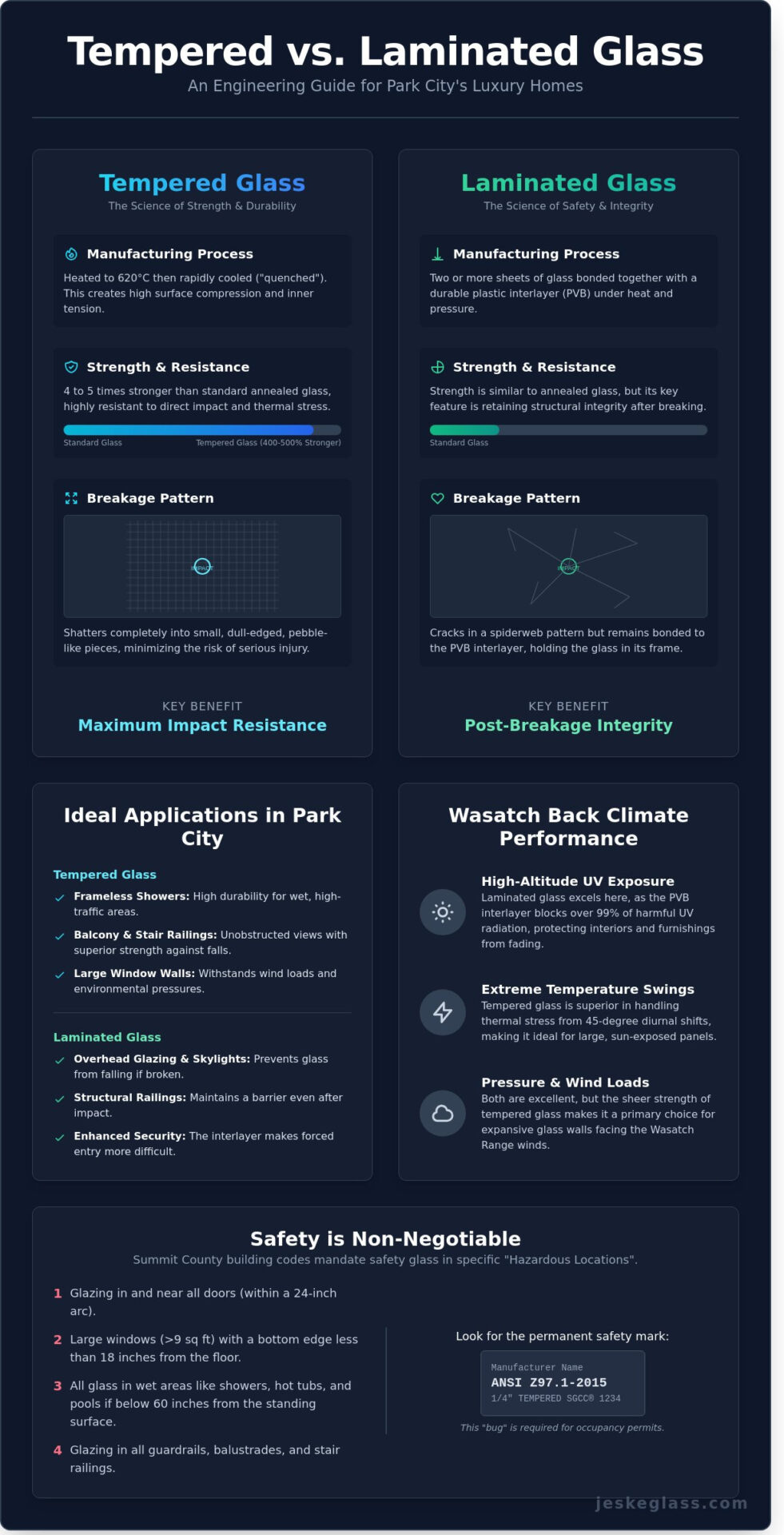
The 2021 International Residential Code (IRC), as enforced by the Summit County Building Department, identifies specific “hazardous locations” where safety glazing is mandatory. You’ll find these requirements apply to any glass within a 24-inch arc of a door or any glazing in a wet area, such as a steam shower, where the bottom edge is less than 60 inches above the standing surface. Other critical impact zones include:
- Glass balustrades and stair railings where a fall could occur.
- Floor-to-ceiling windows where the glass area exceeds 9 square feet and the bottom edge is within 18 inches of the floor.
- Glazing adjacent to hot tubs or indoor pools, frequent features in luxury Park City retreats.
Building inspectors won’t issue a final occupancy permit without verified safety glazing. Every panel must feature a permanent, fired-on “bug” or etch in the corner that identifies the manufacturer and the safety standard met, such as ANSI Z97.1. This certification ensures that the transparency you enjoy is backed by rigorous engineering.
Tempered and Laminated: Two Paths to the Same Goal
While both options fulfill the legal definition of safety glazing, they achieve protection through different methods. Tempered glass is treated with extreme heat and rapid cooling to create high surface compression. This process makes it four to five times stronger than standard glass. If it breaks, it collapses into small, relatively harmless granules rather than jagged spears. It’s the primary choice for high-traffic areas where durability is paramount.
Laminated glass takes a different approach by sandwiching a polyvinyl butyral (PVB) interlayer between two glass sheets. If an impact occurs, the glass cracks but remains adhered to the plastic interlayer, maintaining the building’s envelope. When evaluating tempered vs laminated glass for your project, the decision often hinges on whether you need the sheer strength of tempering or the post-breakage integrity of lamination. Jeske Glass prioritizes both safety and crystal-clear transparency, ensuring that your mountain views remain unobstructed while meeting the highest structural standards in the industry.
The Science of Strength: Tempered vs. Laminated Glass Comparison
Understanding the structural integrity of your home’s glazing requires a look at the molecular level. Standard annealed glass is fragile; it breaks into sharp, dangerous shards under minimal stress. Engineers solved this by developing two distinct paths to safety. When evaluating tempered vs laminated glass, the choice depends on whether you prioritize impact resistance or structural retention after a failure.
Manufacturing Precision: How Tempered Glass is Crafted
The production of tempered glass involves heating the material to approximately 620 degrees Celsius followed by a high-pressure cooling procedure called quenching. This creates a state of permanent tension where the outer surfaces are in compression and the inner core is in tension. This internal stress makes the panel 400% to 500% stronger than its untreated counterparts. You’ll find this durability essential for large-scale architectural features like frameless showers or balcony railings. Precision is mandatory because any attempt to drill or cut the glass after this process will cause the entire sheet to disintegrate. Tempered glass is a pre-stressed safety material that shatters into blunt granules.
The way these materials fail tells the story of their engineering. Tempered glass utilizes its stored energy to explode into small, pebble-like pieces. These “dice” lack the lethal edges of traditional glass, significantly reducing injury risks during a 100-joule impact. Laminated glass behaves differently. It consists of two or more panes bonded by a 0.38mm to 1.52mm Polyvinyl Butyral (PVB) interlayer. The bonding process occurs inside a pressurized autoclave at 140 degrees Celsius, ensuring the layers become an inseparable unit. Comparing the breakage of tempered vs laminated glass reveals two different safety philosophies. Upon impact, the laminated pane cracks in a characteristic spiderweb pattern but remains adhered to the plastic core. This architectural stability ensures that even a shattered pane remains a solid barrier against the elements. If you’re designing a space that requires both elegance and uncompromising protection, exploring innovative structural glazing solutions can help define your project’s safety profile.
The Laminated Advantage: Security and Sound Dampening
The PVB layer serves as more than just an adhesive; it’s a multi-functional barrier. In high-end Park City residences, this interlayer provides a 30% to 50% improvement in sound insulation compared to monolithic glass. It effectively dampens frequencies between 100Hz and 400Hz, blocking the hum of traffic or neighborhood activity. Beyond acoustics, the interlayer filters 99.9% of ultraviolet radiation. This protects expensive hardwood floors and bespoke furniture from fading over a 10-year period. It’s the ultimate choice for security, as the “sandwich” construction requires repeated, heavy strikes to penetrate, often deterring intruders for several minutes.
- Post-breakage integrity: Laminated glass stays in the frame, maintaining the building envelope and preventing falls.
- Impact safety: Tempered glass eliminates the risk of deep lacerations by avoiding sharp, jagged edges.
- Acoustic control: The vibration-dampening properties of PVB make it the superior choice for quiet interiors.
- UV filtration: Laminated options block nearly all harmful rays, preserving the vibrancy of interior finishes.
Performance in the Wasatch Back: Climate and Altitude Factors
The Wasatch Back presents a unique set of environmental challenges that standard building codes often fail to address with sufficient nuance. In Park City, where elevations frequently exceed 7,000 feet, your home’s glass isn’t just a decorative window; it’s a structural barrier against extreme atmospheric pressures. Understanding the technical nuances of tempered vs laminated glass becomes a matter of long-term architectural preservation rather than just a safety check.
Managing Thermal Stress in Park City Homes
Park City homeowners experience temperature swings from -10°F in January to 90°F in July. This 100-degree variance creates immense thermal stress. Standard float glass often fails because the center of the pane heats faster than the edges shaded by the frame, leading to spontaneous breakage. Tempered glass mitigates this risk through its unique manufacturing process, which involves heating the glass to 1,148°F and then rapidly cooling it. This creates internal compression that allows the pane to withstand four times the thermal shock of regular glass. At Jeske Glass, we prioritize precision edge polishing. This removes microscopic chips that could otherwise serve as failure points during a sudden Summit County freeze.
UV Protection and Mountain Views
Sunlight at 7,000 feet is significantly more aggressive than at sea level. UV radiation intensity increases by approximately 4% for every 1,000 feet of gain, meaning Park City interiors face nearly 30% more destructive light than coastal homes. While tempered glass offers structural strength, it provides minimal UV filtration. Laminated glass utilizes a Polyvinyl Butyral (PVB) or SentryGlas (SGP) interlayer that filters out 99.9% of UV rays. This invisible shield protects custom walnut flooring and delicate art collections from the irreversible sun bleaching that occurs within just 24 months of exposure in high-altitude environments. You maintain the expansive, invisible look of the mountains while ensuring your interior investments remain pristine.
Exterior glass railings must account for 120 mph wind gusts and snow loads that can exceed 50 pounds per square foot. Calculating the correct glass thickness requires local expertise that understands the specific wind tunnels created by the Wasatch mountain topography. Choosing between tempered vs laminated glass depends on these load-bearing requirements. Laminated glass remains the superior choice for overhead glazing or high-traffic railings because the interlayer holds the glass shards in place even if a structural failure occurs.
Local engineering expertise is the final, non-negotiable component of a mountain build. Calculating glass thickness for a home in The Colony or Deer Valley requires more than a standard lookup table. It involves analyzing the specific wind-load coefficients of the site. A glass railing that meets code in Salt Lake City might flex dangerously under the localized pressure of a Park City winter storm. We utilize specific glass thickness calculations, often moving from 10mm to 12mm or even 15mm depending on the span and the specific hardware used. This meticulous approach ensures that the transparency of your view never comes at the expense of your family’s security.
Selection Guide: Choosing the Right Glass for Your Project
Selecting the appropriate material when weighing tempered vs laminated glass involves more than meeting local building codes; it’s a decision that defines the architectural legacy and safety profile of your home. Each structural application requires a specific response to environmental pressures, human impact risks, and aesthetic goals. At Jeske Glass, we guide Park City homeowners through these technical nuances to ensure every installation remains as enduring as the mountain views they frame.
Frameless Showers and Interior Partitions
Jeske Glass utilizes 3/8 inch or 1/2 inch tempered glass as the foundational material for luxury frameless shower enclosures. These specific thicknesses provide the necessary structural rigidity to support heavy solid-brass hardware without the visual clutter of bulky metal frames. Tempered glass handles thermal shocks up to 470 degrees Fahrenheit; this makes it the safest choice for high-end steam showers and modern bathroom environments. Beyond safety, the tempering process creates a surface that bonds effectively with high-performance hydrophobic protective coatings. These professional-grade treatments reduce mineral buildup and cleaning labor by 90% over a documented 10-year lifespan. Learn more about our custom frameless glass showers in Utah to see how we blend transparency with engineering precision.
Exterior Railings and Staircases
The 2021 International Building Code (IBC) standards have shifted the industry toward mandatory lamination for glass used as a guardrail. While tempered glass is exceptionally strong, it can vacate the frame if a rare breakage occurs. Laminated glass solves this by keeping the glass fragments adhered to a central interlayer. For the demanding climate of Park City, we specify SentryGlas ionoplast interlayers. These interlayers are 100 times stiffer and five times tougher than standard PVB materials. They offer superior resistance to moisture and delamination, even when exposed to sub-zero temperatures and heavy snow loads on exterior decks.
Precision is the cornerstone of our railing installations. We employ 3D laser measuring technology for every custom project to capture site dimensions within a 1/16th-inch margin of error. This eliminates the risks associated with manual measurements and ensures that the tempered vs laminated glass panels align perfectly with existing stone or timber structures. This level of accuracy is essential for achieving the clean, minimalist lines required in modern mountain architecture.
Custom Mirrors and Specialized Applications
Wall-mounted mirrors often utilize high-quality annealed glass because the wall provides continuous support. However, for home gyms or mirrors located in high-traffic hallways, we prioritize safety. In these scenarios, we apply a category II safety backing or utilize tempered glass to prevent the risk of large shards. For projects requiring the ultimate in clarity, we recommend low-iron glass options. This removes the natural green tint found in standard glass, ensuring that your custom mirrors and partitions reflect colors with 100% accuracy.
Analyzing the cost-benefit of your glass selection requires a long-term perspective. Investing in laminated glass for railings or 1/2 inch tempered glass for showers increases the upfront investment by approximately 30% to 45% compared to thinner, standard alternatives. However, the durability, reduced maintenance, and enhanced safety provide a significant return on investment over the life of the property. We don’t view glass as a mere building material, but as a structural element that must perform flawlessly for decades.
If you’re ready to elevate your home with precision-engineered glass, contact Jeske Glass today for a professional consultation and expert installation.
The Jeske Glass Approach: Precision Craftsmanship in Utah
Since 1954, Jeske Glass has defined the standards for architectural glazing across the Wasatch Front. Our 70 year legacy isn’t merely a record of time; it’s a deep repository of technical expertise applied to the most demanding residential projects in the region. We don’t simply deliver materials. We provide structural solutions that resolve the complex debate of tempered vs laminated glass based on your home’s specific elevation, wind exposure, and interior design goals. From the initial consultation in Provo to final installations in Park City, our craftsmen ensure every panel meets the highest safety benchmarks while enhancing the home’s visual transparency.
Park City’s unique architecture often requires oversized glass panels to capture the expansive mountain views. This creates a specific engineering challenge. We perform custom fabrications that tailor glass thickness and hardware tension to the exact requirements of high-altitude environments. A safety rating is only effective if the installation is flawless. If a mounting point is misaligned by even 2 millimeters, the structural integrity of a tempered panel can be compromised over time. We eliminate these risks by overseeing every stage of production and placement, ensuring your glass performs as intended under Utah’s heavy snow loads and 7,000 foot atmospheric pressures.
3D Laser Measuring: The Secret to a Perfect Fit
Traditional tape measures cannot account for the subtle shifts and organic curves found in high-end custom builds. We utilize 3D laser scanning technology to capture site dimensions with a 1/16th inch tolerance, effectively removing human error from the equation. This precision allows us to achieve 30% faster installation times because every piece arrives perfectly sized for the opening. 3D laser scanning ensures glass railings follow the exact contour of your stairs.
Elevate Your Home with Professional Consultation
Determining the right balance of tempered vs laminated glass requires an understanding of both local building codes and everyday functionality. Our experts analyze your specific floor plan to identify where impact resistance or acoustic dampening should take priority. The Jeske guarantee focuses on safety, precision, and a dignified aesthetic that respects your architect’s original vision. We treat every project as a permanent contribution to your property’s long-term value.
Your home deserves a finish that mirrors the majesty of its surroundings. Whether you’re installing a frameless shower, a glass wine cellar, or a structural balcony, our team brings a master’s touch to every square inch of glass. We invite you to request your free custom glass estimate in Park City today and discover why Utah’s most discerning homeowners trust Jeske Glass for their most ambitious visions. Our commitment to exceptional craftsmanship ensures that your glass is not just a barrier, but a masterpiece of light and safety.
Elevating Your Mountain Sanctuary with Architectural Precision
Selecting the right glazing for a Park City residence requires more than an aesthetic eye; it demands an understanding of how structural integrity meets the unique atmospheric pressures of the Wasatch Back. Whether you’re prioritizing the impact resistance of tempered panels for a custom steam shower or the superior fall protection of laminated layers for an expansive balcony, your decision defines the safety of your living space. The technical distinction between tempered vs laminated glass often dictates the long-term performance of your architectural features against Utah’s extreme thermal shifts and high-altitude conditions.
Jeske Glass brings a combined 70+ years of local Utah experience to every project, ensuring that your vision isn’t just beautiful, but technically flawless. We utilize advanced 3D laser technology to achieve a perfect fit for high-end glass railings and specialized showers, eliminating the margins of error common in traditional measurement methods. Our team operates as a dedicated partner in your design journey, translating complex engineering requirements into transparent, timeless elegance that honors the surrounding landscape. We don’t just install glass; we craft enduring structural elements that stand the test of time.
Secure your Park City home with a free custom glass estimate from Jeske Glass and begin the process of refining your architectural environment today. Your home deserves the precision of master craftsmanship.
Frequently Asked Questions
Which is stronger, tempered or laminated glass?
Tempered glass is physically stronger in terms of impact resistance, offering 4 to 5 times the strength of standard annealed glass. Laminated glass provides superior security because it remains intact even after a fracture occurs. For a Park City residence, the choice between tempered vs laminated glass often depends on whether you prioritize structural impact resistance or post-breakage retention.
Can tempered glass be cut to size after it has been manufactured?
No, you can’t cut or drill tempered glass once the thermal toughening process is complete. Any attempt to alter the dimensions will cause the entire pane to shatter into thousands of small, blunt fragments instantly. Precise measurements are finalized during the CAD design phase at Jeske Glass to ensure a perfect fit for your architectural openings.
Why is laminated glass often required for glass railings in Park City?
International Building Code (IBC) Section 2407 requires laminated glass for all glass railings to prevent fall-through hazards if the glass breaks. In high-elevation environments like Park City, the 0.030-inch or 0.060-inch interlayer holds the shards together, maintaining a protective barrier. This safety standard ensures that a single point of failure doesn’t result in an open void on a balcony or staircase.
Does laminated glass provide better soundproofing for my home?
Yes, laminated glass reduces exterior noise by up to 35 decibels compared to standard monolithic glass. The polyvinyl butyral (PVB) or SentryGlas interlayer acts as a dampening core that disrupts sound wave vibrations. This feature is particularly beneficial for homes near busy Park City thoroughfares like Highway 224, where acoustic comfort is a primary design requirement.
What happens if a tempered glass shower door breaks?
A tempered glass shower door disintegrates into small, relatively harmless cubes instead of sharp, jagged shards. This intentional fragmentation pattern, mandated by ANSI Z97.1 standards, minimizes the risk of deep lacerations during an accidental breakage. While the sudden noise is startling, the 10-millimeter or 12-millimeter glass pieces are designed to prioritize the physical safety of the user.
Is laminated glass more expensive than tempered glass?
Laminated glass typically costs 20% to 40% more than tempered glass due to the complex multi-layer fabrication process. This premium reflects the added material costs of the interlayer and the dual-pane construction required to create a single safety unit. Many homeowners find this investment justified for its 99% UV protection and enhanced structural integrity in demanding mountain climates.
How do I know if my existing glass is safety glass?
You can identify safety glass by locating a permanent, etched monogram or “bug” in one of the corners of the pane. This mark includes the manufacturer’s name and the specific safety standard, such as CPSC 16 CFR 1201, which confirms its rating. If no etch is visible, a professional technician can use a portable spectrometer to determine if the glass has undergone heat treatment or lamination.
Can I use tempered glass for my outdoor deck railing in Utah?
You can only use tempered glass for outdoor railings if it’s also laminated, as per the 2015 IBC updates adopted in Utah. While tempered glass alone is strong, it lacks the “fail-safe” retention required for elevated surfaces. Combining both technologies in tempered vs laminated glass assemblies provides the 200-pound concentrated load resistance needed for secure, transparent deck enclosures.