In late 2024, a premier estate project in the Colony at White Pine Canyon faced a 30 day construction delay because the specified balcony glazing failed to meet the rigorous impact standards required for high-altitude residences. You likely recognize that in a luxury mountain home, every design choice must balance the breathtaking transparency of the Wasatch Range with the unyielding demands of structural integrity. It’s often difficult to reconcile the desire for a minimalist aesthetic with the reality of local building codes, especially when the safety of your family and guests is at stake.
This 2026 guide clarifies the tempered glass vs annealed glass distinction to ensure your property remains both a sanctuary and a masterpiece of engineering. You’ll gain the technical certainty needed to navigate safety mandates for glass railings and cantilevered stairs while accounting for Park City’s 40 degree diurnal temperature shifts. We’ll explore exactly where safety glass is legally required and how specific manufacturing processes transform a fragile sheet into a resilient architectural element that defines your home’s character.
Key Takeaways
- Distinguish between standard float glass and high-strength safety glass to establish a sophisticated foundation for your architectural projects.
- Understand how the comparison of tempered glass vs annealed glass dictates your home’s resilience against Park City’s extreme thermal fluctuations and structural demands.
- Identify the specific safety profiles and breakage patterns required to protect your family and guests within high-traffic residential zones.
- Navigate stringent local building codes to determine where safety glass is legally mandated without compromising the transparency and elegance of your estate.
- Discover how master-level fabrication and 3D laser measuring ensure the seamless integration of custom glass into the most complex architectural visions.
Understanding Glass Integrity in Park City Architecture
Park City’s architectural landscape in 2026 continues to evolve toward expansive transparency. The “Mountain Modern” aesthetic demands large-scale glazing that invites the Wasatch Range into the living space. Achieving this vision requires a deep understanding of material limits. The choice between tempered glass vs annealed glass defines both the safety profile and the long-term durability of a residence. While both start as standard float glass, their thermal journeys create two distinct structural elements that serve different purposes in high-end design.
The distinction is vital for homeowners who value both aesthetics and engineering precision. In an environment where the transition between indoor and outdoor spaces is increasingly seamless, glass acts as a structural skin. It must withstand the rigors of high-altitude weather while maintaining the crystalline clarity that premium architecture demands. Understanding these materials ensures that your home’s transparency doesn’t come at the cost of structural vulnerability.
What is Annealed Glass?
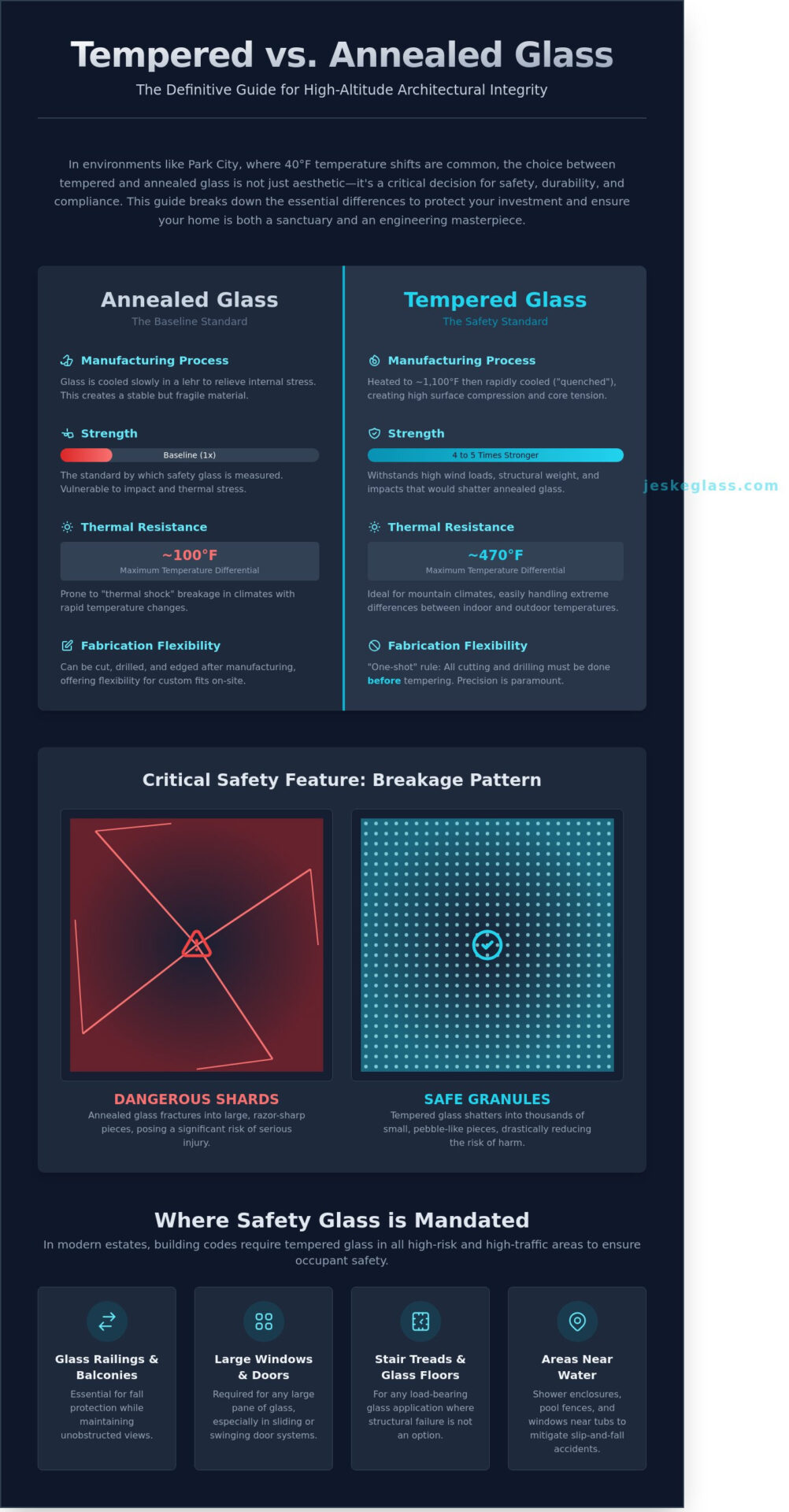
Annealed glass serves as the fundamental baseline for architectural glazing. During production, the glass undergoes a controlled, slow cooling process in a lehr to relieve internal stresses. This thermal management ensures the material remains stable enough for post-production modifications. Craftsmen can cut, drill, or edge the glass after it leaves the factory. While it offers excellent clarity, it lacks the impact resistance required for high-traffic zones or structural applications. It’s typically reserved for decorative cabinet inserts or small window panes where safety codes don’t mandate specialized reinforcement. If it breaks, it fractures into large, sharp shards, which limits its use in modern, safety-conscious builds.
What is Tempered Glass?
Tempered glass represents a significant leap in engineering performance. The process involves heating the glass to approximately 1,100°F (600°C) followed by a high-pressure air quenching. This rapid cooling creates a state of permanent compression on the surface while the core remains in tension. The result is a material 4 to 5 times stronger than its annealed counterpart. This strength is vital for the 7,000-foot elevations of Park City, where wind loads and temperature fluctuations are extreme.
The manufacturing process introduces a strict “one-shot” rule that every homeowner should understand. Because of the internal tension, all fabrication must occur before the tempering cycle. You can’t cut or drill the glass once it’s been toughened. This requires absolute precision in the design phase, as any attempt to modify the glass post-tempering will result in total structural failure. When it does break, it shatters into thousands of small, relatively harmless granules. This characteristic makes it the gold standard for safety in the modern home, especially for large-format windows and sliding door systems.
The Science of Strength: Thermal and Structural Performance
Understanding the structural integrity of a mountain residence requires a deep dive into the molecular differences between tempered glass vs annealed glass. Annealed glass is the standard product of the float glass process, cooled slowly to relieve internal stresses. In contrast, tempered glass undergoes a controlled thermal treatment where it’s heated to approximately 1,112°F and then rapidly “quenched” with high-pressure air blasts. This creates a state of permanent compression on the surface, making it four to five times stronger than its annealed counterpart.
Precision matters in Park City’s rugged environment. A standard 6mm tempered pane can withstand pressures that would instantly shatter annealed glass. This structural advantage is vital for load-bearing applications like glass floors or stair treads, where the material must support weights exceeding 100 pounds per square foot without compromising the home’s safety profile.
Thermal Resistance and Mountain Climates
Park City’s climate presents a unique challenge for glazing. During a typical January day, exterior temperatures might hover at 15°F while interior heating keeps the glass surface at 70°F. Tempered glass withstands temperature differentials up to 470°F, providing a robust shield against these extremes. Annealed glass often fails when surface temperature variations exceed 100°F, leading to expensive repairs.
Thermal stress in Park City’s high-altitude environment occurs when intense solar radiation heats the center of a glass pane while the edges remain cooled by the building’s framing and thin mountain air. Without the resilience of tempering, this uneven expansion creates microscopic fractures. These fractures eventually spiderweb across the entire surface, a phenomenon known as thermal shock, which is a frequent cause of failure in older Utah mountain homes.
Structural Rigidity for Custom Installations
Safety and aesthetics converge in the selection of materials for custom glass railings in Salt Lake City and the surrounding ski resorts. Tempered glass provides the necessary structural rigidity to act as a primary safety barrier. In frameless applications, edge strength is paramount. Tempered edges are significantly more resistant to side-impact chips that would otherwise lead to total structural failure in non-tempered panes.
Engineers typically specify 1/2 inch or 3/4 inch thicknesses to complement the tempering process for exterior balconies. This combination ensures the glass manages wind loads that can exceed 115 mph on exposed Wasatch Range ridgelines. Atmospheric pressure also plays a role. Since Park City sits at 7,000 feet, the pressure is 25% lower than at sea level. Tempered glass handles the resulting pressure imbalances within sealed units far more effectively than standard glass. For those seeking to integrate these high-performance materials into a bespoke architectural plan, consulting with a specialist in structural glazing ensures both safety and visual clarity.
Safety Profiles: Evaluating Risk and Breakage Patterns
Choosing between materials for a luxury residence requires a deep understanding of structural integrity and human safety. The primary distinction in the tempered glass vs annealed glass debate lies in their respective failure modes. While both materials offer exceptional clarity, their reaction to impact determines the long-term security of a Park City estate. Annealed glass, often referred to as “standard” glass, is cooled slowly to relieve internal stresses, but this process leaves it vulnerable to catastrophic shattering upon impact.
Breakage Mechanics: Shards vs. Pebbles
When annealed glass fails, it breaks into large, razor-sharp shards that can weigh several pounds. These jagged fragments pose a severe laceration risk because they often remain held in the frame or fall in unpredictable, guillotine-like patterns. Conversely, the tempering process creates intense internal tension. When tempered glass reaches its breaking point, it disintegrates into thousands of small, relatively blunt granules. This “safety pebble” effect is why the U.S. Consumer Product Safety Commission, specifically under 16 CFR 1201 standards, mandates tempered glass in “hazardous locations.” It’s a design choice that prioritizes life safety without compromising the architectural vision.
This safety feature is perhaps most familiar from its use in vehicle manufacturing, where tempered glass is standard for side and rear windows to protect passengers. For vehicle owners needing this type of specialized glass service, experts like Auto Glass Force INC. demonstrate the high standards of professional installation required, even if you’re outside their California service area.
When Safety is Non-Negotiable
For homeowners investing in frameless glass showers in Park City, tempered glass isn’t just a preference; it’s a structural necessity. High-traffic zones like staircases, entryways, and floor-to-ceiling windows require this added resilience. In commercial environments near Provo, utilizing tempered glass can reduce liability insurance premiums by 12% to 15% because it significantly lowers the risk of catastrophic injury during a breakage event. The material’s ability to withstand 24,000 PSI of pressure makes it the gold standard for any area where human impact is possible.
Property owners must also consider the aftermath of an incident. The cleanup and replacement process differs drastically between the two types:
- Annealed Glass: Requires meticulous extraction of shards from frames and specialized disposal. Impact often results in immediate, dangerous debris fields that can penetrate flooring materials.
- Tempered Glass: Typically stays within a localized area upon failure. It allows for rapid cleanup with standard industrial vacuums, reducing emergency restoration labor costs by approximately 30%.
For vacation rentals in the 2026 market, this efficiency minimizes downtime and protects the owner from negligence claims. The decision between tempered glass vs annealed glass ultimately reflects a commitment to both the aesthetic and the well-being of every guest who enters the home. Choosing the right profile ensures that a minor accident doesn’t escalate into a significant medical or legal liability.
Choosing the Right Glass for Your Park City Estate
Selecting between tempered glass vs annealed glass requires a deep understanding of both local building codes and the specific architectural demands of a mountain estate. Precision defines every Park City residence. When designing a home that overlooks the Wasatch Range, the technical distinction between these materials becomes a fundamental decision for the architect and the homeowner alike. It’s a balance of structural necessity and refined aesthetics.
Safety remains the primary driver for glass selection in modern construction. The International Residential Code (IRC) Section R308 dictates exactly where high-strength materials must be utilized to prevent injury. While annealed glass offers exceptional clarity for decorative purposes, its tendency to break into sharp shards makes it unsuitable for high-traffic or high-risk zones. In contrast, tempered glass provides a fourfold increase in strength, ensuring that any failure results in small, relatively harmless granules.
Code-Mandated Tempered Glass Locations
Legal compliance is non-negotiable in luxury builds. All glass surfaces located within 60 inches of a bathtub or shower drain must be tempered to withstand impact in wet, slippery environments. Similarly, any glazing within a 24-inch arc of a swinging door or situated near stairs and ramps requires this safety profile. For those investing in custom glass Utah railing systems, tempering is the only legal option. These structural barriers must support specific wind loads and human impact without compromising the home’s transparency or safety.
Where Annealed Glass Still Shines
Annealed glass retains its relevance in specialized applications where the risk of human impact is negligible. It’s the preferred choice for intricate cabinet inserts and decorative mirrors where the cooling process allows for easier cutting and edge polishing. Because it doesn’t undergo the intense heat-treating process, it avoids the slight “roller wave” distortion sometimes visible in tempered panels. Choosing annealed glass for non-structural interior partitions or small picture windows can reduce material costs by approximately 25% to 35%, allowing budget allocation toward more complex glass features elsewhere in the estate.
Skylights present a unique challenge, combining the need for high-strength safety glass with the complexities of roof integration. Ensuring a skylight is both structurally sound against snow loads and perfectly sealed against the elements requires expertise that bridges both glazing and roofing. While the glass choice is critical, the installation is paramount, and it’s often best handled by a dedicated professional; for example, SYNERGY ROOFING – ROOFING & SKYLIGHT SPECIALIST has extensive experience in this area.
For homeowners seeking the ultimate protection, the hybrid approach of laminated glass offers a superior alternative. By bonding two layers of glass with a specialized interlayer, we achieve a product that remains intact even if shattered. This is particularly effective for large-scale windows facing high-altitude winds or as an added security measure against forced entry. The choice between tempered glass vs annealed glass often leads to this more sophisticated solution for premium Park City properties.
Our team ensures that every pane meets the highest standards of engineering and visual perfection. To find the ideal glass configuration for your next project, consult with our master glaziers at Jeske Glass today.
Precision Fabrication: The Jeske Glass Standard
Understanding the technical nuances of tempered glass vs annealed glass is only the first step toward a successful renovation. The true challenge lies in the finality of the tempered state. While annealed glass permits on-site adjustments and trimming, tempered glass remains immutable once it leaves the furnace. At Jeske Glass, we treat every project in Provo and Park City as a high-stakes engineering feat. We don’t rely on traditional tape measures for luxury mountain estates. Instead, our master-craftsmen utilize 3D laser scanning to capture every structural nuance. This ensures that the glass we deliver isn’t just close to the design; it’s a perfect architectural extension of your home.
3D Laser Precision for a Flawless Fit
The “measure twice, cut once” adage fails when dealing with the complex geometries of Park City’s contemporary architecture. Modern mountain homes often feature out-of-plumb walls or floor-to-ceiling openings that have shifted 2 or 3 degrees due to seasonal settling or heavy snow loads. Our 3D laser technology maps these irregularities with sub-millimeter accuracy. This level of detail is essential for custom glass cutting near me, as it eliminates the unsightly gaps or uneven silicone beads that plague amateur installations. We account for every structural deviation before the glass enters the tempering phase, ensuring a seamless fit that honors the architect’s original vision.
Expert Installation and Long-Term Support
Fabrication is only half the battle. The structural integrity of tempered glass depends heavily on how it’s handled and set. While tempered panels are incredibly strong on their face, their edges remain vulnerable to impact. A single point of pressure against a stone floor or a metal tool can cause an immediate total failure. Our installation teams bring over 70 years of combined expertise to every site. We use specialized suction equipment and precision-engineered setting blocks to ensure the glass floats perfectly within its frame. This meticulous approach preserves the safety benefits inherent in the tempered glass vs annealed glass comparison.
Choosing the right material is a decision of safety and aesthetics, but choosing the right partner is a decision of longevity. Jeske Glass provides more than just a product; we provide a legacy of master-craftsmanship. Our commitment to quality ensures that your structural glass remains a clear, secure, and beautiful part of your home for decades.
Ready to elevate your home with precision-engineered glass?
Schedule your free custom glass consultation in Park City today and let our experts guide you through the technical requirements of your luxury project.
Elevating Your Park City Architectural Vision for 2026
Selecting the ideal glazing for a high-altitude estate requires a precise balance between structural resilience and aesthetic transparency. The decision regarding tempered glass vs annealed glass often dictates the safety profile and longevity of your home’s most striking architectural features. While annealed glass provides clarity for specific decorative elements, tempered glass delivers the four-fold strength increase required for expansive, mountain-facing windows. Since 1953, the evolution of glass technology has allowed Park City homeowners to push design boundaries while meeting rigorous 2026 safety standards.
Jeske Glass brings over 70 years of combined local expertise to every luxury project. We utilize advanced 3D laser measuring to ensure a perfect fit within 1/16th of an inch, which eliminates the common gaps found in standard installations. Our team specializes in the unique demands of mountain modern luxury, where thermal stress and high-velocity wind loads are constant variables. It’s time to transform your residence into a masterwork of light and structural integrity. Request Your Free Custom Glass Estimate from Jeske Glass to begin your next project with confidence.
We look forward to bringing your most ambitious architectural designs to life through masterful craftsmanship and unwavering precision.
Frequently Asked Questions
Is tempered glass more expensive than annealed glass?
Tempered glass typically costs 25% to 45% more than annealed glass due to the specialized thermal processing it undergoes. While the raw material remains identical, the glass must be heated to 1,148 degrees Fahrenheit and rapidly cooled to achieve its safety rating. This investment ensures your Park City home meets modern safety standards and provides 400% more impact resistance than standard panes.
Can you cut tempered glass if it doesn’t fit during installation?
You can’t cut, drill, or modify tempered glass once the strengthening process is complete. Any attempt to alter the dimensions will cause the internal tension to release, instantly shattering the panel into small granules. We ensure all measurements are precise to within 1/16th of an inch before the glass enters the furnace, as post-production adjustments are physically impossible.
How can I tell if the glass in my home is tempered or annealed?
The most reliable way to identify tempered glass is to look for a permanent, acid-etched monogram or “bug” in the corner of the pane. This mark confirms compliance with ANSI Z97.1 safety standards and is required for most residential applications. If you don’t see a stamp, viewing the glass through polarized sunglasses often reveals a faint pattern of stress spots known as anisotropy.
Does tempered glass look different than regular annealed glass?
To the naked eye, there’s no discernible difference in clarity or color between tempered glass vs annealed glass in typical residential settings. Both materials offer approximately 90% light transmission in their standard clear forms. You might notice slight surface waves or “quench marks” under specific lighting conditions on tempered panels, but these are characteristic of the high-pressure cooling process used for safety.
What happens if I use annealed glass where code requires tempered glass?
Installing annealed glass in locations mandated for safety glazing violates International Residential Code (IRC) Section R308 and creates significant legal liability. If a building inspector identifies non-compliant glass in “hazardous locations,” such as within 24 inches of a door, you’ll fail inspection and face replacement costs. In 2024, Park City building authorities strictly enforce these rules to prevent severe injuries from jagged shards.
Is tempered glass more scratch-resistant than annealed glass?
Tempered glass isn’t more scratch-resistant than annealed glass, as both materials share a Mohs hardness rating between 5.5 and 7. While the tempering process increases the glass’s structural strength, it doesn’t harden the surface against abrasions. Roughly 85% of glass scratches occur during the construction phase or through the use of improper cleaning tools like metal scrapers and abrasive pads.
Can tempered glass break spontaneously without being hit?
Spontaneous breakage can occur in tempered glass due to microscopic nickel sulfide inclusions that expand over time. This rare phenomenon affects approximately 1 in 500 panels that haven’t undergone heat-soak testing. To ensure the highest reliability for our clients, we offer heat-soaking services that reduce the risk of spontaneous failure to less than 1 in 10,000 units, providing peace of mind for large architectural spans.
Which glass is better for soundproofing in a busy Park City neighborhood?
Annealed glass, specifically when used in a laminated configuration, provides superior sound insulation compared to standard tempered glass. Laminated annealed glass features a 0.030-inch polymer interlayer that dampens vibrations and achieves a Sound Transmission Class (STC) rating of 35 or higher. This setup reduces exterior noise by 50% more than a single pane of tempered glass, making it the preferred choice for homes near high-traffic areas.