In the high-altitude environment of Park City, a window isn’t just a design choice; it’s a structural barrier that must withstand 100-mile-per-hour gusts while maintaining the absolute transparency expected of a luxury boutique. You likely recognize that on Main Street, your facade is the first handshake with a discerning clientele. It’s a common frustration when premium storefront glass systems succumb to seal failure or internal fogging after only two seasons of Utah’s 40-degree daily temperature swings.
This guide provides the technical clarity needed to balance mountain durability with architectural elegance. You’ll learn how to select high-performance thermal breaks and specialized triple-pane configurations that satisfy both the 2021 International Building Code and the strict aesthetic mandates of the Park City Historic Preservation Board. We’ll examine the engineering behind snow-load-rated frames and the specific low-emissivity coatings that keep your interior visible even when the snow falls at a rate of two inches per hour. By focusing on precision engineering, you can ensure your commercial space remains a warm, inviting beacon for shoppers throughout the harshest winter months.
Key Takeaways
- Understand how premium glazing serves as a vital strategic interface for luxury brands to capture “stopping power” in competitive resort markets.
- Learn to navigate the technical demands of the Wasatch Back by selecting high-performance storefront glass that balances thermal efficiency with uncompromising safety.
- Evaluate the structural and aesthetic trade-offs between frameless heavy glass and traditional systems to define your building’s architectural character.
- Master the complexities of the Park City Land Management Code and historic design guidelines to ensure your renovation meets rigorous local standards.
- Discover how 3D laser measuring and precision engineering transform a commercial vision into an enduring, high-performance architectural landmark.
The Strategic Role of Storefront Glass in Park City’s Luxury Market
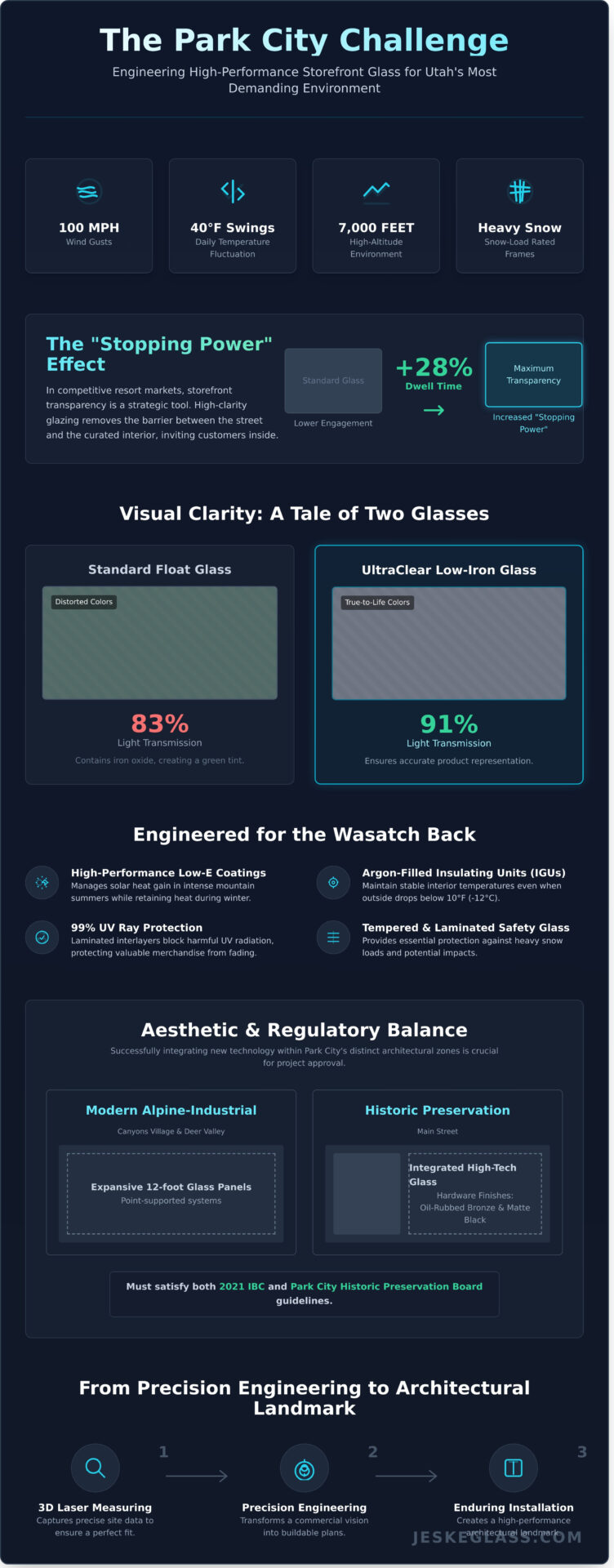
In the competitive retail environment of the Wasatch Back, the implementation of high-performance storefront glass acts as the primary interface between a brand’s identity and the discerning Park City consumer. This physical threshold is more than a structural necessity; it’s a sophisticated tool for engagement. On Main Street, where foot traffic remains a vital driver of revenue, the concept of “Stopping Power” is measured in seconds. A 2023 analysis of resort-side retail behavior indicated that storefronts utilizing maximum-transparency glazing saw a 28% increase in dwell time at window displays compared to those with standard commercial glass.
Transparency serves as the most valuable currency for local boutiques and art galleries. It facilitates an immediate, unobstructed connection with the interior curation. However, achieving this level of visual clarity involves navigating a complex tension. Designers must balance the desire for invisible boundaries with the harsh environmental demands of a mountain climate at 7,000 feet. The glass must withstand extreme thermal shifts, high UV radiation, and significant wind loads while maintaining its aesthetic integrity. For many high-end retailers, the evolution of storefront glass technology allows for these engineering challenges to be met without sacrificing the minimalist elegance that luxury shoppers expect.
First Impressions: Why Clarity Matters for High-End Retail
Luxury consumers in Park City are conditioned to expect perfection. Standard float glass contains iron oxide, which creates a noticeable green tint that distorts the true colors of merchandise. By utilizing UltraClear low-iron glass, retailers achieve 91% light transmission compared to the 83% found in traditional glazing. This clarity ensures that natural light illuminates products accurately, enhancing the mood and perceived value of the inventory inside.
The Park City Aesthetic: Modern vs. Historic Commercial Design
Recent developments in Canyons Village and Deer Valley favor expansive, 12-foot tall glass panels that reflect a modern, alpine-industrial aesthetic. In contrast, historic Main Street requires a delicate integration of new technology within preserved facades. Successful designs often pair these large-format panes with specific hardware finishes, such as oil-rubbed bronze or matte black, to bridge the gap between contemporary performance and rustic-luxe style.
Engineering for the Wasatch Back requires a rigorous approach to both thermal efficiency and structural resilience. The high-altitude environment subjects building envelopes to intense pressure, necessitating the use of specialized Safety glass that is often both tempered and laminated. These configurations provide the essential protection needed against heavy snow accumulation and potential impact while maintaining the slim profiles required for modern architectural visions. Technical specifications for these installations often include:
- High-performance Low-E coatings to manage solar heat gain during intense mountain summers.
- Argon-filled insulating units that maintain interior temperatures when outside mercury drops below 10 degrees Fahrenheit.
- Laminated interlayers that block up to 99% of UV rays, protecting expensive fabrics and fine art from fading.
- Precision-engineered point-supported systems for a seamless, “floating” glass appearance.
The choice of glazing isn’t merely a construction detail; it’s a strategic investment in the brand’s physical presence. When a storefront successfully integrates transparency with technical durability, it creates an inviting atmosphere that beckons the consumer. It’s about removing the barriers to entry, both literal and psychological, ensuring that the transition from the snowy sidewalk to the warm, curated interior feels effortless and exclusive.
Engineering for the Wasatch Back: Thermal and Safety Standards
Engineering for the Wasatch Back necessitates a sophisticated approach to material science. In Park City and surrounding high-altitude corridors, retail environments face diurnal temperature shifts that often exceed 40 degrees Fahrenheit within a 12-hour window. These rapid fluctuations create significant internal pressure within Insulated Glass Units (IGUs), making the choice of storefront glass a matter of long-term structural viability rather than mere aesthetics. To maintain a consistent internal climate when exterior temperatures drop to -10°F, the system relies on a low U-value, typically aiming for 0.28 or lower. This measurement tracks the rate of non-solar heat loss; a lower number indicates superior insulation. Complementing this is the Solar Heat Gain Coefficient (SHGC), which manages how much solar radiation enters the building. In the intense high-altitude sun, an SHGC of 0.25 to 0.35 is ideal to prevent the “greenhouse effect” during winter afternoons while retaining warmth at night.
Thermal Performance: Keeping the Cold Out and the Heat In
Low-E (low-emissivity) coatings are indispensable in this environment. These microscopically thin layers reflect long-wave infrared energy, bouncing heat back into the room during winter and reflecting it away in summer. For businesses at 7,000 feet, Argon gas fills provide a 15% improvement in thermal efficiency over air, while Krypton offers even higher performance in thinner glazing pockets. These investments prevent the frost buildup and condensation that can obscure merchandise and damage window sills during sub-zero nights.
Structural Integrity: Wind, Snow, and Safety
The physical demands on storefront glass in the Wasatch Back are extreme. Wind loads at high elevations produce gusts exceeding 90 mph, requiring thicker panes and reinforced aluminum framing to prevent deflection. Snow load is another critical factor; retail designs with sloped glazing must withstand weights of 30 to 50 pounds per square foot to ensure the system doesn’t buckle under heavy winter accumulation. All installations must strictly adhere to CPSC safety standards for architectural glazing to ensure public protection in high-traffic areas.
A common concern for retail owners is whether meeting these rigorous safety standards requires bulky, unsightly frames. Modern engineering allows for high levels of security without sacrificing transparency. Laminated glass serves as a dual-purpose solution, utilizing a polyvinyl butyral (PVB) interlayer that holds the glass together if impacted. This interlayer also filters out 99.9% of harmful UV rays, protecting expensive interior inventory from fading. Tempered glass is a mandatory safety requirement for all commercial entries and adjacent sidelites to ensure structural resilience and occupant protection. While tempered glass is four times stronger than standard glass, combining it with laminated layers provides the ultimate security profile without the bulk of traditional protective barriers. Architects who prioritize these technical specifications often find that consulting on custom glazing specifications during the early planning stages ensures both peak performance and uncompromised design elegance. This meticulous attention to engineering detail ensures that the storefront remains a clear, inviting portal, regardless of the harsh alpine conditions outside.
Frameless vs. Framed Systems: A Performance Comparison
Selecting the appropriate storefront glass configuration requires a precise balance between architectural transparency and the harsh realities of Utah’s high-altitude climate. While the visual distinction between frameless “heavy glass” and traditional aluminum systems is immediate, the engineering implications dictate the long-term viability of the retail space. Modern retail design in Salt Lake City often pits the desire for an invisible envelope against the necessity for structural resilience. A well-engineered system ensures that transparency doesn’t compromise safety or thermal efficiency.
The Frameless Appeal: Unobstructed Mountain Views
Frameless systems utilize 1/2-inch or 3/4-inch tempered glass to create a monolithic appearance that maximizes natural light. For luxury boutiques in Park City, this “all-glass” look is achieved through structural glass fins or point-supported hardware rather than vertical metal mullions. These systems offer nearly 98% visual clarity, yet they require rigorous engineering to manage lateral wind loads that often exceed 30 pounds per square foot in the Wasatch Back. Structural glass fins provide the necessary stiffening without interrupting the sightlines. It’s a common misconception that these systems are fragile. When designed to meet commercial glazing safety standards, frameless installations handle seismic shifts and heavy snow loads with the same reliability as their framed counterparts. They’re best suited for protected entryways or interior partitions where the primary goal is an elite, high-transparency aesthetic.
Aluminum Framing: Durability and Thermal Breaks
Traditional aluminum storefront systems remain the industry standard for high-traffic exterior envelopes due to their superior moisture management. In Salt Lake City, where winter temperatures frequently drop below 20°F, non-thermal frames lead to significant condensation and frost buildup on the interior surface. This results in a 24% increase in energy loss compared to thermally broken systems. Modern aluminum frames utilize a polyamide strut to separate the interior and exterior metal profiles, effectively breaking the path of thermal conduction. These systems offer extensive customization through AAMA 2605-compliant powder coatings. This allows architects to match specific palettes, such as deep bronzes or charcoal greys, that define Park City’s mountain modern aesthetic. Aluminum frames also simplify the integration of heavy-duty commercial doors. Whether opting for offset pivots or continuous hinges, the metal frame provides a stable substrate for hardware that must withstand thousands of cycles annually.
Maintenance for these systems varies significantly during the winter months. Frameless systems rely on high-modulus silicone for glass-to-glass joints. These joints require inspection every 24 months to ensure the sealant hasn’t degraded due to UV exposure or extreme freeze-thaw cycles. In contrast, framed storefront glass uses internal gaskets and weep holes to channel moisture away from the building. Proper maintenance ensures that ice doesn’t expand within the glazing pocket, which can cause glass breakage or seal failure.
- Frameless Systems: Best for maximum transparency and high-end luxury branding.
- Framed Systems: Essential for extreme thermal performance and high-traffic durability.
- Hybrid Approaches: Utilizing frameless glass for display windows while using framed systems for primary entry doors.
Ultimately, the choice isn’t merely about appearance. It’s about how the structure interacts with the environment. A frameless system isn’t weak; it’s a sophisticated piece of engineering that uses the glass itself as a load-bearing element. Conversely, aluminum framing isn’t just a utility; it’s a durable shield that protects the interior climate against the volatile Utah weather.
Navigating Park City Regulations and Historic Main Street Requirements
Park City’s architectural identity relies on the strict enforcement of the Land Management Code (LMC). For retailers on Historic Main Street, the LMC Section 15-11 dictates every structural and aesthetic detail of a facade renovation. It’s a delicate dance between preserving the 1880s mining town aesthetic and meeting the thermal demands of a high-altitude climate. Local planning commissions scrutinize the reflectivity and tint of any new storefront glass to prevent modern glares from disrupting the rustic, weathered palette of the district. Success in this environment requires more than just high-quality materials; it demands a deep understanding of the Historic District Design Guidelines. These rules ensure that the visual weight of the building remains consistent with its 19th-century neighbors while allowing for contemporary retail functionality.
The technical challenge lies in balancing “historically appropriate” visuals with “modern performance” metrics. High-altitude environments like Park City, sitting at 7,000 feet, subject glass to intense UV radiation and extreme temperature fluctuations. A standard window won’t suffice. Retailers need glazing that offers a low U-value to retain heat during winter months, yet maintains a Visible Light Transmittance (VLT) that satisfies the town’s desire for transparency. Working with a local fabricator who understands these specific town council expectations is vital. They act as a bridge between the architect’s vision and the rigid demands of the preservation board, ensuring that the final installation passes inspection without costly delays or aesthetic compromises.
Historic Preservation: Maintaining the Mining Town Heritage
The Park City Planning Department often mandates specific glass-to-frame ratios to maintain architectural integrity. Historically, retail fronts featured a dominant 75% transparency rate, framed by substantial wood or dark-anodized metal. Modern storefront glass installations must replicate these proportions while integrating high-performance features. Choosing hardware and muntin patterns requires a meticulous eye; these elements must simulate traditional divided lites without sacrificing the structural strength of the pane. In a 2023 restoration project, we utilized specialized low-iron glass treated with a subtle, non-reflective coating. This allowed the shop to showcase luxury goods with 98% color accuracy while adhering to the strict “non-glare” requirements of the LMC.
Code Compliance: Fire Ratings and Accessibility
Accessibility and safety are non-negotiable pillars of modern commercial design. ADA standards require that entrance thresholds don’t exceed a 0.5-inch height to accommodate all patrons, a task that’s difficult when dealing with the uneven foundations of historic buildings. In the dense, zero-lot-line environment of downtown Park City, fire-rated glass becomes a structural necessity. Buildings positioned within five feet of a property line must often utilize glass assemblies rated for 60 to 120 minutes of fire resistance. We utilize 3D laser measuring to capture every structural nuance of these century-old openings, ensuring a code-compliant fit that eliminates the need for unsightly on-site adjustments.
Achieving this level of precision requires a partner who treats every installation as a piece of architectural art. If you’re planning a renovation in a sensitive historic district, you should consult with Jeske Glass to ensure your project meets both aesthetic and regulatory standards.
The Jeske Glass Process: Precision Engineering for Park City
The architectural landscape of Summit County demands a level of technical rigor that standard glazing contractors often fail to meet. At Jeske Glass, we view every installation as a structural contribution to the local aesthetic. Our methodology centers on engineering integrity, ensuring that high-end retail spaces in Park City maintain their visual transparency while resisting the harsh thermal fluctuations of the Wasatch Range. We don’t just install windows; we provide a comprehensive technical partnership for architects and developers who require perfection in every joint and seal.
3D Laser Precision: Eliminating the Margin of Error
Precision begins long before the first sheet of glass is cut. We utilize advanced 3D laser measuring technology to map every millimeter of an opening. This is critical for Park City’s historic Main Street, where stone foundations and timber-frame structures have shifted over 100 years. By capturing 360-degree digital point clouds, we eliminate the 5% to 10% error margin common with manual tape measurements. Our team operates with a strict tolerance of 1/16th of an inch, a standard that protects the substantial investment required for high-performance commercial glazing. This accuracy ensures that heavy-duty storefront glass panels seat perfectly into their frames on the first attempt, preventing the air leaks and structural stress that lead to premature failure.
Custom Craftsmanship: More Than Just a Supplier
Our facility transforms raw materials into architectural statements through a rigorous fabrication cycle. With over 70 years of combined experience, our technicians manage the entire lifecycle of the project, from the initial design consultation to the final edge polish. We don’t just supply materials; we engineer solutions that balance structural loads with aesthetic clarity. Each piece of storefront glass undergoes a multi-stage quality control check to ensure the clarity and strength required for high-traffic commercial environments. This commitment to excellence has made us the preferred partner for developers who prioritize durability alongside visual impact.
The professional installation phase is where our planning yields tangible results for active businesses. We understand that a closed door is a lost opportunity. Our crews coordinate with site managers to execute installations during off-peak hours, often completing complex retrofits within a single 24-hour window. This efficiency is achieved through a structured workflow:
- Site Preparation: We establish a secure perimeter and protect all existing interior finishes.
- Structural Verification: A final check of the framing ensures the substrate can support the weight of premium glass.
- Precision Sealing: We use high-grade silicone and weather-stripping designed for sub-zero temperatures.
- Final Polish: Every surface is cleaned to a gallery-standard finish before we hand over the keys.
Our presence on a job site reflects the dignity of the brands we serve. We maintain a clean, organized workspace that respects the surrounding environment and neighboring businesses. We position ourselves as an extension of your design team, providing the technical data and structural certifications necessary for modern building codes. Our focus remains on the light, the space, and the security of your investment. Request a free custom estimate for your Park City storefront project to see how our engineering-first approach can elevate your commercial property.
Elevating Your Commercial Vision in the Wasatch Back
Park City’s unique climate and historic aesthetic demand more than standard solutions. Achieving the perfect balance between thermal efficiency and architectural transparency requires a specialized approach. Our team utilizes 3D laser measuring to ensure a perfect fit for every installation, eliminating the margin for error in complex high-altitude environments. We leverage over 70 years of combined expert experience to navigate the strict regulations of Main Street while maintaining the structural integrity required for extreme mountain weather.
Choosing the right storefront glass isn’t just a construction decision; it’s an investment in your brand’s visibility and long-term operational costs. Jeske Glass specializes in high-altitude thermal engineering, providing systems that resist heat loss and withstand heavy snow loads without compromising on the sleek, modern aesthetic your clientele expects. We act as your architectural partner, turning technical challenges into seamless glass transitions that define the local landscape. Your project deserves the stability and mastery that only decades of dedicated craft can provide.
Request Your Free Park City Storefront Consultation
We look forward to bringing your architectural vision to life with the precision it demands.
Frequently Asked Questions
How much does storefront glass cost per square foot in Park City?
Storefront glass installations in Park City typically range from $55 to $125 per square foot. It’s a price point that reflects the specialized logistics and high-performance thermal requirements of the 84060 zip code. While standard 1/4 inch monolithic glass sits at the lower end, 1 inch insulated units with Low-E coatings represent the premium tier. Precise estimates depend on the structural complexity and the specific architectural vision of your retail space.
Can I use frameless glass for an exterior storefront in a cold climate?
You can implement frameless glass for exterior storefronts in cold climates by utilizing 1/2 inch or 3/4 inch tempered glass panels. These systems prioritize transparency and modern aesthetics, though they don’t offer the same R-values as insulated units. We mitigate heat loss through high-performance perimeter seals and specialized structural silicone. This approach ensures your architectural vision remains uncompromising even when winter temperatures drop below 20 degrees Fahrenheit.
What is the best type of glass to prevent my store merchandise from fading?
High-performance laminated glass equipped with a specialized polyvinyl butyral (PVB) interlayer is the superior choice for protecting retail inventory. This configuration filters 99.9% of ultraviolet radiation, which is the primary catalyst for material degradation and color fading. By integrating these invisible protective layers, we ensure your merchandise retains its original vibrancy and exclusive appeal under the intense high-altitude sunlight of the Intermountain West.
How long does it take to replace a commercial glass storefront?
Replacing a standard commercial glass storefront typically requires 1 to 2 business days for on-site installation once the materials arrive. If your project utilizes standard 1/4 inch tempered glass, fabrication usually spans 3 to 5 business days. Custom-engineered insulated units or oversized structural panels may extend the lead time to 15 business days. Our team manages every logistical detail to ensure your business operations face minimal disruption.
What are the Park City building codes for commercial glass safety?
Commercial glass in Park City must adhere to the 2021 International Building Code (IBC) standards regarding safety glazing. Any glass panel located within a 24-inch arc of a door opening or positioned less than 18 inches above the finished floor requires tempered or laminated glass. These regulations ensure structural integrity and public safety. We verify that every installation meets these specific legal mandates to protect both your investment and your clientele.
Does Jeske Glass provide emergency storefront glass repair in Park City?
Jeske Glass provides 24-hour emergency storefront glass repair services to businesses throughout the Park City area. Our technicians arrive within 90 minutes to secure your premises through professional board-up services or immediate glass replacement if stock sizes are available. We understand that a compromised entrance threatens both security and brand prestige. Our rapid response ensures your retail environment returns to its pristine state without unnecessary delay.
What is the difference between tempered and laminated storefront glass?
The primary distinction lies in how the material reacts to impact and structural stress. Tempered glass undergoes a thermal strengthening process that causes it to shatter into small, blunt granules. Laminated glass consists of two glass layers bonded by a plastic interlayer that holds fragments in place if broken. This provides an additional layer of security and acoustic insulation, making it an ideal component for high-end storefront glass solutions.
How does altitude affect the seals in double-pane commercial windows?
Elevation changes between sea-level manufacturing plants and Park City’s 7,000-foot altitude create pressure imbalances that can shatter double-pane seals. We address this by installing small stainless steel capillary tubes that allow the internal air pressure to equalize during transport and installation. This technical precision prevents the glass from bowing or collapsing. It ensures the long-term transparency and thermal efficiency of your commercial windows in mountainous environments.