

Could a mere 3.17 millimeters be the deciding factor between a seamless architectural vision and a costly structural failure? In the high-altitude environments of Summit County, where internal pressures and mountain temperatures fluctuate, selecting the correct specification is never just a matter of preference. This glass thickness guide provides the technical clarity required to distinguish between the delicate profile of 3/8 inch panels and the commanding presence of 1/2 inch structural glass.
You likely recognize that a premium Park City residence demands materials that reflect its stature, yet the distinction between safety requirements and aesthetic weight often remains blurred. We’ll bridge this gap by providing a definitive framework for your 2026 renovation. You’ll gain the confidence to select specifications that exceed Utah’s R308.4 building codes while achieving the exact level of transparency your design requires. We’ll examine the specific load-bearing capacities for railings and the tactile luxury of heavy-gauge shower enclosures to ensure your investment remains both secure and timeless.
Key Takeaways
- Understand how selecting the proper architectural glass thickness serves as the foundation for structural integrity and timeless elegance in custom Utah residences.
- Navigate the technical spectrum from 1/4″ decorative inserts to 3/8″ frameless standards, ensuring every specification aligns with the functional demands of your interior.
- Consult this professional glass thickness guide to ensure your project remains fully compliant with the safety standards and building codes specific to the Park City region.
- Discover the concept of “visual weight” and how the deliberate choice of heavy glass contributes to a sense of permanence and architectural luxury.
- Learn why precision 3D laser measurements are non-negotiable for heavy glass installations, where even a marginal error can compromise a high-end design.
Understanding Glass Thickness Standards for Park City Architecture
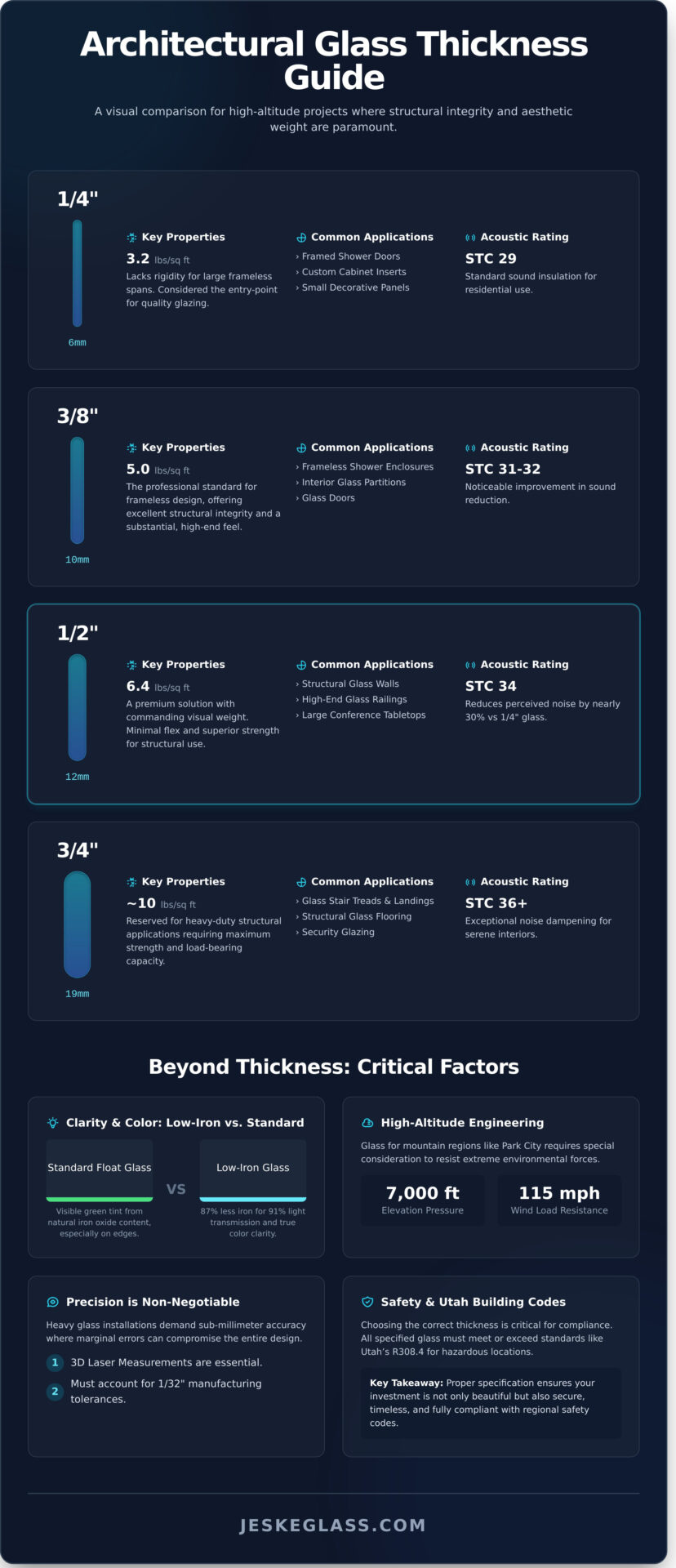
Structural integrity in custom glazing begins with a precise calculation of density. In the context of Park City architecture, glass isn’t merely a filler for a frame; it’s a load-bearing element that defines the silhouette of a residence. This glass thickness guide focuses on the transition from the 1/8 inch (3mm) panes found in 1970s residential windows to the 1/2 inch (12mm) heavy Architectural glass utilized in contemporary alpine designs. Choosing the correct thickness ensures the glass can withstand both internal pressures and external environmental stressors without compromising the visual intent of the architect.
Aesthetics are inextricably linked to the physical volume of the material. As thickness increases, the natural iron oxide content in standard float glass becomes more apparent, manifesting as a distinct green tint along the edges. In a 1/2 inch pane, this hue can shift the perceived color of interior walls. To maintain 91 percent light transmission and absolute clarity, premium projects often utilize low-iron glass. This specialized material reduces iron content by approximately 87 percent, allowing the high-altitude light of the Wasatch Mountains to permeate the space without distortion.
Park City’s unique geography requires specific engineering considerations. At an elevation of 7,000 feet, atmospheric pressure differs significantly from sea-level manufacturing sites. If a glass unit’s density isn’t calibrated for these conditions, the panes can bow or even burst. Furthermore, local building codes often account for wind loads reaching 115 mph in exposed canyon areas. This necessitates a glass thickness guide that prioritizes structural rigidity to prevent deflection during winter storms. Thick glass provides the necessary mass to resist these forces while serving as a thermal barrier against sub-zero temperatures.
Common Glass Thickness Measurements in the US
Precision in the glass industry requires moving between fractional inches and millimeters. While a project might specify 1/4 inch glass, the manufacturing reality is often a nominal thickness of 6mm (0.236 inches). This 0.014-inch discrepancy is critical when designing custom metal channels or gaskets. Standard residential applications range from 1/8 inch (3mm) for decorative inserts to 3/4 inch (19mm) for structural glass stairs. Understanding the 1/32 inch manufacturing tolerance is essential for a seamless installation.
The Relationship Between Thickness, Weight, and Support
Mass is the direct byproduct of thickness. Glass weighs approximately 1.6 pounds per square foot for every 1/8 inch of thickness. Consequently, a 1/2 inch glass panel weighs 6.4 pounds per square foot. A standard 8-foot tall shower door can easily exceed 170 pounds, requiring specialized heavy-duty hardware and reinforced structural blocking. Beyond physical support, thickness is the primary driver of acoustic insulation. Increasing glass from 1/4 inch to 1/2 inch improves the Sound Transmission Class (STC) rating from 29 to 34, which reduces perceived exterior noise by nearly 30 percent, creating a serene interior sanctuary.
A Comparative Analysis: From 1/4″ to 3/4″ Glass Applications
Selecting the appropriate material for an architectural project requires a balance between structural necessity and visual weight. This glass thickness guide serves as a technical foundation for understanding how different specifications perform under real-world conditions. Glass is not a static element; it’s a structural component that must resist wind loads, impact, and gravitational stress while maintaining absolute clarity.
The 1/4″ (6mm) thickness represents the entry point for residential glazing. At approximately 3.2 pounds per square foot, this glass lacks the inherent rigidity for large-scale frameless applications. It finds its purpose in framed shower doors or custom cabinet inserts where the surrounding metal or wood provides the required support. Moving up to 3/8″ (10mm) introduces a professional-grade feel. This thickness weighs roughly 5.0 pounds per square foot and offers the structural integrity needed for most modern interior partitions without requiring heavy perimeter framing.
For projects demanding a higher level of architectural presence, 1/2″ (12mm) glass provides a premium solution. It’s the standard for structural glass walls and high-end railings, offering a significant reduction in vibration and flex. At the peak of the spectrum, 3/4″ (19mm) glass is reserved for heavy-duty applications. Weighing nearly 10 pounds per square foot, it’s utilized for glass flooring or expansive dining surfaces where the edge profile itself becomes a dominant design feature. When specifying these materials, architects in Utah and across the nation often consult the International Building Code (IBC) to ensure compliance with safety standards regarding hazardous locations and load-bearing requirements.
Selecting the Right Spec for Custom Showers
In Utah’s luxury bathroom market, 3/8″ glass has emerged as the definitive “sweet spot” for 90% of frameless installations. It provides a substantial, high-quality feel during operation without placing excessive strain on the wall structures. However, when a design calls for a door exceeding 30 inches in width or 84 inches in height, upgrading to 1/2″ glass becomes a functional necessity. This extra 28% in thickness minimizes the “whip” or flex of the panel during closing. It’s essential to pair 1/2″ panels with heavy-duty solid brass hinges; standard hinges may experience premature pivot wear or sagging within 24 months due to the increased weight. You can explore our custom shower gallery to see how these different thicknesses influence the final aesthetic of a spa-like retreat.
The Standard for Glass Railings and Partitions
Structural integrity is paramount in open-space design. For base-shoe railing systems, 1/2″ tempered glass is the industry baseline to meet the 200-pound concentrated load requirement. While 3/8″ glass might appear sufficient for a partition, it can deflect up to 2 inches under moderate pressure in a freestanding environment. The 1/2″ specification reduces this deflection by nearly 50%, providing a sense of permanence and safety. Thickness also dictates hardware selection; standoff pins for 1/2″ glass require 3/4″ diameter holes and specialized gaskets to ensure the pressure is distributed evenly across the surface. This precision ensures the glass remains a transparent, yet immovable, boundary within the architectural volume.
- 1/4″ (6mm): Best for lightweight cabinet inserts and fully framed enclosures.
- 3/8″ (10mm): The ideal standard for 85% of frameless shower projects.
- 1/2″ (12mm): Required for structural railings and oversized glass doors.
- 3/4″ (19mm): Reserved for glass floors, stairs, and luxury furniture.
Using this glass thickness guide allows designers to match the material’s physical properties to the project’s specific mechanical demands. Every millimeter added to the profile increases the glass’s ability to dampen sound and resist thermal stress, contributing to the longevity of the installation. Precision in these measurements isn’t just a matter of code; it’s the difference between a temporary fixture and a timeless architectural element.
Application-Specific Thickness: Showers, Railings, and Mirrors
Architectural glass serves as more than a mere barrier; it’s a structural statement of permanence and intent. In the high-altitude environments of Park City, where temperature fluctuations and structural settling are common, selecting the correct specification from a glass thickness guide is a matter of both engineering and aesthetics. Visual weight plays a silent but powerful role in luxury design. A 12mm glass panel doesn’t just provide safety; it communicates a sense of stability and premium quality that thinner alternatives lack. Custom residences in Salt Lake County frequently require non-standard thicknesses to account for expansive spans and unique wind load requirements at elevations exceeding 6,000 feet.
Every room presents a different set of functional demands. A bathroom requires moisture resistance and tactile stability, while a living area demands maximum transparency and structural safety. Balancing these needs requires a deep understanding of how glass behaves under stress. When we design for open-concept homes, we often utilize thicker glass to eliminate the need for bulky hardware, allowing the architecture itself to remain the focal point. This approach ensures that the glass remains a “invisible” yet rigid component of the home’s structural fabric.
Frameless Glass Showers: 3/8″ vs. 1/2″
The choice between 10mm (3/8″) and 12mm (1/2″) glass often defines the entire bathroom atmosphere. While 3/8″ glass is a standard for many, 1/2″ glass offers a 25% increase in mass that virtually eliminates vibration when the door swings shut. This additional weight allows for headerless configurations in custom walk-in showers, maintaining a minimalist profile without the need for top-support bars. For handmade custom grid showers in Draper and Lehi, the 1/2″ specification provides the necessary rigidity to support heavy industrial frames. This thickness ensures the door feels substantial and expensive every time it’s used, reflecting the quality of the surrounding stonework.
Glass Railings: Safety Meets the Park City View
Preserving an unobstructed view of the Wasatch Range requires a delicate balance of transparency and strength. For external decks, we prioritize 9/16″ or 13/16″ laminated glass over monolithic options. Laminated glass consists of two layers bonded by a 1.52mm SentryGlas interlayer, ensuring the panel remains upright even if an impact occurs. Achieving a perfect fit in modern mountain homes involves 3D laser measuring tools that capture site dimensions within 0.5mm of accuracy. This precision ensures that 15mm thick glass panels slide into recessed base shoes with zero friction, creating a seamless transition from the interior to the alpine landscape. This specific glass thickness guide approach prevents the “rattle” often felt in lower-quality railing installations.
Custom Mirrors and Interior Partitions
Standard mirrors often rely on 1/4″ glass, yet large-scale gym walls or grand entryways demand the 3/8″ premium standard. When a mirror exceeds 48 inches in width or height, thinner glass tends to flex, creating a “funhouse” distortion that ruins the visual depth of a room. Thick 3/8″ mirrors stay perfectly flat, providing a crisp, true reflection across massive surfaces. For interior partitions, 1/2″ glass is the superior choice for acoustic insulation. These heavy panels effectively dampen sound by approximately 36 decibels, making them ideal for private home offices. They create a quiet workspace that remains visually connected to the rest of the house, using mass to block noise where thinner glass would fail.
Choosing the right thickness is a technical decision that impacts the daily experience of a home. Whether it’s the solid thud of a 1/2″ shower door or the crystal-clear reflection of a 3/8″ mirror, the specifications we choose define the longevity and luxury of the space. We look at each project in Salt Lake County as a unique engineering challenge, ensuring the glass is thick enough to be safe, yet refined enough to be beautiful.
Beyond Thickness: Safety Standards and Utah Building Codes
Selecting the proper dimensions involves more than just aesthetics; it’s a matter of legal compliance and structural integrity. A common error among property owners is assuming that increased mass inherently equals safety. While a comprehensive glass thickness guide provides the baseline for structural stability, it cannot replace the essential safety treatments required by Utah law. Standard annealed glass, regardless of its thickness, breaks into large, razor-sharp shards. In contrast, safety glass must undergo specific thermal or lamination processes to meet the CPSC 16 CFR 1201 standards. Every architectural pane installed in a high-risk zone must carry a permanent ‘Safety Glazing’ stamp, typically etched into a corner. This mark confirms the glass has been tested to withstand specific impact energies without creating life-threatening fragments.
The Utah State Legislature adopts the International Building Code (IBC), which mandates specific glazing protocols for residential and commercial structures. These regulations are particularly stringent in areas where human impact is likely. For instance, any glass panel within 24 inches of a door or located less than 18 inches above the floor must be tempered. Relying solely on a 12mm thickness without the proper tempering process fails to meet these legal requirements and creates a significant liability for the property owner.
Tempered vs. Annealed Glass in Residential Projects
In Utah residential architecture, the distinction between annealed and tempered glass is non-negotiable for specific ‘hazardous locations.’ All shower enclosures and glass railings must utilize tempered glass to comply with the IBC 2021 standards. The heat-strengthening process involves heating the glass to approximately 1,200 degrees Fahrenheit and then rapidly cooling it. This creates a state of high compression on the surface and tension in the core. It results in a pane four to five times stronger than standard glass. When it breaks, it disintegrates into small, relatively harmless granules rather than jagged spears. This transformation is vital for wet areas where slip-and-fall risks are elevated.
Structural Requirements for Park City Deck Railings
Projects in Park City demand a higher level of engineering due to the extreme environmental variables at 7,000 feet elevation. Wind loads in Summit County often reach speeds of 115 miles per hour, exerting immense lateral pressure on external glass barriers. A glass thickness guide for mountain environments must account for these forces alongside the 200lb concentrated load requirement. This means a railing must withstand a 200-pound force applied at any point along the top rail without failing. At these altitudes, snow load pressures also become a factor; heavy snow resting against a glass balustrade can cause structural failure if the glass isn’t precisely specified for the local climate.
- Wind Load: Must accommodate 115+ mph gusts in high-altitude zones.
- Concentrated Load: 200lb force resistance required for all residential railings.
- Safety Certification: Mandatory CPSC 16 CFR 1201 etching on all panels.
- Elevation Impact: Pressure-equalized units are often necessary to prevent bowing at 7,000+ feet.
Architectural excellence is found at the intersection of visual transparency and uncompromising safety. Don’t leave your project’s compliance to chance. You can consult with the experts at Jeske Glass to ensure your selection meets every Utah building code and environmental requirement.
Precision Engineering: Why Measurements Matter More Than Specs
Selecting the correct width from a glass thickness guide is only the first step in a successful architectural project. Structural integrity depends on the physical reality of the site rather than the theoretical numbers on a blueprint. A 1/2 inch glass panel weighs approximately 6.4 pounds per square foot. It possesses zero flexibility. If a wall leans by even 0.5 degrees, a standard rectangular cut will fail. We don’t guess. We measure with mathematical certainty to ensure the glass performs as an architectural anchor rather than a liability. Consulting a glass thickness guide provides the technical foundation, but execution requires a master’s touch.
The Jeske 3D Laser Advantage
Our team utilizes 3D laser scanning technology that captures spatial data with 0.5mm accuracy. This digital templating process identifies every out-of-plumb wall and uneven floor surface before fabrication begins. For projects involving 3/4 inch glass, these tight tolerances are non-negotiable. By creating a digital twin of your space, we reduce installation friction by 40 percent and eliminate the need for on-site adjustments that compromise edge quality. It’s the difference between a generic fit and a bespoke architectural integration that looks like it grew out of the structure itself.
Professional fabrication transforms raw material into a design statement. Thick glass requires specialized CNC polishing to achieve a brilliant edge finish that remains clear for decades. When glass reaches thicknesses of 1/2 inch or more, the edge becomes a visible design element. We treat these edges with the same reverence a jeweler treats a gemstone. Our shop uses multi-stage polishing wheels to ensure every linear inch is free of micro-fractures or cloudiness. This level of detail isn’t just about looks; it’s about the long-term structural health of the pane.
A 1/16 inch discrepancy might seem negligible on paper. In the world of heavy glass, it’s catastrophic. When a 1/2 inch panel meets a marble curb, that tiny gap becomes a focal point for failure. It causes hinges to bind. It makes seals leak. It ruins the clean lines of a minimalist bathroom or glass railing. We eliminate these risks by merging high-tech measurement with old-world craftsmanship. Expert installation is the final, most critical stage. We treat every 400-pound panel with the delicacy of a timepiece, ensuring the load is distributed exactly as the engineers intended.
Investing in Quality: The Long-Term Value of Proper Specs
Choosing premium thickness increases property value in the Utah luxury market, specifically in high-altitude environments like Park City where structural demands are unique. Data from 2023 luxury home sales suggests that custom glass features with 1/2 inch or 3/4 inch profiles contribute to a higher perceived build quality. Thicker glass resists vibration and stands the test of time better than thinner alternatives. It provides a tactile sense of permanence that defines modern mountain architecture. The weight of the door and the silence of the seal tell a story of quality that guests notice immediately.
This principle of investing in substantial, master-crafted elements extends beyond glazing. In European design, for example, the integration of custom-built fireplaces and tiled stoves serves a similar role, becoming the architectural and thermal heart of a luxury home. For those interested in this level of bespoke craftsmanship, the work of specialists like HrejiciKrby kamnářství kominictví showcases how traditional techniques can be applied to modern, high-end residential projects, offering inspiration for similar features that add timeless value.
Maintenance and durability are the hidden benefits of going thicker. A 3/4 inch glass partition is nearly impossible to chip or crack under normal residential use. It handles the thermal expansion and contraction common in the Wasatch Range without stressing the mounting hardware. You aren’t just buying a piece of glass; you’re investing in a permanent fixture of your home’s envelope. To ensure your vision meets these exacting standards, request a free custom estimate for your Park City project.
Defining the Future of Your Park City Architectural Vision
Selecting the ideal glass specification isn’t just a technical necessity; it’s a commitment to the structural and aesthetic longevity of your home. This glass thickness guide highlights that whether you’re installing a 1/2 inch frameless shower or 3/4 inch structural railings, every millimeter impacts the transparency and safety of your living space. Utah building codes for 2026 demand rigorous adherence to these standards to ensure your architectural investment withstands the unique alpine environment of Park City. We understand that premium design requires more than just meeting a minimum spec.
Jeske Glass brings a combined 70+ years of local Utah glass expertise to every high-end residential project. We don’t rely on guesswork or outdated manual tools. Our specialists utilize advanced 3D Laser Measuring to guarantee a perfect fit that aligns with the most demanding engineering requirements. We’ve spent decades refining our craft in exclusive Salt Lake City and Park City estates, transforming complex architectural challenges into timeless glass features. Elevate your space with a custom glass consultation from Jeske Glass and watch your vision come to life with unmatched clarity. Your home deserves the enduring elegance that only master craftsmanship and technical precision can provide.
Frequently Asked Questions
Is 1/2 inch glass better than 3/8 inch for a frameless shower?
1/2 inch glass provides a more substantial, premium feel and increased structural stability compared to 3/8 inch glass. While 3/8 inch (10mm) is the industry standard for frameless showers, the 1/2 inch (12mm) option reduces vibration when the door closes. It weighs 6.4 pounds per square foot, creating a sense of permanence that 4.8 pound 3/8 inch glass can’t match. This choice defines the architectural weight of a high-end bathroom.
What is the minimum glass thickness required for a railing in Utah?
Utah building codes, following the 2021 International Building Code (IBC) Section 2407, require a minimum thickness of 1/2 inch for monolithic tempered glass or 9/16 inch for laminated safety glass in railing systems. These installations must withstand a concentrated load of 200 pounds applied to the top rail. Our engineering team ensures every project meets these 2021 standards to guarantee both transparency and absolute structural safety in residential or commercial spaces.
Does thicker glass have a stronger green tint?
Thicker glass displays a more pronounced green hue on its edges because of the natural iron oxide present in standard clear glass. This tint becomes 25% more visible when you increase thickness from 1/4 inch to 1/2 inch. For projects where color neutrality is vital, we recommend low-iron glass. It removes 90% of the iron particles to maintain crystal clarity regardless of the dimensions specified in your glass thickness guide.
Can my existing walls support the weight of 1/2 inch glass?
Most standard walls require additional structural blocking, such as doubled 2×4 studs, to support the 6.4 pounds per square foot weight of 1/2 inch glass. A typical 30 by 80 inch shower door weighs approximately 106 pounds. You’ll need to secure the hinges directly into solid wood rather than just drywall or tile. This ensures the heavy architectural element remains stable and safe for decades of daily use.
What thickness is standard for a custom bathroom mirror?
1/4 inch (6mm) is the professional standard for custom bathroom mirrors because it offers the ideal balance of reflection quality and durability. Thinner 1/8 inch glass often distorts the image, creating a “funhouse” effect over larger surface areas. By using 1/4 inch silvered glass, we ensure a perfectly flat, distortion-free reflection that aligns with the high aesthetic standards of modern interior design and luxury renovations.
Why is tempered glass required for certain thicknesses and applications?
Tempered glass is mandatory for safety in areas like showers and doors because it’s 4 times stronger than standard annealed glass. Under the CPSC 16 CFR 1201 federal safety standard, glass in “hazardous locations” must break into small, blunt granules rather than sharp shards. This thermal strengthening process is essential for any thickness used in high-traffic zones, ensuring the structural glass provides both elegance and protection for inhabitants.
How much does the price increase when moving from 3/8″ to 1/2″ glass?
Moving from 3/8 inch to 1/2 inch glass typically results in a 15% to 30% increase in total project costs. This price adjustment reflects the 33% increase in raw material weight and the specialized heavy-duty hardware required to support the additional load. While the investment is higher, the enhanced rigidity and premium aesthetic often justify the 25% average material surcharge for clients seeking an uncompromising architectural finish.
Does glass thickness affect the soundproofing of a room?
Increasing glass thickness directly improves acoustic insulation by providing more mass to dampen sound vibrations. For example, 1/2 inch glass typically achieves a Sound Transmission Class (STC) rating of 36, while 1/4 inch glass only reaches a rating of 31. This 5-point difference is significant in reducing ambient noise. Consulting a glass thickness guide helps you select the correct density to create a serene, quiet environment within busy urban settings.