

Navigating Park City’s Glass Railing Code Requirements: A 2025 Guide
In Park City, where breathtaking vistas demand architectural transparency, the creation of a seamless glass railing is an exercise in precision. This pursuit of unobstructed beauty, however, is often shadowed by the complexities of local building ordinances. Navigating the specific glass railing code requirements Park City enforces-from load-bearing capacities under heavy snow to safety glazing standards at high altitude-can feel like a daunting task. The prospect of a failed inspection, resulting in costly delays and compromises to your design vision, is a significant concern for any discerning homeowner or builder seeking perfection.
This comprehensive 2025 guide is engineered to demystify the entire process. We provide a clear, authoritative exploration of these critical regulations, translating the technical language of the International Building Code (IBC) into actionable insights. Our purpose is to empower you with the knowledge to proceed with confidence, ensuring your project not only meets but exceeds every standard for safety and durability, culminating in a structure that is both impeccably compliant and an enduring statement of elegance.
Key Takeaways
- Recognize that all compliant glass railing projects in Park City must adhere to the specific standards outlined in the adopted 2021 International Building and Residential Codes.
- Master the critical height and spacing mandates for balconies, stairs, and decks to ensure your project successfully meets the glass railing code requirements Park City.
- Learn to distinguish between tempered and laminated safety glass, as selecting the correct engineered material is non-negotiable for both structural integrity and code compliance.
- Prepare the necessary documentation, from engineered hardware specifications to site plans, to navigate Park City’s permitting and inspection process with precision and efficiency.
Understanding the Governing Codes for Glass Railings in Park City
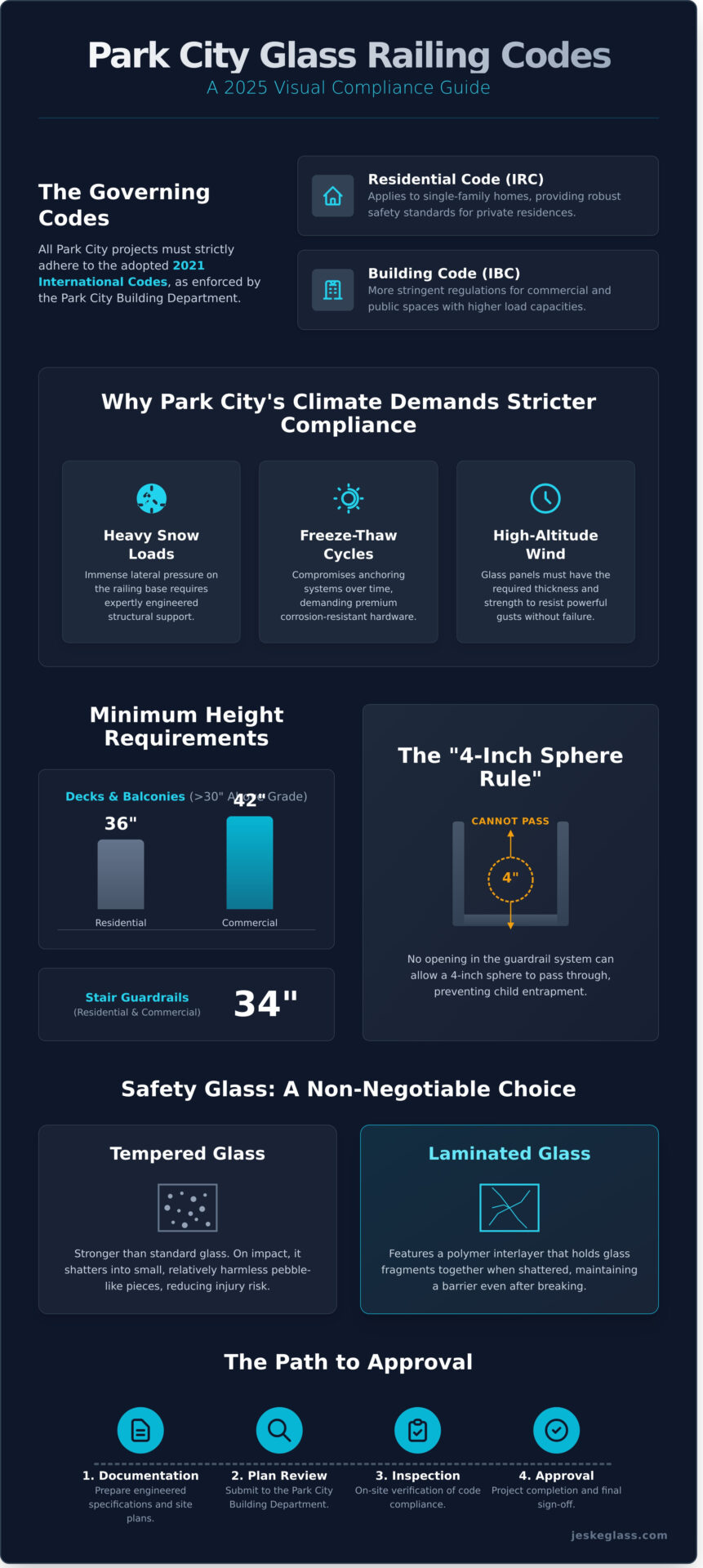
Navigating the landscape of building regulations is the first critical step in bringing an architectural vision to life. For glass railings in Park City, compliance is not merely a suggestion but a foundational requirement for safety, longevity, and structural integrity. The primary governing documents are the International Building Code (IBC) and the International Residential Code (IRC). Park City has officially adopted the 2021 versions of these codes, which serve as the definitive standard for all construction. The Park City Building Department is the local authority responsible for interpreting and enforcing these standards through plan reviews and on-site inspections, ensuring every installation meets their rigorous criteria. While general state-level advice can be a starting point, a deeper dive into the governing codes for glass railings reveals why localized requirements are paramount for uncompromised safety and performance.
Key Differences: Residential vs. Commercial Projects
The distinction between residential and commercial applications is a crucial factor in determining the applicable code. For single-family homes, the International Residential Code (IRC) provides the framework. These standards are robust, yet tailored for a private residential setting. In contrast, multi-family residences, hotels, restaurants, and public spaces fall under the more stringent International Building Code (IBC). The IBC mandates higher structural load capacities for guardrails to account for greater public use and occupancy, ensuring safety in high-traffic environments.
This holistic view of safety in commercial spaces often extends beyond structural integrity to include essential fire and security systems. For developers and property managers, understanding the full scope of compliance is key, and looking at how specialists such as Quartz Empire Fire & Security Ltd approach commercial projects can provide valuable insights into creating a secure environment.
Why Park City’s Climate Demands Stricter Compliance
The unique alpine environment of Park City introduces challenges that generic building codes may not fully address, making strict local compliance essential. The specific glass railing code requirements Park City enforces are a direct response to these environmental forces. An expertly engineered system must account for:
- Heavy Snow Loads: Significant snow accumulation on decks and balconies creates immense lateral pressure against the base of a railing system. The mounting and structural support must be engineered to withstand this force, which far exceeds standard load calculations.
- High-Altitude Wind Loads: Park City’s elevation exposes structures to powerful wind gusts. Glass panels, especially in frameless designs, must possess the required thickness and strength to resist these forces without failure or excessive deflection.
- Freeze-Thaw Cycles: The constant cycling between freezing and thawing temperatures can compromise anchoring systems. Moisture penetrating mounting points can expand when frozen, degrading the connection over time. This necessitates the use of premium, corrosion-resistant hardware and meticulous installation techniques to ensure enduring stability.
Critical Dimensions: Height and Spacing Requirements
In architectural glass design, precision is paramount. The success of a glass railing installation hinges not only on its aesthetic clarity but on its meticulous adherence to safety codes. Understanding the specific height and spacing rules is the first step toward achieving a design that is both visually stunning and structurally sound. These dimensions are non-negotiable, ensuring the prevention of falls and entrapment hazards.
The glass railing code requirements Park City enforces are based on model codes from the International Code Council (ICC). Here is a concise summary of the minimum height requirements for different applications:
| Application Location | Residential Minimum Height (IRC) | Commercial Minimum Height (IBC) |
|---|---|---|
| Decks, Balconies & Porches (over 30″ above grade) | 36 inches | 42 inches |
| Stair Guardrails (measured from stair nosing) | 34 inches | 34 inches |
Beyond height, the spacing within the railing system is critically regulated by the “4-inch sphere rule.” This standard dictates that no opening in the guardrail system-be it between glass panels, posts, or beneath the bottom rail-can be large enough for a 4-inch diameter sphere to pass through. This crucial requirement is designed to prevent small children from accidentally passing through the barrier. While these dimensions define the spatial boundaries of safety, the material itself must meet stringent standards. The International Code Council provides comprehensive guidelines on Glass Specification: Ensuring Strength and Safety, detailing the necessary thickness and tempering for glass panels to withstand required loads.
Guardrail Height for Decks and Balconies in Park City
For any elevated surface more than 30 inches above the ground, a guardrail is mandatory. In residential settings, such as a home deck or second-story balcony, the top of the glass railing must be at least 36 inches from the walking surface. For commercial properties, which anticipate higher foot traffic, the requirement increases to a minimum of 42 inches. This height is engineered to protect an average-sized adult from accidentally falling over the barrier, providing an uncompromising level of safety without sacrificing the view.
Stair Railing and Handrail Specifications
Stairways present unique requirements where guardrails and handrails serve distinct but related functions. The glass guardrail along a staircase must be a minimum of 34 inches high, measured vertically from the leading edge (nosing) of the stair treads. Furthermore, a separate, graspable handrail is required. This handrail must be continuous for the entire length of the flight of stairs and positioned between 34 and 38 inches above the stair nosings. For unimpeded grip, a minimum clearance of 1.5 inches must be maintained between the handrail and the wall or glass surface it is mounted to.
Glass Specification: Ensuring Strength and Safety
In a glass railing system, the glass itself is not merely an infill panel but a critical structural component. Its specification is therefore paramount to the safety, longevity, and legal compliance of your installation. The use of safety glazing is not an option but an absolute mandate under building codes. Understanding the material science behind the glass is fundamental to meeting the stringent glass railing code requirements Park City enforces for residential and commercial properties.
The selection of glass type, thickness, and engineering directly impacts the system’s ability to withstand environmental forces and human interaction, ensuring a barrier that is as strong as it is transparent.
Tempered vs. Laminated Glass: Which is Right for Your Project?
While both tempered and laminated glass are classified as safety glazing, they perform differently under stress. The optimal choice depends on the application and desired level of security.
- Tempered Glass: This glass undergoes a specialized heat-treating and rapid cooling process that makes it four to five times stronger than standard glass. Its defining safety feature is its fracture pattern; upon a significant impact, it shatters into small, pebble-like pieces, minimizing the risk of serious injury.
- Laminated Glass: Comprised of two or more layers of glass bonded together by a durable interlayer (typically PVB or SGP), laminated glass offers a higher level of protection. When it breaks, the glass fragments adhere to the interlayer, maintaining a continuous barrier and preventing fall-through.
For the ultimate synthesis of strength and post-breakage safety, Jeske Glass frequently recommends laminated tempered glass, a premium solution that combines the superior strength of tempered glass with the barrier-retention properties of laminated glass.
Load Requirements: Resisting Wind, Snow, and Impact
A railing’s primary function is to resist force. The International Building Code (IBC) specifies two critical load types that all guardrails must withstand: a uniform load of 50 pounds per square foot (psf) and a concentrated load of 200 pounds. In real-world terms, this means your railing must safely resist the sustained pressure of heavy snow accumulation and wind gusts, as well as the immediate force of a person leaning or falling against it.
At Jeske Glass, our systems are meticulously engineered to exceed these baseline requirements, a crucial factor in Park City’s demanding alpine climate. This is especially vital for frameless designs, where each glass panel must independently bear these loads without a traditional frame. Adhering to these structural benchmarks is a non-negotiable aspect of the glass railing code requirements Park City officials will verify. Ensuring your project meets these exacting standards requires expert analysis. Get a free consultation for your code-compliant project.
Hardware & Mounting Systems: The Foundation of Compliance
A glass railing’s breathtaking transparency is only possible due to the structural integrity of its hardware. These components are not merely decorative; they are the critical connection points that absorb and distribute forces, ensuring the system performs safely under load. The selection and installation of mounting hardware are paramount, as any failure here compromises the entire guardrail and its ability to protect.
Every clamp, standoff, and base shoe must be specifically engineered and rigorously tested for guardrail applications. This is a non-negotiable aspect of meeting the glass railing code requirements Park City has in place. For durability against the region’s demanding freeze-thaw cycles and moisture, we exclusively utilize materials like 316 marine-grade stainless steel, which offers superior corrosion resistance and enduring strength. Common mounting systems include:
- Base Shoe: A continuous structural channel that supports the glass from the bottom, offering a seamless and robust foundation for an uninterrupted view.
- Clamps: Individual components that grip the glass at the bottom or side, providing a secure yet minimalist attachment.
- Spigots: Small, elegant posts that elevate the glass from the mounting surface, creating a distinctive floating effect.
- Standoffs: Cylindrical fittings that mount the glass panels to the side of a deck or staircase, maximizing usable floor space and creating a bold architectural statement.
Securing the Base: Anchoring for Maximum Stability
Proper anchoring is the bedrock of a safe installation. The method must be tailored to the substrate-be it concrete, steel, or wood framing. Simply fastening a railing to a deck’s surface boards is insufficient and dangerous. We insist on anchoring directly into structural joists or installing dedicated blocking to create an unyielding attachment point. Our advanced 3D laser measurement process, a hallmark of the precision detailed at jeskeglass.com, ensures every anchor point is mapped for perfect alignment and maximum structural engagement.
The Debate on Top Rails and Handrails
A frequent question concerns the necessity of a top rail. Generally, building codes require a top cap or rail on monolithic tempered glass panels to protect the vulnerable top edge and help panels act in unison. However, an important exception exists: when using laminated tempered glass, the structural interlayer provides residual strength if one pane breaks. This often eliminates the need for a top rail, allowing for the purest frameless aesthetic while still satisfying safety standards. On stairways, a separate, graspable handrail is almost always required for safe passage, a distinct component from any structural top cap.
The Park City Permitting and Inspection Process Explained
Navigating the municipal building permit and inspection process is a critical final step in realizing your architectural vision. This structured oversight ensures your installation is not only visually stunning but also unequivocally safe and compliant with local regulations. While it may seem complex, understanding the key stages demystifies the process and underscores the value of professional partnership.
A successful project begins with a meticulously prepared application. The Park City Building Department requires more than a simple sketch; they demand a comprehensive submission that demonstrates a complete understanding of the structural and safety implications of your design. This is where precision and experience become paramount.
Preparing Your Permit Application
Your permit application must provide undeniable proof of compliance. This is achieved through detailed documentation that leaves no room for ambiguity. At Jeske Glass, we manage this entire process, providing a submission package that demonstrates full adherence to the glass railing code requirements Park City has established. Key documents typically include:
- Detailed Shop Drawings: These architectural plans illustrate elevations, dimensions, and the precise placement of the railing system.
- Structural Engineering Calculations: A licensed engineer must verify that the system, including its anchoring and components, can withstand all required structural loads.
- Material Specifications: Every component must be identified, from the type and thickness of the safety glass (e.g., ½” tempered) to the manufacturer and model number of all hardware, fasteners, and mounting brackets.
Passing the Final Inspection
Once the installation is complete, a city inspector will conduct a final on-site review. This is not a cursory glance; it is a thorough verification of the approved plans. The inspector will focus on critical safety elements, checking for secure mounting, proper hardware installation, and overall structural integrity. They will physically measure guardrail heights and baluster spacing and will look for the permanent safety glazing stamp on each glass panel. It is crucial to only schedule this inspection when the work is 100% finished, as any incomplete items will result in a failed inspection and project delays. This final approval is the official confirmation that your railing is as safe as it is beautiful.
Navigating these final steps requires precision and deep familiarity with local protocols. Let us handle the complexities of your Park City glass project.
Transforming Vision into Compliant Architectural Reality
Successfully navigating the intricate glass railing code requirements Park City demands a meticulous approach that balances aesthetic ambition with uncompromising safety. As we’ve explored, from specifying the correct tempered or laminated glass to adhering to critical height, spacing, and mounting standards, every detail is foundational to a successful inspection and final approval. Achieving this harmony of transparency, strength, and compliance is the hallmark of a masterfully executed architectural vision.
This is where deep, localized expertise becomes indispensable. With over 70 years of combined experience in Utah, Jeske Glass possesses an unparalleled understanding of these local nuances. Our expertise in Park City’s unique building codes and challenging climate, combined with advanced 3D laser measuring for perfect, compliant fits, ensures your project transcends mere regulation to become a statement of enduring quality and precision.
Allow us to be your expert partner in this process. Request Your Free, Code-Compliant Glass Railing Estimate for Park City Today and take the first step toward realizing your vision with confidence and clarity.
Frequently Asked Questions About Park City Glass Railing Codes
Do I need a top rail or cap on my frameless glass railing in Park City?
The necessity of a top rail on a frameless glass railing is determined by the glass specification. Systems using laminated tempered glass, where two panes are bonded for superior strength, may not require a top rail if the edges are polished. However, single-pane tempered glass installations almost universally mandate a top cap or handrail to provide structural support and interlink the panels, ensuring the system’s integrity and safety in compliance with local building codes.
What is the minimum required thickness for glass used in deck railings?
The minimum glass thickness for deck railings in Park City is dictated by the specific system and engineering requirements, but it is typically no less than 3/8-inch (10mm) tempered safety glass. For larger panels or systems with minimal hardware, such as base shoe installations, 1/2-inch (12mm) tempered glass is often specified to guarantee the necessary strength and deflection resistance. An engineering review is essential to confirm the precise thickness for your project’s unique structural demands.
Can I install a glass railing myself or do I need a licensed contractor in Summit County?
While a DIY installation may seem feasible, it is strongly discouraged due to the precision and structural knowledge required. Summit County building permits and inspections necessitate that the railing meets stringent safety standards. Engaging a licensed and insured contractor specializing in glass systems is the most prudent approach. This ensures the installation is not only aesthetically flawless but also structurally sound, fully compliant with local codes, and safely anchored for long-term performance.
Are there specific code requirements for glass railings around pools in Park City?
Yes, the glass railing code requirements Park City enforces for pool enclosures are particularly stringent. These barriers must meet specific safety protocols, including a minimum height of 48 inches and non-climbable surfaces to prevent unsupervised access. Furthermore, any gates integrated into the glass system must be self-closing and self-latching, with the latch mechanism placed at a specified height. These regulations provide an elegant safety barrier without compromising on critical life-safety standards.
How do I know if my existing deck structure can support a glass railing system?
A professional structural assessment is imperative before installation. Glass railing systems are substantially heavier than traditional alternatives and exert significant lateral forces on their mounting points. A qualified contractor or structural engineer must evaluate your deck’s framing, joists, and ledger board connections to confirm they possess the necessary load-bearing capacity. This critical step ensures the long-term safety and stability of both your deck and the new, elegant glass railing system.
What happens if my glass railing fails a building inspection in Park City?
If a glass railing fails a Park City building inspection, the building department will issue a correction notice outlining the specific code violations. The homeowner is then responsible for rectifying these deficiencies, which could involve costly modifications or even a complete replacement of the system. A re-inspection is required to verify compliance before final approval is granted. This underscores the importance of engaging professionals who understand all local requirements from the project’s inception.