Your Park City home was designed to embrace the majestic Wasatch vistas, yet conventional railings often erect unintended visual barriers, compromising the very connection to nature you cherish. For discerning homeowners, the challenge is twofold: achieving architectural purity without sacrificing structural integrity or the anxiety of ensuring absolute safety. The solution lies in a seamless integration of transparency and strength, a philosophy perfectly embodied by the modern interior glass railing Park City residences demand to become true mountain modern masterpieces.
This definitive 2026 guide illuminates the intersection of luxury design and precision engineering. We invite you to discover how state-of-the-art 3D laser technology ensures a flawless, custom fit within the most complex mountain architecture. You will learn how bespoke craftsmanship transforms structural glass into a timeless, secure feature that floods your interiors with natural light, provides uninterrupted panoramic views, and adheres rigorously to all Summit County safety regulations. Prepare to redefine the boundaries between your living space and the alpine landscape.
Key Takeaways
- Discover how to leverage specific glass railing systems to amplify natural light and frame alpine views, embodying Park City’s “Mountain Modern” design ethos.
- Learn why 3D laser scanning is the definitive method for 2026 projects, guaranteeing a flawless, gap-free fit that manual measurements cannot replicate.
- Understand the crucial differences between frameless, standoff, and talon mounting systems to make an informed decision that aligns with your architectural vision.
- Navigate local building codes to ensure your interior glass railing Park City project meets Summit County’s specific safety and handrail requirements for full compliance.
Elevating Park City Interiors with Custom Glass Railings
In Park City, where architecture is a dialogue between the structure and the sublime landscape, interior design elements must honor that connection. Traditional wood or iron railings, with their inherent visual weight, can create barriers that interrupt this conversation. The evolution of glass from a commercial utility to a staple of residential luxury offers a sophisticated, modern alternative. Advancements in material science, as covered in this Architectural Glass Overview, have unlocked new possibilities for safety and design, allowing transparency to become a core structural component within the home.
The Mountain Modern Aesthetic
Mountain Modern design is a sophisticated balance of organic, rustic materials and minimalist, clean lines. An interior glass railing Park City residence doesn’t just fit this aesthetic; it elevates it. Where heavy timber or ornate iron creates division, glass fosters unity, acting as a transparent bridge between warm wood beams and sleek steel finishes. In expansive great rooms, a frameless glass railing for a staircase or loft creates a stunning “floating” effect, preserving architectural volume and enhancing the sense of open, uninterrupted space.
Maximizing Park City Views
For a luxury ski-in/ski-out property, the view is a primary asset. Every design choice must serve to enhance, not obstruct, the connection to the alpine surroundings. This is where the functional elegance of glass becomes indispensable. By eliminating the visual clutter of traditional balusters, glass railing systems maintain pristine sightlines from every angle. For ultimate fidelity, we specify low-iron glass, which removes the subtle green tint of standard panels, ensuring the vibrant whites and deep blues of the Wasatch Range are rendered with absolute clarity. The transformation is profound: a once-dim mountain cabin becomes a light-filled sanctuary where the barrier between inside and out seems to dissolve.
The Engineering of Transparency: 3D Laser Precision
An exceptional interior glass railing appears effortless, a seamless plane of light and air. This aesthetic purity, however, is born from profound engineering and an intolerance for imprecision. Traditional manual measurements, while once standard, often fail to capture the subtle imperfections of a structure-the slight bow in a wall or the gentle slope of a floor. In Park City’s mountain homes, where structures naturally settle over time, these minute discrepancies can result in visible gaps, misaligned panels, and a compromised installation.
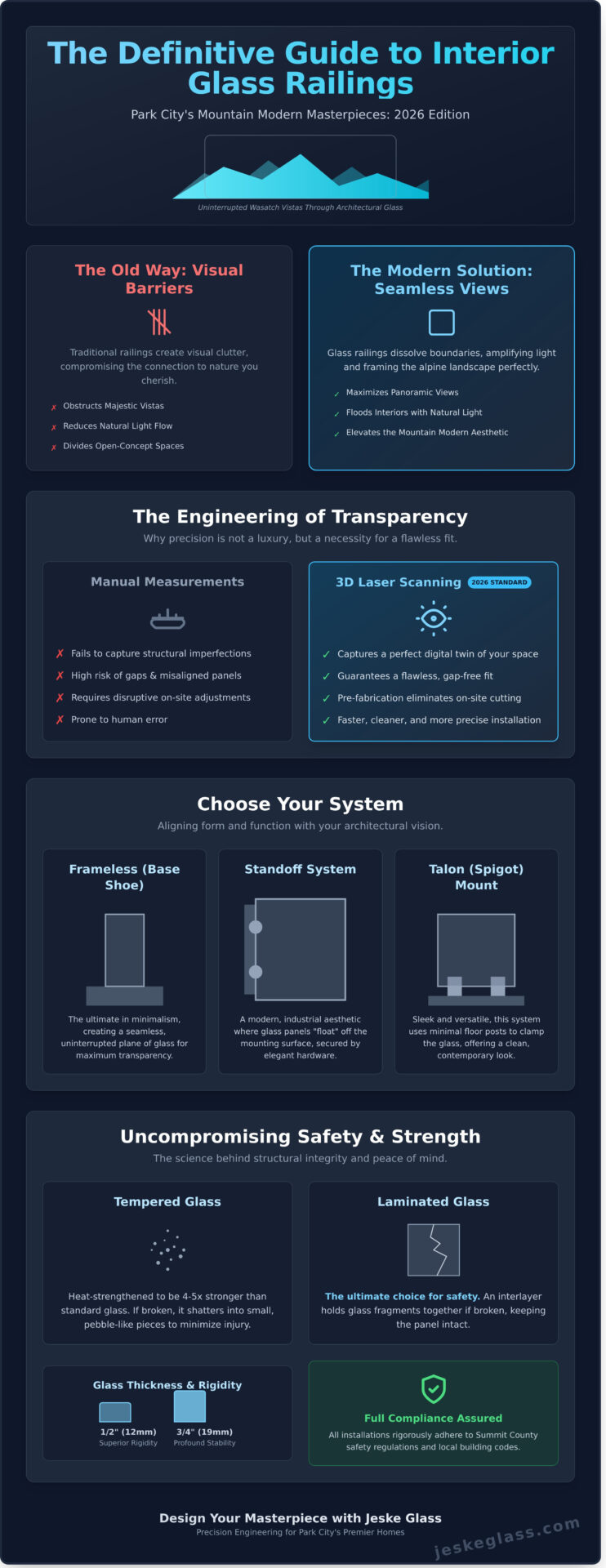
At Jeske Glass, we have eliminated this margin of error. Beginning with our 2026 projects, we are integrating 3D laser scanning technology, a revolutionary approach that guarantees a flawless fit by creating a perfect digital twin of your space. This digital templating is not merely a measurement; it is a complete structural analysis that ensures your custom interior glass railing Park City project is fabricated to the most exacting tolerances imaginable.
3D Laser Measuring: A Perfect Fit Guaranteed
Our process begins with a non-intrusive 3D laser scan of your staircase, loft, or balcony. This device captures millions of data points, mapping every surface and angle with millimetric accuracy. This data is then used to create a precise 3D model, allowing our engineers to pre-fabricate each glass panel to perfection, especially for complex architectural curves. This digital-first approach virtually eliminates the need for disruptive on-site cutting, ensuring a faster, cleaner installation.
Advanced Glass Science for Safety
The structural integrity of a glass railing is paramount, defined by the type, thickness, and treatment of the glass itself. We work exclusively with two types of architectural safety glass:
- Tempered Glass: Heat-strengthened to be four to five times stronger than standard glass, it shatters into small, pebble-like pieces if broken, minimizing injury risk.
- Laminated Glass: Consists of two or more glass lites bonded by a durable interlayer. If it breaks, the fragments adhere to the interlayer, keeping the panel intact. This is the ultimate choice for safety and is often required for frameless systems.
The choice between 1/2″ and 3/4″ thickness directly influences the railing’s structural feel, with thicker panels offering superior rigidity and a profound sense of stability. Adhering to the industry’s best Glass Handrail Design Practices, we also recommend heat-soaking for high-altitude applications. This process identifies and eliminates panels with nickel sulfide inclusions, a primary cause of spontaneous breakage, ensuring your installation remains timeless and secure.
Choosing Your System: Frameless, Standoff, and Talon Railings
The selection of a mounting system is a foundational decision in the design of an interior glass railing, dictating both its aesthetic presence and structural integration. This choice represents a critical intersection of architectural vision and engineering precision. For 2026, three primary systems dominate the landscape for luxury residential applications: the minimalist frameless base shoe, the industrial-chic standoff mount, and the versatile Talon spigot. Each offers a distinct visual language, fundamentally shaping how your interior glass railing Park City home achieves its goals of openness, light, and flow.
Frameless Base Shoe Systems
For the purest expression of architectural glass, the frameless base shoe system offers an unparalleled “invisible” look. The structural support-a robust metal channel or “shoe”-is recessed into the subfloor, creating the illusion of glass panels emerging seamlessly from the finished floor. This method is ideal for mezzanine levels, balconies, and loft overlooks where the primary objective is to preserve panoramic views without any visual obstruction. While its minimalist appeal is undeniable, households with high traffic should consider that the recessed track requires periodic cleaning to prevent debris accumulation and maintain its pristine appearance.
Standoff and Talon (Spigot) Mounts
Standoff and Talon systems celebrate their hardware, transforming structural necessities into deliberate design elements.
- Standoff Mounts: These systems utilize cylindrical stainless steel pins to anchor glass panels to the side of a structural surface, such as a staircase stringer or floor fascia. The result is a “floating” glass plane that exudes a sophisticated, industrial-chic appeal. Successful installation is contingent upon robust structural blocking, as all loads are transferred through these discrete points.
- Talon (Spigot) Systems: Offering a modern, floor-mounted alternative, Talons are small, elegant clamps that grip the bottom edge of the glass. They provide a secure foundation with a much smaller footprint than a continuous base shoe, making them an excellent solution for staircases and level runs where a point-supported look is desired without side-mounting.
The final layer of customization lies in the hardware finish, which harmonizes the railing with your home’s unique palette. In Park City’s mountain-modern interiors, matte black offers a bold, graphic contrast against light walls and wood tones, while brushed gold introduces a layer of warmth and luxury. Classic stainless steel remains a timeless choice for its clean, technical aesthetic. Regardless of the system, the integrity of the entire assembly relies on certified materials. It is imperative that all tempered or laminated glass panels adhere to strict federal guidelines, such as the CPSC Safety Standard for Architectural Glazing Materials, which governs impact resistance and ensures uncompromising safety for your home.
Safety Standards and Local Building Codes in Summit County
The breathtaking transparency of an interior glass railing Park City homes feature is achieved not by compromising safety, but by mastering it. In Park City and throughout Summit County, the installation of glass railings is governed by a precise framework of codes designed to protect residents while enabling architectural innovation. Understanding these standards is the foundational step in transforming a design vision into a secure, compliant, and timeless reality.
The International Building Code (IBC) serves as the primary reference, with specific Summit County amendments that must be meticulously followed. Key among these are structural and spacing requirements that ensure every installation is fundamentally secure:
- Load Capacity: Each railing system must be engineered to withstand a 200-pound concentrated load applied in any direction at any point along its top edge. This ensures structural integrity under the most demanding real-world conditions.
- The “4-Inch Sphere” Rule: To safeguard children and pets, no opening within the guardrail system-be it between panels or below the bottom edge-can allow a 4-inch diameter sphere to pass through. This standard is non-negotiable for residential safety.
Handrail Requirements and Aesthetics
While a frameless aesthetic is highly sought after, a top cap rail or handrail is often required for enhanced rigidity and code compliance, particularly with monolithic tempered glass. The 2026 design forecast favors minimalist, low-profile cap rails or discreet, side-mounted handrails that preserve the glass’s clean lines. For an integration of safety and ambiance, low-voltage LED lighting can be seamlessly incorporated into the handrail, providing both sophisticated illumination and improved stairway visibility.
Long-Term Durability and Maintenance
In Park City’s unique high-altitude climate, maintaining pristine clarity is essential. We strongly recommend a professional-grade hydrophobic coating, such as EnduroShield, which creates an invisible barrier to repel dust, fingerprints, and moisture, simplifying cleaning significantly. It is a testament to modern engineering that when properly specified and installed, a structural glass railing offers durability comparable to that of steel, providing decades of secure, unobstructed views. For a detailed consultation on your project’s specific code requirements, contact the experts at Jeske Glass.
Designing Your Masterpiece with Jeske Glass
Transforming an architectural vision into a tangible reality requires a partnership built on precision, expertise, and a shared commitment to excellence. At Jeske Glass, we approach each project not as a simple installation, but as the creation of a central architectural feature. Our process is a meticulous journey, from initial concept to the final polish, backed by over 70 years of combined craftsmanship in Utah. We understand the distinct aesthetic of Park City-from the soaring lines of a mountain modern home to the refined rusticity of a luxury lodge-and we bring that local insight to every consultation.
Our collaborative approach begins long before the glass is cut. We partner directly with your architect and builder, often during the crucial framing stage, to ensure that every structural detail is perfectly aligned for a flawless installation. This early integration allows for truly seamless designs, where the glass becomes an organic part of the structure. The process is defined by precision, starting with an advanced 3D laser scan of your space to capture every nuance with sub-millimeter accuracy. This data forms the blueprint for your custom interior glass railing in Park City, guaranteeing a perfect fit that honors your home’s unique character.
The Custom Fabrication Advantage
Your project takes shape in our state-of-the-art Provo facility, where our artisans command complete control over every phase of production. This in-house advantage is critical for premium projects, as it allows us to maintain uncompromising standards of quality-from selecting the finest low-iron glass to achieving the perfect edge polish. This commitment to precision is powered by industry-leading technology, and you can explore the technical details of our 3D laser measuring for glass in Utah on our site.
Start Your Park City Project Today
Embarking on your design journey is straightforward. To prepare for your complimentary consultation and custom estimate, we recommend gathering a few key items that will help us understand your vision. Consider bringing the following to your design meeting:
- Architectural blueprints or floor plans
- Photographs of the existing space
- Inspirational images or design concepts
These elements provide a valuable foundation for our discussion, allowing us to craft a solution that is both technically sound and aesthetically breathtaking. When you are ready to explore the possibilities for your home, we are here to guide you. Schedule your free Park City glass railing consultation today.
Transform Your Park City Home with Unrivaled Glass Artistry
As we have explored, the integration of a custom glass railing is a profound architectural statement, one where flawless engineering and sophisticated design must converge. From the millimeter-perfect accuracy of 3D laser measurement to the critical adherence to Summit County building codes, every detail contributes to a final masterpiece of safety and transparency. Choosing the perfect interior glass railing Park City homeowners envision requires a partner who commands both the technical and the artistic aspects of this unique craft.
At Jeske Glass, our specialized Park City installation team brings over 70 years of combined experience to your project, ensuring your vision is realized with unparalleled precision. We are not just installers; we are architectural partners dedicated to elevating your space. The journey toward transforming your home with light, clarity, and timeless elegance begins with a conversation.
We invite you to Request Your Free Custom Glass Railing Estimate and discover how our expertise can bring your design to life.
Frequently Asked Questions About Interior Glass Railings
Is an interior glass railing safe for a home with young children?
The safety of our glass railings is paramount and engineered without compromise. We exclusively utilize tempered or laminated safety glass, which is significantly stronger than standard glass and designed to withstand substantial impact. The seamless, solid panels eliminate the gaps found in traditional balusters, removing climbing hazards for children. This structural integrity ensures a secure, protective barrier that meets or exceeds all safety codes, providing peace of mind for families in their Park City homes.
How much does an interior glass railing cost in Park City?
The cost of an interior glass railing Park City project is an investment in bespoke architectural design, and as such, it varies based on several key factors. The final price is determined by the complexity of the design, the type of glass selected (such as low-iron), the mounting system (e.g., base shoe, standoffs), and the total linear footage. We provide detailed, transparent consultations to align your architectural vision with a precise, project-specific quotation that reflects our commitment to superior materials and craftsmanship.
Do I need a handrail on my glass staircase to meet Utah building codes?
Yes, Utah building codes, which align with the International Residential Code (IRC), mandate a graspable handrail for any staircase with four or more risers. While a frameless glass system provides an unobstructed view, a handrail is a non-negotiable safety requirement. This can be elegantly integrated as a slim profile top cap mounted directly on the glass or as a separate, wall-mounted fixture, ensuring both compliance and ergonomic support without compromising the minimalist aesthetic.
Will the glass railing make my home feel too modern or cold?
On the contrary, the architectural versatility of glass allows it to enhance rather than dominate a space. Its fundamental quality is transparency, which invites natural light and creates a sense of openness, making interiors feel larger and more connected. By pairing the glass with complementary materials such as warm wood handrails or brushed metal hardware, the railing system can be seamlessly integrated into diverse aesthetics, from rustic mountain modern to timeless transitional, adding sophistication instead of coldness. Another way to personalize and warm up these modern spaces is through carefully selected artwork; for inspiration on fine art prints that suit contemporary interiors, many homeowners look to collections like those at the First4Frames Gallery.
How long does the installation process typically take?
Our installation process is a testament to meticulous planning and precision engineering. Following a detailed site measurement and the custom fabrication of your glass panels, the on-site installation is remarkably efficient. For a standard residential staircase, the physical installation is typically completed within one to three days. We coordinate carefully to ensure minimal disruption to your home, delivering a flawlessly executed project that reflects our high standards from conception to completion.
Can I install glass railings on an existing wooden staircase?
Absolutely. Retrofitting glass railings onto an existing wooden staircase is a common and highly effective method for modernizing a home’s interior. Our process begins with a thorough structural assessment of your current staircase to ensure it can support the system. We then design a bespoke solution, utilizing mounting hardware that integrates seamlessly with the existing wood treads or stringers. This combination of classic wood and modern glass creates a stunning visual contrast and architectural focal point.
For homeowners looking to carry this theme of natural materials and modern craftsmanship throughout their home, it’s worth it to discover River Table, which specializes in creating similar focal points with bespoke resin and wood tables.
What is the difference between standard glass and low-iron glass for railings?
The primary distinction lies in visual purity. Standard clear glass possesses an inherent iron content, which results in a subtle green tint, most noticeable along the polished edges. Low-iron glass, by contrast, undergoes a specialized manufacturing process to reduce this iron content, yielding a product of exceptional neutrality and unparalleled clarity. This ultra-clear quality ensures true color transmission, allowing the authentic tones of your interior design to shine through without distortion, making it the superior choice for high-end architectural applications.
How often do I need to clean my glass railings?
Maintaining the pristine appearance of your glass railings requires minimal effort. For interior applications, a simple cleaning every two to four weeks is typically sufficient to remove fingerprints and dust. We recommend using a soft, lint-free microfiber cloth with a simple solution of water and a small amount of mild dish soap or a dedicated glass cleaner. This straightforward routine is all that is needed to preserve the flawless transparency and elegance of your architectural glass feature.