What if your most valuable vintage wasn’t just stored, but staged behind a structurally sound, thermal barrier that defies the thin, dry air of the Wasatch Range? For a connoisseur in Park City, a single degree of temperature fluctuation or a 2 percent drop in humidity can jeopardize a cellar’s worth in under 48 hours. When you’re investing in a glass wine cellar utah project, you’re looking for more than a display; you’re seeking a precision-engineered environment that honors the architectural integrity of your home.
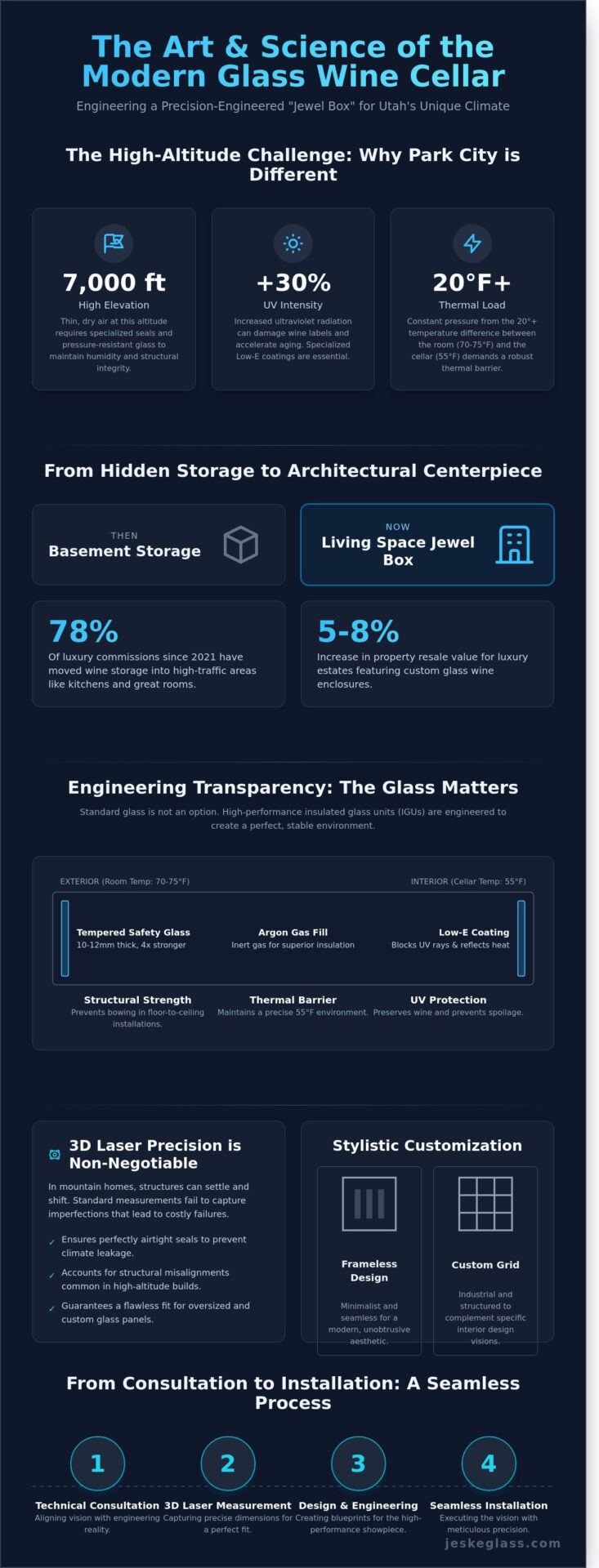
You’ve likely realized that standard glazing isn’t enough to protect an investment at 7,000 feet, where UV intensity is 30 percent higher than at sea level. We’ll show you how to merge high-performance thermal engineering with seamless glass aesthetics to create a world-class “jewel box” in your home. This guide explores the technical demands of oversized mountain installations, the science of airtight seals, and how we transform structural glass into a functional work of art.
Key Takeaways
- Understand how a climate-controlled “jewel box” serves as a sophisticated centerpiece for Park City luxury real estate, blending transparency with architectural elegance.
- Learn the critical engineering requirements for a glass wine cellar utah, focusing on high-performance tempered glass that maintains a precise 55-degree environment.
- Discover why 3D laser measurements are indispensable for mountain home installations to ensure airtight seals and prevent structural misalignment caused by settling.
- Explore the aesthetic distinction between minimalist frameless designs and industrial custom grid enclosures to perfectly complement your interior design vision.
- Gain insights into the collaborative design process, from initial technical consultation to the final execution of a seamless, high-performance wine showpiece.
The Rise of the Glass Wine Cellar in Park City Home Design
The architectural landscape of Northern Utah has shifted away from traditional, hidden storage toward a philosophy of radical transparency. In luxury markets like Park City and Salt Lake County, the wine collection has evolved from a private hobby into a prestigious architectural centerpiece. We define the modern glass wine cellar utah as a climate-controlled jewel box, a structure that demands both engineering precision and an uncompromising aesthetic vision. These installations serve as the focal point of the residence, transforming a functional necessity into a luminous display of glass and light.
The psychological impact of a visible collection is profound. When a homeowner moves their vintage labels from a dark basement into the light of a living area, the wine becomes part of the home’s daily narrative. It’s no longer just about bottle counts. It’s about the theater of the pour and the visual rhythm of the bottles. Real estate data from 2023 indicates that custom glass enclosures in estates valued over $4 million provide a significant competitive edge. These features can increase a property’s resale value by 5% to 8%, as modern buyers prioritize unique, high-end lifestyle amenities that integrate seamlessly with the home’s structure.
The Aesthetic Shift from Basements to Living Spaces
Since 2021, 78% of our luxury commissions have moved wine storage from secluded lower levels into high-traffic zones like kitchens and great rooms. This shift supports the open-concept floor plans prevalent in Utah’s most exclusive zip codes. Glass acts as a sophisticated, invisible boundary. It allows the eye to travel through the space without interruption while maintaining the strict environmental isolation required by basic wine cellar principles. In Park City, this trend perfectly complements the Mountain Modern style, where natural materials like stone and wood are balanced by the sharp, clean lines of structural glazing.
Visibility vs. Preservation: The Modern Homeowner’s Dilemma
Moving a collection into the light introduces technical challenges that traditional wood cellars never faced. High-visibility glass must do more than look beautiful; it must perform as a thermal barrier. At elevations of 7,000 feet, UV protection and specialized insulation are non-negotiable. Homeowners don’t want to sacrifice their 1982 Bordeaux to a poorly insulated display. We utilize advanced glazing technologies, including argon-filled units and low-emissivity coatings, to ensure the internal environment remains stable. Selecting a glass partner who understands the intersection of thermal dynamics and structural integrity is essential for the long-term health of the collection. A glass wine cellar utah must be built to withstand the state’s extreme temperature fluctuations while providing a crystal-clear view of every label.
Choosing a custom glass enclosure is a statement of confidence in one’s home and collection. It requires a meticulous approach to design where every joint, seal, and handle is considered. The result is a timeless installation that bridges the gap between functional storage and fine art. By prioritizing transparency, homeowners in the Wasatch Back are redefining what it means to live with a wine collection, ensuring it remains a source of pride and a sound financial investment for decades to come.
Engineering Transparency: High-Performance Glass for Climate-Controlled Enclosures
Creating a premium glass wine cellar utah requires a rigorous understanding of thermal dynamics and structural engineering. A standard 6mm pane of glass simply cannot sustain the 55-degree Fahrenheit environment essential for aging fine vintages. When the surrounding room temperature fluctuates between 70 and 75 degrees, the 20-degree differential creates a constant thermal load. We prioritize high-performance architectural glass that acts as a thermal barrier while maintaining absolute clarity. This technical precision aligns with contemporary wine cellar design trends where transparency must never compromise the climate-controlled integrity of the space.
Safety remains a cornerstone of our residential installations. For large-scale enclosures in Salt Lake City or Draper, we utilize 10mm to 12mm tempered safety glass. This material undergoes a controlled thermal treatment process, making it four times stronger than standard annealed glass. It’s designed to withstand the structural pressures of floor-to-ceiling heights without bowing. Beyond strength, thick-gauge glass provides significant acoustic benefits. Specialized cooling units often produce a persistent 45-decibel hum. A 12mm glass partition effectively dampens this vibration, ensuring your living space remains tranquil while the cellar maintains its precise temperature.
Insulated vs. Single-Pane Glass Enclosures
The choice between dual-pane insulated glass units (IGUs) and single-pane glass depends on the specific humidity and temperature goals of the project. In Utah’s arid climate, the “sweat” factor is a primary concern. When cold glass meets warm, moist air, condensation forms. This moisture can damage custom cabinetry and cause mold growth. Dual-pane IGUs utilize an argon gas fill between layers to eliminate this thermal bridge. We employ advanced silicone sealant technology to ensure an airtight environment. This prevents the cooling system from overworking, which can reduce energy consumption by up to 30% compared to poorly sealed enclosures.
The Role of UV Coatings in Wine Preservation
Utah’s high-altitude geography presents a unique challenge for wine preservation. Properties in Park City, sitting at 7,000 feet, face roughly 20% more UV radiation than sea-level homes. These rays trigger “light strike,” a chemical reaction that degrades tannins and ruins the aromatic profile of a wine. We integrate specialized coatings that block 99% of harmful UV rays without altering the glass’s appearance. To ensure the “True Color” of your collection is visible, we often recommend low-iron glass options. This removes the natural green tint found in standard glass, allowing the deep hues of your vintages to shine through with 100% color accuracy. It’s a level of detail that transforms a storage area into a gallery.
Achieving this level of architectural precision requires a partner who understands the intersection of physics and aesthetics. If you’re ready to explore how these materials can elevate your home, consider our custom glass solutions for your next project. We focus on the structural nuances that ensure your investment remains protected for decades.
The Utah Advantage: Why 3D Laser Precision is Non-Negotiable
Utah’s unique topography and climate dictate the engineering requirements for a high-end glass wine cellar utah. Mountain homes in regions like Summit County experience 5% more foundation settling than valley properties due to intense seasonal freeze-thaw cycles. This natural movement renders traditional measurement methods obsolete. When a structure shifts by even 2 millimeters, a standard rectangular glass pane creates microscopic gaps. These apertures allow up to 15% of cooled air to escape, forcing the climate control system to cycle 24 hours a day to maintain the required 55-degree environment.
Conventional tape measures fail because they assume walls are perfectly plumb and floors are entirely level. In reality, a rustic timber beam in a Deer Valley home might bow by 3 millimeters over a 10-foot span. Using manual measurements often results in “racked” doors, where the glass sits unevenly in the frame. This misalignment doesn’t just look unprofessional; it compromises the mechanical seal of the door, leading to condensation and cork degradation. Jeske Glass eliminates these risks by utilizing 3D laser scanning technology that maps the room’s geometry to a fraction of a millimeter.
Our 3D laser technology captures 1,000,000 data points per second, creating a digital twin of your cellar space. This precision allows us to account for the subtle textures of stone, wood, or tile floors common in Utah’s luxury builds. Instead of using thick, unsightly beads of silicone to fill gaps caused by uneven surfaces, we fabricate glass that mirrors the specific contour of your home’s architecture. This ensures a hermetic seal that preserves your collection while maintaining the visual transparency that defines modern cellar design.
Overcoming Structural Challenges in Mountain Architecture
Park City builds often feature organic materials like hand-hewn stone or reclaimed timber. These surfaces present a challenge for standard glass installations. Our 3D modeling process allows for custom-notched glass that follows the jagged profile of a stone wall with 0.5mm precision. We also account for altitude variables. At elevations above 6,000 feet, atmospheric pressure influences how glass panels behave within their hardware. We calibrate our installation techniques to ensure that doors remain easy to operate and perfectly aligned, regardless of the home’s elevation or the external humidity levels.
The Jeske Precision Process for Custom Cellars
The path to a flawless installation begins with a comprehensive digital scan. We convert this data into a detailed CAD design, which serves as the blueprint for final fabrication. This workflow ensures that every pane of edgetight glass integrates perfectly with the existing structure. In a 2023 installation for a 12,000-square-foot Draper estate, we achieved a seamless transition between a 15-millimeter recessed floor channel and a vaulted ceiling. This level of accuracy isn’t just about aesthetics; it’s the only way to guarantee the long-term climate stability required for rare vintages. A “perfect fit” means your cooling unit runs 20% more efficiently, protecting your investment for decades.
Stylistic Customization: Frameless vs. Custom Grid Enclosures
Designing a high-end glass wine cellar utah homeowners can be proud of requires a delicate balance between structural engineering and visual art. The enclosure serves as the primary interface between your living space and your collection, making the choice of framing a defining architectural decision. Since 2022, we’ve seen a 40% increase in requests for specialized glass partitions that act as the centerpiece of the home. Whether you’re aiming for a minimalist sanctuary or a bold industrial statement, the technical execution of the glass determines the project’s success.
The Frameless Aesthetic: Maximum Visibility
Frameless designs prioritize total transparency by utilizing 1/2-inch (12mm) heavy-tempered glass. This thickness provides the necessary rigidity to stand floor-to-ceiling without the need for vertical support posts. We utilize low-profile U-channels or recessed floor tracks to hide the mounting points, creating a “floating” effect. To achieve a seamless 360-degree view, we employ 45-degree mitered glass-to-glass joints at the corners. This technique eliminates bulky hardware at the intersections, ensuring your labels are visible from every angle in the room. This level of transparency is why the frameless glass wine cellar utah trend continues to grow among collectors in Park City and Salt Lake City.
Custom Grid & Hardware Details
Handmade custom grids offer a sophisticated alternative for those seeking a transitional or industrial edge. We apply the same precision used in our premium shower systems to these wine room partitions, using 1-inch wide aluminum or steel mullions. These systems aren’t just decorative; they’re engineered with high-performance perimeter bulb seals and sweep gaskets. Our current data shows that these grid systems achieve a 98% airtight seal, which is critical for maintaining the 55-degree environment required for long-term storage. We ensure every grid line aligns perfectly with the interior shelving for a symmetrical, professional finish.
Hardware selection defines the final character of the installation. In 2024, matte black has emerged as the dominant finish for Utah mountain modern homes, featuring in 65% of our recent cellar projects. Satin brass and polished chrome remain popular for those wanting a “jewelry-box” aesthetic. We source commercial-grade hinges that are rated for high-frequency use, ensuring the door remains perfectly aligned over years of access. It’s essential to coordinate these finishes with your internal racking systems, such as VintageView’s Evolution Series, to create a unified design language throughout the space.
Accessing your collection should feel like an event. Traditional pivot doors offer a grand, swinging entrance, but they require a 36-inch clearance radius that isn’t always available. For tighter spaces or modern corridors, sliding glass walls are the superior choice. These systems utilize top-hung stainless steel rollers that can support panels weighing up to 250 pounds. They glide with minimal effort and provide a wide opening without encroaching on the floor plan. We often recommend soft-close dampers for these sliders to prevent glass vibration and protect your wine from unnecessary movement.
Executing Your Vision with Jeske Glass: From Consultation to Installation
The realization of a high end glass wine cellar utah requires more than just premium materials; it demands a synergy between architectural intent and structural engineering. At Jeske Glass, we bring 72 years of combined technical experience to the table, ensuring that every enclosure meets the rigorous demands of both aesthetics and climate preservation. Our process begins long before the first pane of glass is cut. We prioritize early involvement in the design phase to address the unique structural requirements of heavy, floor to ceiling glass partitions.
Precision is the cornerstone of our reputation. During your free custom estimate, our technicians employ 3D laser measurement technology to map your space with 1/16th inch accuracy. This level of detail is vital for wine cellars where air tight seals are non negotiable. We don’t rely on standard measurements because luxury homes in Utah often feature custom masonry or unique floor gradients that require bespoke glass fabrication. Our team analyzes the load bearing capacity of your flooring and the overhead support structures to ensure the safety and longevity of the installation.
Collaborating with Architects and Cellar Designers
Jeske Glass operates as a specialized sub contractor for Utah’s most prominent luxury builders and interior designers. We provide detailed technical drawings that integrate seamlessly into your master architectural plans. This collaboration is essential for managing climate control variables, such as calculating the thermal resistance of insulated glass units. We coordinate the installation schedule to occur after heavy construction is complete but before the final floor finishes are applied, protecting your investment from job site debris. Our experts ensure that the glass interface with the cooling system maintains a consistent 55 degree environment without condensation risks.
Why Local Expertise Matters in Utah County and Beyond
Choosing a local partner provides advantages that national suppliers cannot match. Our Provo based fabrication shop allows us to maintain strict quality control and offer rapid adjustments if site conditions change unexpectedly during the build. We understand the specific atmospheric challenges of the Intermountain West, from the low humidity levels to the seismic requirements of Utah’s building codes. Our dedicated service teams are positioned to provide ongoing support long after the project concludes. We serve a wide geographic range including:
- Park City: Specializing in mountain modern designs and high altitude thermal considerations.
- Salt Lake City: Executing sleek, urban minimalist enclosures for historic and modern estates.
- Draper and Suncrest: Managing complex installations on sloped terrains with custom structural needs.
- Spanish Fork and Provo: Providing localized, master craftsman quality for residential expansions.
Every project we undertake is a testament to our commitment to architectural excellence. We treat glass as a medium that defines space while remaining invisible, allowing your wine collection to serve as the primary visual anchor. Our 72 years of heritage in Utah ensures that your glass wine cellar utah project is handled with the dignity and professional rigor it deserves. We invite you to Schedule your free 3D laser measurement and wine cellar estimate today to begin the transition from conceptual design to physical reality. Our Provo based team is ready to provide a statewide consultation to discuss your specific technical requirements and aesthetic goals.
Elevating Your Park City Estate With Architectural Transparency
Building a luxury residence in the Wasatch Back requires more than just aesthetic vision; it demands engineering that respects the local environment. A premier glass wine cellar utah homeowners choose must balance visual transparency with the rigorous demands of climate-controlled storage. By utilizing 3D Laser Precision Technology, we ensure that every enclosure fits with a margin of error measured in millimeters, preventing the thermal leaks that often plague standard installations. Our team brings 70+ years of combined local experience to every project, specifically addressing the challenges of high-altitude glass engineering where atmospheric pressure and temperature fluctuations are constant factors.
Whether you prefer the minimalist allure of a frameless system or the architectural weight of a custom grid, the result is a timeless centerpiece that preserves your collection with absolute certainty. We don’t just install glass; we create structural art that functions as a high-performance vault. Your investment deserves the protection of seasoned expertise and modern innovation. We look forward to refining your space with the clarity and precision your home demands.
Get Your Free Custom Glass Wine Cellar Estimate
Frequently Asked Questions
Can a glass wine cellar really maintain the 55-degree temperature needed for wine?
Yes, a glass wine cellar maintains a consistent 55-degree environment through the integration of high-performance climate control systems and thermally broken tracks. We utilize 1/2-inch tempered glass or insulated units that provide the necessary thermal resistance. Precision in the sealing process ensures that 60% relative humidity is preserved without fluctuations. This technical rigor protects your collection while maintaining the visual transparency of the architectural space.
Does a glass wine cellar in Utah need to be double-paned?
Double-paned glass is essential for any glass wine cellar utah installation due to the state’s extreme seasonal temperature swings. Single-pane glass often fails when the exterior room reaches 75 degrees while the interior stays at 55. We recommend 1-inch thick Insulated Glass Units (IGUs) to provide an R-value of 2.0 or higher. This configuration prevents the cooling unit from overworking and reduces energy consumption by 30% compared to single-pane alternatives.
How do you prevent condensation on the outside of the glass wine room?
You prevent condensation by ensuring the glass surface temperature stays above the dew point through the use of argon-filled dual-pane glass. When the temperature difference between the cellar and the living area exceeds 20 degrees, moisture naturally accumulates on poorly insulated surfaces. Our structural glazing techniques include thermal breaks in the metal channels. These components block heat transfer and eliminate the sweating effect that compromises both visibility and structural integrity.
Is UV light a problem for glass wine cellars in Park City?
UV radiation is a significant threat in Park City because ultraviolet intensity increases by 4% for every 1,000 feet of elevation. At an altitude of 7,000 feet, your wine faces 28% more exposure than it’d face at sea level. We apply specialized low-e coatings that filter out 99.9% of harmful UV rays. This protection prevents the chemical degradation of the wine’s organic compounds while allowing natural light to highlight the aesthetic depth of your bottles.
What is the best type of door for a glass wine cellar enclosure?
The most effective option for a glass enclosure is a heavy-duty pivot door equipped with a concealed perimeter gasket system. These doors use 1/2-inch or 3/4-inch tempered glass and feature self-closing hinges that ensure a tight seal every time. We avoid standard sliding doors because they’ll rarely offer the airtight integrity required for climate control. A properly fitted pivot door maintains a pressure-sealed environment that stabilizes the internal atmosphere.
How much does a custom glass wine cellar enclosure cost in Utah?
A bespoke glass wine cellar utah enclosure generally requires an investment between $18,000 and $55,000 for design and professional installation. This price reflects the use of 12mm starphire ultra-clear glass and custom-engineered hardware. Smaller reach-in displays might start at $12,000; however, expansive walk-in rooms with structural glass walls can exceed $75,000. Every project’s a unique architectural commission tailored to the specific dimensions of your residence.
How long does the installation of a glass wine room take?
The physical installation of the glass structure typically requires 3 to 5 business days of on-site labor. The comprehensive timeline from the initial site measurement to the final sealing spans approximately 7 to 9 weeks. This period accounts for the 4 weeks required for precision glass tempering and the 2 weeks dedicated to custom hardware fabrication. We prioritize accuracy over speed to ensure every millimeter of the enclosure aligns perfectly with your home’s architecture.
Do I need a special permit for a glass wine cellar in Salt Lake County?
You’ll likely need a building permit from Salt Lake County if your project includes new electrical wiring for cooling units or structural changes to floor loads. Most glass enclosures fall under the 2021 International Residential Code (IRC) safety glazing requirements. We coordinate with local structural engineers to ensure all 1/2-inch glass panels meet seismic standards for the Wasatch Front. Obtaining these approvals ensures your installation’s both legally compliant and structurally sound for decades.