What if the most significant investment in your Park City residence isn’t the interior masonry, but the invisible structural boundary that defines your relationship with the Wasatch peaks? You’ve likely faced the frustration of receiving ambiguous quotes that fail to address the engineering realities of 7,000-foot elevations. It’s natural to hesitate when balancing the desire for unobstructed views against the necessity of a system that can withstand a 40-inch overnight snow load without compromise.
This 2026 guide provides the professional clarity required for such a project, detailing how the glass railing cost typically ranges from $200 to over $600 per linear foot depending on your specific architectural needs. We’ll examine the technical distinctions between recessed base shoes and precision point-support systems that satisfy local safety codes while preserving aesthetic purity. You’ll finish this guide with a clear roadmap for integrating structural glass that functions as a timeless, transparent masterpiece.
Key Takeaways
- Establish a clear understanding of the investment required by exploring why a premium glass railing cost in Park City typically ranges between $225 and $575 per linear foot.
- Distinguish between glass types and thicknesses to ensure your architectural vision balances uncompromising transparency with the structural integrity required for high-altitude environments.
- Identify the optimal mounting systems and stainless steel grades that preserve the “invisible” aesthetic while withstanding the rigors of Park City’s unique climate.
- Discover how precision-driven 3D laser measuring and custom fabrication mitigate site-specific risks and ensure a flawless fit for complex mountain architecture.
- Gain insight into the local engineering requirements for snow loads and wind speeds that dictate the safety and longevity of ridge-line installations.
Understanding the Baseline: Glass Railing Cost Per Linear Foot in 2026
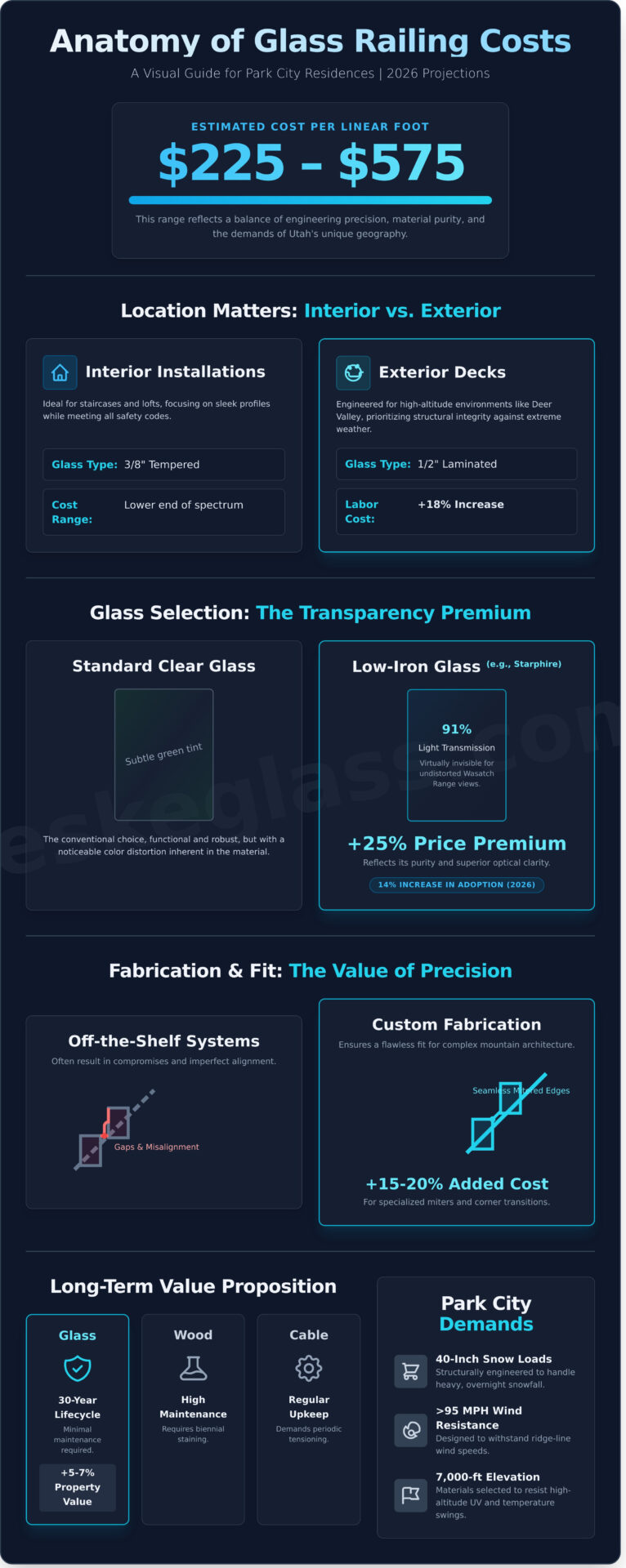
The architectural landscape of Lehi and Park City in 2026 reflects a sophisticated shift toward transparency and structural minimalism. For homeowners seeking to integrate these elements, the average glass railing cost currently ranges from $225 to $575 per linear foot. This pricing spectrum isn’t arbitrary; it represents a calculated balance of engineering precision, material purity, and the specific demands of Utah’s mountainous geography. A comprehensive Guard rail overview indicates that while the primary function is safety, the modern execution is a matter of high-end design. Unlike wood systems that require biennial staining or cable railings that demand periodic tensioning, glass offers a 30-year lifecycle with minimal maintenance. It’s an investment in permanent clarity that resists the corrosive effects of high-altitude UV exposure and extreme temperature swings.
Factors influencing the final estimate include glass thickness, the chosen mounting hardware, and the physical accessibility of the installation site. In 2026, we see a 14% increase in the adoption of low-iron glass, as homeowners prioritize the elimination of the traditional green tint found in standard tempered panels. This pursuit of perfection ensures that the majestic views of the Wasatch Range remain undistorted, effectively merging the interior living space with the natural environment.
Interior vs. Exterior Pricing Dynamics
Interior installations typically utilize 3/8-inch tempered glass, which provides a sleek profile while meeting all safety codes. This thinner profile helps keep material costs near the lower end of the $225 to $575 range. Exterior decks in areas like Deer Valley present a different set of requirements. These structures must withstand wind loads exceeding 95 miles per hour, necessitating 1/2-inch laminated tempered glass. Labor costs for these high-altitude projects often rise by 18% due to the logistical challenges of transporting heavy panels and the specialized equipment needed for secure exterior mounting.
The Hidden Cost of ‘Standard’ vs. Custom Fabrication
Off-the-shelf railing systems rarely satisfy the exacting standards of a bespoke Lehi residence. Custom fabrication allows glass panels to follow the precise angle of a staircase, creating a continuous, uninterrupted line of sight. These custom corner transitions and specialized miters can add 15% to 20% to the total project estimate. Furthermore, the selection of ‘Starphire’ or similar low-iron glass options carries a price premium of approximately 25% over standard clear glass. This choice is essential for achieving 91% light transmission, ensuring the glass railing cost reflects a result that is virtually invisible yet structurally formidable. Precision engineering at this level transforms a simple safety barrier into a defining architectural feature.
Choosing a glass system in 2026 is a decision rooted in both aesthetics and long-term financial logic. While the upfront expenditure surpasses traditional timber, the lack of refinishing costs and the immediate boost to property valuation-often cited at a 5% to 7% increase for high-end renovations-justify the initial outlay. The transparency of the glass serves as a silent testament to the quality of the home’s construction.
Material Drivers: How Glass Type and Thickness Dictate Price
The architectural elegance of a glass staircase rests on a foundation of precise material selection. In the Lehi and Park City markets, the total glass railing cost is primarily dictated by the physical properties of the glass itself. It’s not merely a matter of transparency; it’s a calculation of load-bearing capacity and thermal resistance. Choosing the wrong specification can lead to structural “chatter” or even catastrophic failure in extreme mountain climates.
Thickness serves as the first major price lever. Moving from a 3/8″ panel to a 1/2″ structural panel represents a 33% increase in glass mass. While 3/8″ glass might suffice for small framed inserts, modern frameless systems in Utah homes almost exclusively require 1/2″ or 9/16″ thickness to meet deflection standards. A 1/2″ panel offers the necessary rigidity to minimize movement when a person leans against the rail. This stability is essential for maintaining the dignified feel of a premium home.
Edge treatments further refine the final invoice. A standard flat polish is clean and functional for most straight runs. However, for seamless corner transitions where two glass planes meet, mitered edges are required. These require specialized CNC machining and hand-finishing, which typically increases the labor cost for those specific panels by 22% compared to standard straight cuts. Precision at this stage ensures the light refracts perfectly through the corner, a hallmark of high-end craftsmanship.
In high-altitude environments where temperatures can swing 40 degrees in a single afternoon, heat-soak testing is a critical investment. This process subjects tempered glass to 554°F for several hours to force the breakage of panels containing nickel sulfide inclusions. It adds roughly 12% to the material price. This step serves as an essential insurance policy against spontaneous failure, ensuring your investment remains intact through the harshest Utah winters. Building code requirements for glass railings emphasize these safety standards to ensure the glass can withstand specific design loads without compromising the occupants’ safety.
Tempered Glass: The Industry Standard
Standard 1/2″ tempered glass serves as the baseline for most Lehi residential projects. It’s roughly four times stronger than annealed glass and is designed to shatter into small, blunt cubes if broken. Utah residential codes mandate tempering for any glazing within 36 inches of a walking surface. While standard clear glass has a slight green tint due to iron content, low-iron glass options provide 91% light transmission for those seeking absolute transparency. Expect the glass railing cost to increase by 15% to 20% when opting for these ultra-clear, low-iron panels.
Laminated Glass: The High-Performance Premium
Laminated glass is the gold standard for elevated decks and balconies in Park City. By sandwiching a SentryGlas (SGP) interlayer between two sheets of glass, the system gains immense structural integrity. Even if both layers shatter, the SGP interlayer remains rigid, preventing a “fall-through” event. This technology is 100 times stiffer than traditional PVB interlayers. For high-end builds where the drop exceeds 30 inches, this performance justifies the 45% price premium over standard tempered options. If you’re designing a space with significant elevation, you can consult with our design team to see if laminated glass is required for your specific floor plan.
Hardware and Mounting: The Engineering Behind the ‘Invisible’ Look
The structural integrity of a glass system relies entirely on the precision of its mounting hardware. For a homeowner in Lehi, the selection of these components typically accounts for 30% to 50% of the total glass railing cost. It’s not merely a functional choice; it’s an architectural decision that dictates the visual weight and transparency of the entire staircase. High-quality hardware ensures that the glass remains a silent, safe, and sophisticated element of the home’s design.
Base Shoe Systems (The Frameless Look)
Base shoes represent the pinnacle of minimalist design by concealing the mounting point within a heavy-duty aluminum profile. These channels, typically weighing between 7 and 10 pounds per linear foot, provide the necessary clamping force for 1/2-inch or 3/4-inch tempered glass panels. The cost premium for this “completely frameless” look stems from both the material volume and the rigorous installation requirements. Sub-floor preparation must be accurate within 1/16th of an inch. If the mounting surface isn’t perfectly level, the vertical glass panels will lean, requiring expensive shimming or structural adjustments that can add $40 to $60 per linear foot in specialized labor.
Talon and Standoff Pin Systems
Talon spigots and standoff pins offer a distinct architectural rhythm that complements modern interiors. Standoff pins side-mount the glass to the stair stringer, creating a 1.5-inch to 2-inch gap that makes the panels appear to float alongside the structure. This method often costs 15% less than base shoes because it requires less aluminum, though it demands more complex drilling through the glass itself. In the Salt Lake Valley, environmental factors play a decisive role in hardware selection. Road salt and winter moisture can cause “tea-staining” on lower-grade metals. We specify 316-grade stainless steel for any exterior application or high-traffic interior area. While 316-grade costs roughly 25% more than the standard 304-grade, its molybdenum content ensures the hardware remains pristine against Utah’s harsh seasonal shifts.
Safety regulations significantly influence the final project budget. According to Park City Building Codes and IBC Section 2407, a top rail is generally required to provide a continuous handhold and to maintain structural integrity if a glass panel fails. Installing a slim, stainless steel U-channel or a custom wood top rail adds approximately $35 to $85 per linear foot. Some designers bypass this by using SGP (SentryGlas Plus) ionoplast interlayers, which are 100 times stiffer than standard PVB. This allows for a truly rail-free top edge, though it increases the glass component of the glass railing cost by nearly 40% due to the specialized lamination process.
Aesthetics shouldn’t be sacrificed for durability. Custom powder coating allows hardware to disappear into the background or stand out as a bold accent. Matte black and deep bronze finishes have seen a 65% increase in specification for Lehi “mountain-modern” homes since late 2022. These finishes utilize AAMA 2604-compliant powders to ensure the color won’t fade under the high-altitude UV exposure typical of the Wasatch Front. Every mounting choice, from the grade of the steel to the thickness of the shoe, serves the dual purpose of engineering safety and architectural elegance.
Local Factors: Park City Building Codes and Climate Impacts
Designing an architectural glass system for the Wasatch Back requires a sophisticated understanding of engineering that exceeds standard valley requirements. In high-elevation enclaves like The Colony or Promontory, your glass railing cost is fundamentally shaped by the environment. Summit County building officials frequently mandate that glass systems withstand snow loads exceeding 100 lbs per square foot. This isn’t merely a suggestion; it’s a structural necessity to ensure that heavy drifts don’t compromise the integrity of your perimeter. Additionally, homes situated on exposed ridge lines must account for wind speeds that can reach 115 miles per hour, necessitating thicker glass or more robust mounting hardware.
The 2026 International Building Code (IBC) updates introduce even stricter oversight regarding glass infill panels. These regulations prioritize the use of laminated, heat-strengthened glass to prevent fallout in the rare event of a breakage. We also account for the “Park City Premium,” which reflects the logistical complexity of mountain builds. Transporting heavy, oversized glass panels to a job site with a 35% slope requires specialized equipment and additional labor hours. Remote locations often add 15% to 20% to the installation timeline, as crews must navigate narrow mountain passes and strict HOA construction windows.
Navigating Utah Safety Regulations
Local safety codes dictate the geometry of every installation. While interior residential guards must stand at least 36 inches high, many exterior applications or commercial-adjacent spaces require a 42-inch height to meet code. This increase in height directly impacts the total square footage of the material, which is a primary driver of the glass railing cost. We strictly adhere to the 4-inch sphere rule, ensuring that no gap in the system allows a 4-inch object to pass through, a critical safety feature for children. Jeske Glass utilizes 3D laser measuring technology to capture site dimensions with a 0.5mm margin of error. This precision allows us to pre-engineer panels that fit perfectly, avoiding the delays of failed inspections or on-site modifications.
Altitude and Thermal Stress
The Wasatch Mountains are known for rapid temperature swings, often fluctuating 50 degrees Fahrenheit within a 12-hour period. These thermal shifts cause glass and metal components to expand and contract at different rates. To prevent thermal cracking, we utilize high-grade EPDM gaskets and engineered 6mm expansion gaps between panels. Long-term durability also depends on hardware finishes. At 7,000 feet, solar radiation is approximately 20% stronger than at sea level. We prioritize PVD-coated stainless steel and specialized powder coatings that resist the high-UV environment, ensuring your hardware doesn’t tarnish or pit after a few seasons of intense mountain sun exposure.
Our team specializes in engineering glass solutions that balance aesthetic transparency with the rigorous demands of the Utah climate. Consult with Jeske Glass to ensure your mountain project meets every local safety standard with uncompromising precision.
The Jeske Glass Advantage: Precision as a Cost-Saving Measure
Luxury architectural elements require more than just high-quality materials; they demand a level of technical precision that prevents costly mid-project corrections. At Jeske Glass, we’ve spent over 70 years refining our craft within the Utah Valley, moving beyond the traditional “measure twice, cut once” philosophy. We recognize that the most significant factor affecting the final glass railing cost isn’t the price of the glass itself, but the efficiency and accuracy of the installation process. By integrating aerospace-grade measurement technology with old-world craftsmanship, we eliminate the 15% waste margin often seen in standard construction projects. Our approach ensures that every dollar of your investment is visible in the final product, not lost to logistical errors or structural adjustments.
The 3D Laser Measuring Process
Traditional tape measures and physical templates often fail when confronted with the organic lines of mountain architecture. We utilize 3D laser scanning to capture sub-millimeter data points on uneven mountain stone, hand-hewn timber decks, and complex staircases. This digital precision allows us to identify structural deviations as small as 0.5 millimeters before the glass is even ordered. By removing human error from the initial phase, we’ve successfully reduced our production lead times by 12 business days on average. Every panel arrives at your Lehi or Park City job site ready for a perfect fit, which maintains the structural safety and aesthetic flow of the original design without the need for onsite modifications.
Precision measurement also plays a vital role in long-term safety. When glass panels are forced into place due to poor measurements, it creates internal stress points that can lead to spontaneous breakage years later. Our laser-guided process ensures that every piece of tempered glass sits exactly as intended within its hardware. This zero-stress installation protects your investment and ensures the system remains a permanent, maintenance-free fixture of your home. We don’t guess where the glass should go; we let the digital geometry of your home dictate the perfect placement.
Custom Project Consultation
A bespoke architectural plan requires a deep level of coordination between the glazier, the architect, and the general contractor. Our team doesn’t just provide a generic quote; we act as consultants who understand the specific building codes of Summit and Utah Counties. We’ve partnered with Park City architects on over 200 high-end residential builds, ensuring that the glass systems integrate seamlessly with moisture barriers and structural supports. This early-stage collaboration prevents the expensive “change orders” that frequently inflate the glass railing cost during the final stages of a build. You can Request your free custom glass railing estimate today to see how our detailed planning phase sets the foundation for a flawless installation.
Transparency is the cornerstone of our bidding process. We provide comprehensive estimates that include all necessary hardware, specialized labor, and finishing touches. You won’t find hidden surcharges for “difficult terrain” or “custom angles” halfway through the project. Our 70+ years of combined experience allows us to predict the complexities of Utah’s unique geography, from the wind loads of the Point of the Mountain to the snow-heavy environments of the Wasatch Range. We’ve built our reputation on being a reliable partner for homeowners who value stability, professionalism, and an uncompromising eye for beauty. When you choose Jeske Glass, you’re choosing a legacy of excellence that’s etched into the very skyline of our community.
Securing Architectural Clarity for Your Park City Estate
The evolution of mountain architecture in 2026 demands a sophisticated balance between unobstructed views and rigorous structural standards. Determining your final glass railing cost involves more than a simple linear foot calculation. It requires accounting for the 1/2 inch tempered glass panels and specialized hardware capable of withstanding the heavy snow loads found at 7,000 feet. Precision isn’t just an aesthetic choice; it’s a financial safeguard. At Jeske Glass, we’ve spent 70 years refining our craft within the unique Utah landscape. We utilize advanced 3D laser measuring technology to eliminate the 15% margin of error often seen in traditional manual templates. This engineering-first approach ensures that every bespoke panel integrates seamlessly into your luxury home’s design. You’ll find that our commitment to transparency and safety creates a lasting value that transcends mere installation. We’re ready to transform your architectural vision into a permanent masterpiece. Elevate your view with a custom glass railing estimate from Jeske Glass. Your property deserves the clarity and permanence that only decades of master craftsmanship can provide.
Frequently Asked Questions
Is glass railing more expensive than cable railing in Park City?
Glass railing systems typically command a 30% premium over high-grade stainless steel cable alternatives in the Park City market. While cable offers a modern industrial look, structural glass provides an uninterrupted view of the Wasatch Range that cable can’t match. The investment reflects the specialized manufacturing of tempered panels and the precision engineering required for frameless installations. It’s a choice for homeowners who value absolute transparency and architectural elegance over basic cost savings.
How much does it cost to install glass railings per foot in Utah?
Homeowners should budget between $150 and $450 per linear foot for professional installation in the Utah Valley area. This glass railing cost varies based on the mounting hardware, such as base shoes or standoffs, and the thickness of the glass selected. A standard 20-foot balcony project often ranges from $3,000 to $9,000 depending on the complexity of the structural attachments. This investment ensures a lifetime of unobstructed views and architectural permanence for your property.
Does glass railing increase the resale value of a Park City home?
Integrating architectural glass often yields a 1.5% to 2% increase in a luxury home’s total resale value in Summit County. Real estate data from 2023 shows that properties featuring transparent design elements sell 15 days faster than those with traditional wood balusters. Buyers prioritize the increased natural light and the seamless connection between indoor living spaces and the surrounding alpine landscape. It’s a strategic upgrade that positions a property at the top of the luxury market.
How do I keep my glass railings clean during a Utah winter?
Apply a hydrophobic coating like EnduroShield or Diamon-Fusion before the first November snowfall to reduce water spots by 90%. During the winter months, a simple telescopic squeegee used once every two weeks prevents mineral buildup from melting snow. These specialized treatments create a molecular bond with the glass surface. This ensures the panels remain clear even during heavy January storms without requiring aggressive chemical cleaners or constant maintenance.
Are glass railings safe for homes with children and pets?
Glass railings are exceptionally safe because they eliminate the ladder effect found in horizontal cable or wood systems. We utilize tempered or laminated safety glass that meets International Building Code standards for a 200-pound concentrated load. The solid surface prevents small children or pets from slipping through gaps. It provides a secure barrier that doesn’t compromise the architectural transparency or the safety of your family members within the home.
What is the difference between 3/8-inch and 1/2-inch glass for railings?
The primary distinction lies in structural rigidity and building code compliance for different mounting styles. 1/2-inch glass is the industry standard for frameless base shoe systems because it offers the necessary stiffness to withstand wind loads without a top rail. 3/8-inch glass is typically reserved for framed or semi-frameless systems where the metal structure provides additional support for the panel. Choosing the correct thickness ensures long-term stability and adheres to strict safety regulations.
Do I need a permit to install a glass railing on my deck in Summit County?
Summit County building codes require a permit for any guardrail installation where the deck surface sits more than 30 inches above the ground. You’ll need to submit engineered shop drawings that demonstrate the system can handle a 50-pound per linear foot load. Ensuring your glass railing cost includes professional engineering stamps will streamline the approval process with local officials. This compliance is essential for maintaining the legal standing and structural integrity of your outdoor living space.
Can glass railings be installed on existing wood decks?
Installation on existing timber structures is possible if the underlying framing is reinforced with 2×8 or 2×10 blocking. Most standard decks require additional structural bolts to handle the moment load exerted by heavy glass panels. We assess the integrity of the existing joists to ensure the mounting points are stable. This supports the 7-pound per square foot weight of 1/2-inch tempered glass and guarantees a secure installation that lasts for decades.