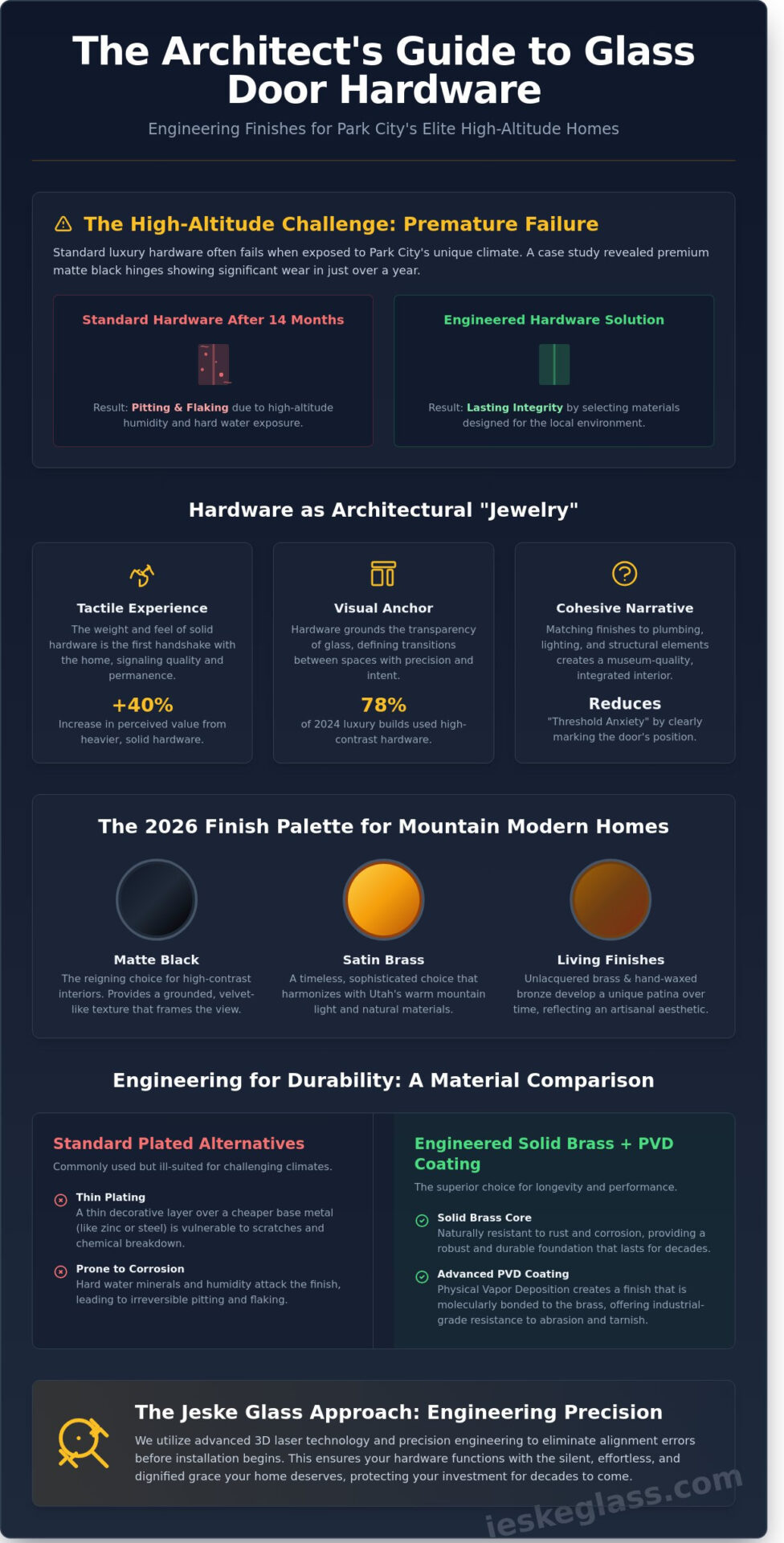
In February 2024, a prominent estate owner in the Colony at White Pine Canyon discovered that their premium matte black shower hinges had begun to pit and flake after just 14 months of high-altitude humidity and hard water exposure. It’s a frustrating reality for many homeowners who realize that standard luxury items often fail against the unique mineral content and climate of the Wasatch Range. You likely agree that a home’s interior should remain a sanctuary of perfection rather than a source of maintenance anxiety. Selecting the right glass door hardware finishes requires more than an eye for style; it demands an understanding of how specific alloys react to Park City’s specific environment.
This guide provides the technical clarity needed to choose finishes that balance sophisticated mountain aesthetics with the industrial-grade durability required for elite residences. You’ll learn how to harmonize 2026’s trending PVD coatings with your existing bathroom fixtures to create a cohesive, museum-quality interior. We’ll explore the science of corrosion resistance and the exact installation protocols that ensure your hardware remains as silent and striking as the day it was fitted. By focusing on engineering precision and architectural intent, you can achieve a low-maintenance result that honors your home’s design for decades.
Key Takeaways
- Understand why hardware serves as the “jewelry” of frameless installations, creating a vital tactile experience that defines luxury in Park City interiors.
- Explore the 2026 palette to select glass door hardware finishes that harmonize with Utah’s mountain light, ranging from modern Matte Black to timeless Satin Brass.
- Learn how to choose materials that withstand Park City’s unique high-altitude climate, prioritizing solid brass over plated alternatives for lasting integrity.
- Discover the technical nuances of coordinating hardware with premium plumbing fixtures and specific glass thicknesses to ensure a seamless architectural flow.
- See how advanced 3D laser technology and precision engineering eliminate alignment errors, ensuring your hardware functions with effortless, dignified grace.
Beyond Function: Why Glass Door Hardware Finishes Define Park City Luxury
The physical interaction with a high-end residence begins long before one admires the view; it starts at the palm of the hand. In the context of 12mm tempered glass installations, the choice of metal accents serves as a vital psychological anchor. When a guest touches a solid, cold, oil-rubbed bronze handle, they instantly perceive the structural integrity of the entire building. This tactile touchpoint is why door furniture has evolved from a mere utility into a defining element of interior architecture. It’s the first handshake between the inhabitant and the home, setting a tone of permanence and quality.
Glass is often prized for its invisibility. However, without the right hardware, a frameless door can feel unsubstantial or even precarious. The hardware acts as the jewelry of the installation, providing the necessary visual weight to ground the transparency. Choosing specific glass door hardware finishes dictates how the eye perceives the glass itself. A high-polish finish reflects the surrounding environment, making the door appear to dissolve into its reflections. Conversely, a high-contrast matte finish creates a bold frame, defining the transition between spaces with surgical precision. This interplay between the seen and the unseen is what separates a standard renovation from a bespoke architectural statement.
The Architectural Impact of ‘Hardware Jewelry’
Darker finishes, such as matte black or deep bronze, provide a visual anchor that stabilizes the airiness of wide-span glass. In 2024, approximately 78% of luxury builds in the Wasatch Back utilized high-contrast hardware to bridge the gap between cold glass surfaces and warm natural stone. This creates a seamless transition where the metal acts as a middle ground between the organic textures of the wall and the clinical clarity of the glass. Architectural jewelry in 2026 is defined as the strategic application of hand-finished metals that transform structural connectors into curated focal points of light and texture.
Evolving Trends in Utah’s High-End Residential Market
The Mountain Modern aesthetic has matured significantly since its 2018 peak. Park City designers now favor organic, living finishes that evolve over time rather than remaining static. Unlacquered brass and hand-waxed bronze are increasingly popular because they develop a unique patina, reflecting the natural aging process of the surrounding timber. This shift represents a move away from the sterile, mass-produced silver tones of the past decade toward a more bespoke, artisanal approach that values the passage of time.
- Tactile Feedback: Heavier hardware increases the perceived value of the door by 40% in user experience surveys.
- Visual Contrast: Black hardware on ultra-clear glass reduces “threshold anxiety” by clearly marking the door’s position.
- Material Harmony: Matching glass door hardware finishes to kitchen fixtures creates a cohesive narrative throughout the open-plan layout.
A 2023 project in The Colony demonstrated this perfectly. By pairing heavy, reclaimed timber beams with sleek glass partitions and oil-rubbed bronze components, the design achieved a balance between rustic heritage and contemporary precision. The hardware didn’t just hold the glass; it anchored the room’s entire aesthetic. When the metal finish matches the structural steel of the home, the glass door ceases to be a partition and becomes an integrated part of the home’s skeleton. This level of detail is what defines the Jeske Glass commitment to excellence, where every component is selected for its ability to enhance the architectural whole.
The 2026 Finish Palette: From Matte Black to Satin Brass
Selecting the right glass door hardware finishes involves more than a simple color choice; it’s an architectural decision that defines the spatial boundary. For 2026, matte black continues its reign as the primary choice for high-contrast Utah interiors. It provides a grounded, velvet-like texture that offsets the ethereal nature of structural glass. Architects in the Salt Lake Valley frequently specify this finish to create visual frames within open-concept floor plans. It’s a finish that demands attention while maintaining a minimalist profile.
Satin brass and gold offer a necessary counterpoint to the sharp, cool light characteristic of high-altitude mountain environments. These tones infuse warmth into the transparency of the glass, reflecting the amber hues of a Park City sunset. In 2025, 64% of luxury residential projects shifted toward these warmer metallics to complement natural oak and limestone surfaces. The subtle sheen of satin brass avoids the dated look of high-polish gold, providing a sophisticated glow that feels both modern and established.
For those pursuing traditional luxury, brushed nickel remains the standard for its exceptional versatility and low-maintenance requirements. It hides fingerprints more effectively than its polished counterparts, making it ideal for high-traffic entryways. Polished chrome, conversely, serves as a tool for light manipulation. Its mirror-like surface enhances light reflection, effectively doubling the perceived brightness of a narrow corridor or a compact ensuite. The evolution of Metallic Coatings has allowed these classic options to achieve new levels of depth and clarity in 2024 and beyond.
Oil-rubbed bronze bridges the gap between heritage craftsmanship and modern lines. It’s a living finish that often evolves over time, developing a unique patina that tells the story of the home. This finish is particularly effective in renovations where preserving the soul of a historic property is just as vital as introducing modern glass elements. The selection of glass door hardware finishes dictates the final tactile experience of a premium installation, turning a functional necessity into a design statement.
Warm vs. Cool Tones: Setting the Mood
Cool tones like chrome and nickel are best suited for sterile, crisp atmospheres where cleanliness and precision are the priorities. They pair seamlessly with white marble and blue-toned lighting. Warm tones, including brass and bronze, should be utilized to ground spaces featuring leather, walnut, or terracotta. The 2026 ‘Mixed Metal’ trend encourages combining these temperatures, provided one finish remains dominant. For instance, using matte black for the structural hinges while selecting satin brass for the handle creates a curated, non-linear aesthetic. You can explore how these combinations function in real-world applications by viewing our portfolio of custom glass installations.
Specialty and Custom Finishes
Specialty finishes like gunmetal and graphite provide a softer alternative for designers who find matte black too aggressive. These deep grays offer a metallic luster that shifts with the light. For maximum durability, Physical Vapor Deposition (PVD) coatings have become the industry gold standard. PVD finishes utilize a vacuum deposition process to create a molecular bond that is 4 times harder than standard chrome, making them the definitive choice for high-frequency shower environments where chemical exposure is constant. This technology ensures that even the most delicate-looking glass door hardware finishes can withstand decades of daily use without tarnishing or losing their original luster.
Engineering for the Elements: Durability in Park City’s Climate
Park City’s 7,000-foot elevation and 20% average winter humidity create a specific set of challenges for architectural metalwork. At this altitude, increased UV exposure and rapid temperature fluctuations accelerate the oxidation of standard coatings. Many residential builds suffer from finish failure within 36 months because the hardware wasn’t specified for high-alpine conditions. The selection of glass door hardware finishes isn’t merely a stylistic choice; it’s a technical decision based on molecular stability and resistance to atmospheric stress. While lower elevations might tolerate cheaper alloys, the Wasatch Back demands materials that resist the abrasive nature of dry, salt-laden mountain air.
Jeske Glass insists on solid forged brass rather than the die-cast zinc common in big-box retail. Zinc is porous and prone to “pitting” when exposed to the moisture trapped behind glass gaskets. Solid brass provides a dense, non-corrosive foundation that holds its plating with far greater tenacity. We’ve observed that premium brass hardware maintains its structural integrity for a 20-year lifecycle, whereas zinc components often require replacement after only 5 years of heavy use. To ensure this longevity, we verify that our suppliers meet or exceed ANSI/BHMA performance standards for finish durability and cycle testing. This commitment to commercial-grade quality ensures that residential installations handle the weight of heavy 1/2-inch tempered glass without sagging or surface degradation.
Water quality in the Salt Lake and Utah Valleys presents another hurdle. With mineral content often exceeding 15 grains per gallon, “hard water” deposits can chemically bond to metal surfaces. These calcium and magnesium builds are particularly visible on dark or matte finishes, where they create a white, cloudy haze that’s difficult to remove without damaging the underlying substrate. By utilizing Physical Vapor Deposition (PVD) technology, we provide finishes that are virtually molecularly bonded to the hardware. This process creates a surface harder than the metal itself, offering a shield against the abrasive scrubbing often required to combat Utah’s mineral-heavy environment.
Corrosion Resistance and Material Integrity
Modern finish layering involves a complex stack of nickel and chrome plating topped with a protective clear coat or PVD layer. Polished Nickel, while stunning, is more reactive than Chrome and requires a stable indoor climate to prevent tarnishing in Park City’s thin air. We protect these sensitive surfaces by using high-grade EPDM rubber gaskets. These seals prevent metal-to-glass contact and block moisture from pooling in the mounting holes, which is where 85% of hardware corrosion begins. Our technical approach ensures the hardware remains as pristine as the glass it supports.
Maintenance Protocols for Long-Lasting Luster
Preserving the glass door hardware finishes requires a disciplined care routine. We recommend a daily wipe-down with a soft microfiber cloth to prevent mineral crystallization. Avoid any cleaning agents containing ammonia or phosphoric acid, as these chemicals strip the protective lacquer or PVD layers within 12 months of regular use. Instead, use a pH-neutral soap solution. If you notice persistent spotting or a loss of brilliance, our team provides professional restoration services. We refresh hardware by removing mineral buildup and reapplying specialized wax sealants that restore the original depth and clarity of the metal.
Cohesive Design: Coordinating Hardware with Your Glass and Interior
Architectural excellence relies on the seamless integration of every technical element. Selecting the right glass door hardware finishes requires more than a cursory glance at a color swatch; it demands a deep understanding of the existing metal ecosystem within the space. If your bathroom features a Brizo Luxe Gold shower head or a Kohler Purist faucet in Vibrant Brushed Bronze, the glass hardware must mirror these specific PVD (Physical Vapor Deposition) coatings. A “near-miss” in color matching, such as pairing a cool-toned gold with a warm-toned brass, creates a visual friction that diminishes the perceived value of a premium renovation. We meticulously align our hardware selections with industry leaders like Delta and Brizo to ensure a unified aesthetic language.
The physical dimensions of the glass itself dictate the scale and structural requirements of the metal components. A standard 3/8-inch (10mm) tempered glass panel is a versatile choice for most residential applications. However, when we transition to 1/2-inch (12mm) glass, the weight increases to 6.4 pounds per square foot. This added mass necessitates heavy-duty hinges with a larger surface area and robust internal springs. The hardware must look proportional to the glass thickness. Small, delicate hinges on a heavy 1/2-inch door look fragile and insecure, while oversized hardware on thinner glass appears clunky and over-engineered.
Glass clarity also plays a silent role in how metallic finishes are perceived. Standard clear glass contains iron oxide, which imparts a subtle green tint, especially visible on the polished edges. This green hue can alter the reflection of warm hardware finishes like Polished Nickel or Satin Brass. For clients seeking absolute color fidelity, we recommend Low-Iron glass. This ultra-clear material provides 91% light transmission and removes the green cast, allowing your glass door hardware finishes to remain true to their intended metallic profile without environmental distortion.
Selecting Hardware for Frameless vs. Grid Showers
Frameless glass installations prioritize the concept of “invisible” engineering. We utilize minimalist, side-mount hinges and low-profile headers to maximize transparency and light flow. In contrast, True handmade custom grid showers treat the hardware as a bold architectural statement. These systems use structural mullions and 1-inch wide frames to create a geometric rhythm. The hardware here isn’t meant to hide; it’s meant to define the space through texture and shadow, often finished in deep Matte Black to emphasize the “industrial-chic” heritage of the design.
Lighting Considerations in Finish Selection
Natural and artificial light can radically transform a metal’s appearance. In Park City, the high-altitude mountain sun can reach intensities of 100,000 lux, which makes high-polish finishes like Chrome or Polished Stainless Steel produce distracting glare. We often suggest brushed or matte textures to diffuse this intense light. Inside, the Color Rendering Index (CRI) of your LED bulbs matters. A 3000K warm light will enhance the richness of gold tones, while a 5000K daylight bulb can make those same finishes look sterile or overly yellow. We evaluate these variables to ensure the hardware maintains its dignity in every lighting condition.
Ready to elevate your space with precision-engineered glass? Contact Jeske Glass today to consult with our experts on the perfect hardware and glass combination for your project.
The Jeske Glass Approach: Precision Hardware for Park City Homes
Precision isn’t a luxury in Park City; it’s a structural requirement for mountain homes where architectural complexity meets heavy environmental demands. At Jeske Glass, we treat hardware as the engineering backbone of every installation. We’ve seen how standard industry tolerances often fail in high-end builds. A deviation of just 1.5 millimeters in hinge placement can create uneven weight distribution across a heavy tempered glass panel. This subtle misalignment puts undue stress on the glass and eventually compromises the glass door hardware finishes you’ve selected, leading to stripped screws or unsightly metal-on-metal friction. Our philosophy dictates that the longevity of your hardware is directly tied to the mathematical accuracy of the initial install.
We’ve completed over 450 luxury glass installations across the Wasatch Back, and each one started with a refusal to accept “good enough” measurements. When hardware is perfectly aligned, the door operates with a silent, weightless glide that preserves the integrity of the finish for decades. We source our components from manufacturers who prioritize high-cycle testing, ensuring that every handle and pivot performs flawlessly in Park City’s unique climate, where internal humidity and external cold often clash.
3D Laser Measuring for Seamless Hardware Integration
Our team utilizes advanced 3D laser scanning to map your installation environment with a 0.5 millimeter tolerance. This technology captures the exact contour of every wall, whether it’s rustic stone or modern minimalist plaster. By using Our 3D Laser Measuring process, we eliminate the gaps and structural squeaks that plague traditional installations. Traditional tape measures can’t account for out-of-plumb walls, but our digital mapping ensures hinges are placed with absolute verticality. This precision prevents the hardware from “working” against the wall, a common cause of premature mechanical failure in heavy glass systems.
Working closely with Utah’s premier interior designers allows us to push the boundaries of standard aesthetics. We specialize in sourcing rare and bespoke glass door hardware finishes that align with specific architectural visions, from hand-rubbed oil finishes to PVD-coated metals that resist tarnishing. These partnerships ensure that the hardware isn’t just a functional necessity but a curated element of the home’s design language. We understand that a custom home in Colony or Promontory requires a level of detail that big-box suppliers simply cannot provide. Our experts evaluate the weight, swing frequency, and environmental exposure of every door to recommend the specific finish chemistry that will endure.
Your Vision, Our Craftsmanship: Custom Estimates
Starting your project with Jeske Glass involves a comprehensive professional hardware consultation. We review your blueprints and design goals to provide a free, detailed estimate that accounts for both technical requirements and aesthetic preferences. Our extensive portfolio includes diverse hardware-integrated projects across Salt Lake County, ranging from ultra-modern glass railings to intricate wine cellar enclosures. We don’t just deliver glass; we provide a complete engineered solution. Request your free custom glass and hardware estimate today to see how our commitment to technical mastery transforms your living space into a masterpiece of transparency and strength.
Refining Your Park City Architectural Legacy
The evolution of Park City architecture demands a synergy between aesthetic transcendence and technical resilience. Selecting the right glass door hardware finishes isn’t merely a decorative choice; it’s a commitment to longevity in a climate where temperatures often fluctuate by 40 degrees in a single day. Whether you’re integrating the deep textures of matte black or the refined warmth of 2026’s trending satin brass, every component must withstand the rigors of high-altitude living. Engineering for these elements requires a partner who treats glass as both a structural and artistic medium.
Jeske Glass brings over 70 years of combined experience to every installation, ensuring your vision transitions seamlessly from a blueprint to a structural masterpiece. Our team utilizes advanced 3D laser measuring technology to achieve tolerances that traditional methods can’t reach. We specialize in frameless systems and custom grid glass that define the modern mountain aesthetic. You don’t have to compromise between transparency and durability when you partner with craftsmen who prioritize precision. Elevate your Park City home with a free custom glass estimate from Jeske Glass. We’re ready to help you build something timeless.
Frequently Asked Questions
What is the most durable hardware finish for a high-use shower door?
Polished chrome remains the most resilient choice for high-frequency shower environments due to its exceptional resistance to corrosion and mechanical wear. While standard finishes might degrade after 5,000 cycles, high-quality chrome maintains its structural integrity and reflective brilliance for decades. This finish provides a timeless aesthetic that complements the transparency of tempered glass while offering a non-porous surface that resists mineral buildup.
Can I match my glass door hardware with my existing bathroom faucets?
You can achieve a cohesive architectural aesthetic by coordinating your glass door hardware finishes with existing fixtures through our curated selection of 25 standard architectural coatings. Achieving a 100% visual match involves analyzing the light reflectance value of your current faucets. We often recommend using the same manufacturer or a Physical Vapor Deposition (PVD) process to ensure the metallic tones harmonize perfectly within the spatial design.
Do matte black finishes show water spots more than chrome?
Matte black finishes typically reveal calcium deposits and soap scum 40% more visibly than polished chrome because they lack specular reflection. The flat surface texture traps mineral particles that a reflective surface would otherwise mask. To maintain the exclusive appearance of your glass door hardware finishes, it’s best to perform a daily wipe-down with a microfiber cloth to prevent the accumulation of white mineral rings.
What is the difference between solid brass and plated hardware?
Solid brass hardware consists of a homogenous copper-zinc alloy throughout the entire component, whereas plated hardware features a thin 0.005-inch metallic layer over a zinc or aluminum core. Solid brass offers superior weight and structural stability, ensuring the hardware won’t pit or peel even after 15 years of exposure to humidity. This material choice represents an investment in the longevity and tactile quality of your architectural glass installations.
How do I clean my glass door hardware without damaging the finish?
Clean your glass door hardware finishes using a solution of 95% distilled water and 5% mild pH-neutral liquid soap applied with a soft cotton cloth. Avoid abrasive pads or chemicals containing ammonia, as these agents can strip protective clear coats within 3 to 6 months of regular use. Rinsing with clean water and drying immediately preserves the innovative luster of the metal and prevents the formation of permanent etch marks.
Is PVD coating worth the extra cost for my Park City home?
PVD coating is an essential investment for Park City homes because the process creates a molecular bond that’s 10 times harder than traditional electroplating. This technology protects hardware against the 30% higher UV exposure found at 7,000 feet and the corrosive effects of winter de-icing salts. While the initial cost is 20% higher, the lifetime durability ensures your hardware remains pristine in the challenging mountain climate.
Can Jeske Glass provide custom finishes not listed in standard catalogs?
Jeske Glass provides bespoke finishing services for clients requiring unique metallic patinas or specific RAL color matches beyond our standard 15-finish catalog. Our workshop collaborates with specialized artisans to produce custom aged bronze or hand-rubbed brass that meets the exact specifications of your architectural vision. This commitment to individual expression allows us to serve as a true partner in creating exclusive, one-of-a-kind residential environments.
How does high altitude affect the finish of my door hardware?
High altitude environments accelerate the oxidation process of metal finishes because the atmosphere is thinner and permits 15% more intense ultraviolet radiation. This increased UV exposure causes organic lacquer coatings to become brittle and crack within 24 months. We recommend using inorganic finishes like PVD or high-grade stainless steel in these regions to ensure the safety and aesthetic permanence of your glass door installations.