

What if the boundary of your terrace didn’t define your view, but rather liberated it? For homeowners in Summit County, the decision to install an exterior glass railing is often a pursuit of architectural perfection where the structure itself yields to the majesty of the Wasatch Range. You understand that in a landscape this powerful, any visual obstruction feels like a compromise on the very reason you chose to build here.
This same attention to structural detail is vital for other load-bearing surfaces on mountain properties, including concrete Driveways, which must be expertly installed to handle heavy snow and prevent freeze-thaw damage.
This 2026 guide provides the technical clarity needed to balance high-end aesthetics with the rigorous demands of an environment that sees upwards of 350 inches of snow in a single season. You’ll discover how to adhere to complex local safety codes while selecting a low-maintenance system that offers unyielding structural integrity and a premium, modern finish. We’ll explore the specific engineering behind tempered-laminated glass and the mounting hardware required to ensure your mountain retreat remains a sanctuary of light and space.
Key Takeaways
- Learn how to select the optimal exterior glass railing system, from frameless to post designs, to capture the unobstructed panoramas of the Wasatch Range.
- Understand the critical engineering requirements for Park City, including specific snow load PSI ratings and the safety differences between tempered and laminated glass.
- Identify professional maintenance strategies to preserve glass transparency against high-altitude UV exposure and the corrosive effects of mountain snowmelt.
- Discover how 3D laser precision and structural engineering ensure a seamless integration of glass elements into the complex, modern architecture of Utah’s mountain estates.
The Aesthetic and Functional Appeal of Exterior Glass Railings in Park City
The Wasatch Range demands an architectural response that respects the horizon. In Park City, the 2026 design season shows a 15% increase in the adoption of frameless systems compared to traditional metal balustrades. An exterior glass railing functions as a silent observer. It preserves the jagged silhouette of the mountain peaks while providing a structural boundary that essentially disappears into the landscape. For homeowners across Salt Lake County, this transparency isn’t just a luxury choice. It’s a fundamental requirement for maintaining the visual continuity of high-end estates and modern mountain retreats.
Why Transparency Matters in Mountain Architecture
Natural light remains a scarce resource on north-facing slopes, where shadows linger for up to 6 hours longer than on southern exposures. Structural glass systems allow 90% of available sunlight to penetrate deep into the living space, dissolving the barrier between the heated interior and the rugged outdoors. This approach ensures that bespoke timber beams and hand-carved stone masonry remain the primary focal points of the property. You aren’t looking at a fence; you’re looking through a precision-engineered lens that honors the site’s original topography.
Functional Benefits Beyond the View
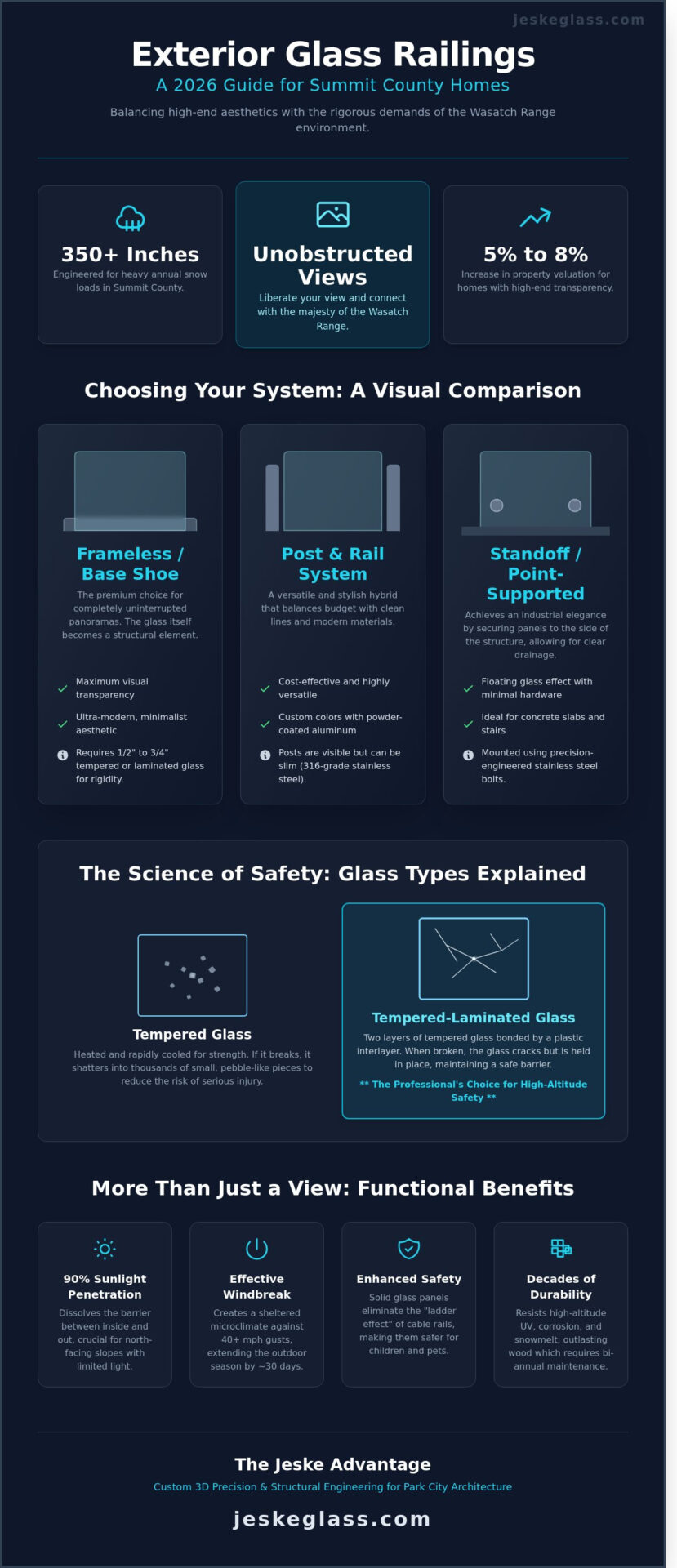
High-altitude decks in Utah frequently face wind gusts exceeding 40 miles per hour. A solid exterior glass railing acts as a sophisticated windbreak, creating a sheltered microclimate on the terrace. This thermal protection can extend the outdoor living season by approximately 30 days each year. Safety is equally paramount. Glass panels eliminate the “ladder effect” found in horizontal cable rails, which prevents children or pets from climbing. While cedar or redwood railings require intensive maintenance every 24 months due to high-UV exposure, tempered glass remains structurally inert and clear for decades.
- Structural Integrity: Engineered to withstand seismic shifts and heavy snow loads common in Summit County.
- Property Appreciation: Homes featuring high-end transparency solutions see a 5% to 8% higher valuation in the luxury market.
- Minimalist Profile: Eliminates visual clutter, allowing the architecture to speak for itself without interference.
The transition toward these systems reflects a broader shift in Utah’s premium construction sector. Architects now prioritize materials that offer permanence without imposing a heavy visual footprint. By choosing glass, designers solve the conflict between the need for safety and the desire for an unobstructed connection to the alpine environment. It’s a solution that balances engineering precision with the raw beauty of the Wasatch landscape.
Comparing Glass Railing Systems: Frameless, Post, and Standoff Designs
Choosing the appropriate architecture for an exterior glass railing requires a sophisticated balance between structural engineering and visual clarity. Each system dictates how light and space interact with the building’s envelope. Frameless designs prioritize the “invisible” look, relying on the glass itself to bear environmental loads. In contrast, standoff or point-supported systems achieve industrial elegance by securing panels to the side of concrete slabs using precision-engineered stainless steel bolts. For those who prefer minimalist floor-mounted hardware, talon or spigot systems provide clean lines while allowing for 100% unobstructed drainage beneath the glass panels.
Frameless Glass: The Premium Choice for Uninterrupted Panoramas
Frameless systems represent the pinnacle of modern transparency. These installations utilize a heavy-duty base shoe, which is a continuous U-shaped channel that grips the bottom edge of the glass. This method removes the need for vertical posts, making it the ideal application for rooftop decks or primary suite balconies where the view is the primary asset. To ensure absolute safety, these systems require 1/2-inch to 3/4-inch tempered or laminated glass. This specific thickness provides the necessary rigidity to withstand 120 mph wind gusts without the support of a traditional frame. The heavy glass panels don’t just provide a barrier; they act as a structural element of the architecture itself.
Post and Rail Systems: Balancing Budget and Style
Post systems offer a versatile hybrid look, combining slim metal profiles with glass infill panels. Designers typically select between 316-grade stainless steel or powder-coated aluminum. Stainless steel provides a timeless, high-sheen finish, while powder-coated aluminum allows for dozens of custom color options to match existing window frames. Incorporating a slim top rail often increases the psychological comfort of guests on high-altitude decks. Maintenance varies by material; stainless steel benefits from a bi-annual protective coating to prevent tea-staining, whereas powder-coated aluminum remains virtually maintenance-free for 15 to 20 years. You can view our portfolio of custom hardware to see these systems integrated into luxury Utah residences.
Engineering for the Wasatch: Safety Standards and Snow Load Requirements
Designing an exterior glass railing for the Wasatch Range demands a departure from standard architectural assumptions. In high-altitude environments like Park City, snow accumulation isn’t just a seasonal nuance; it’s a structural variable. Summit County building departments often require railings to withstand snow loads exceeding 100 pounds per square foot in specific micro-climates. We prioritize laminated glass over simple tempered panels because the SentryGlas ionoplast interlayer provides five times the tear strength of traditional PVB. This ensures that even if a rare impact occurs, the system maintains its physical barrier and structural integrity.
Precision begins long before the glass arrives on site. We utilize 3D laser measuring to map the mounting surface within a 1.5mm tolerance. This accuracy is vital for Salt Lake County projects where even a slight misalignment can lead to internal stress during the freezing and thawing cycles common to the Utah valley. High-performance projects rely on these exact measurements to ensure the hardware distributes weight evenly across the deck fascia or concrete slab.
Structural Integrity in Extreme Weather
Wind gusts in Parleys Canyon frequently surpass 100 mph, exerting immense lateral pressure on every square inch of an exterior glass railing. Our engineering accounts for the physics of thermal expansion, as glass panels fluctuate between -10°F during winter nights and 95°F under direct summer sun. Professional installation isn’t optional here. It’s the only way to ensure these forces don’t lead to hardware fatigue or glass binding within the base channels.
Safety and Compliance in 2026
The 2024 International Building Code, which dictates 2026 regional standards, mandates that glass guards must resist a concentrated load of 200 pounds applied to the top rail. We utilize heat-soak testing to mitigate the risk of spontaneous breakage caused by nickel sulfide inclusions. This process involves heating tempered glass to 550°F to trigger potential failures in the factory rather than on your balcony.
- IBC 2024 compliance requires a 4x safety factor for all glass components.
- Summit County regulations specify height minimums of 42 inches for residential guards.
- Salt Lake County mandates specific fastener embedment depths for cantilevered systems.
Structural glass for 2026 residential applications is defined as a load-bearing glazing assembly designed to maintain its protective position through high-modulus interlayers even after the total fracture of all glass plies.
Maintenance and Durability: Preserving Clarity in Utah’s Mountain Climate
Utah’s high-altitude environment presents unique challenges for architectural glass. At elevations like Park City’s 7,000 feet, UV radiation is approximately 70% stronger than at sea level. This intense exposure can degrade inferior laminates or cause hardware finishes to oxidize if they aren’t engineered for extreme conditions. Maintaining an exterior glass railing in this climate requires a sophisticated understanding of material science and local environmental stressors.
Cleaning Strategies for Large Glass Surfaces
Hard water spots are the primary aesthetic threat in the Wasatch Back. Utah’s groundwater often contains mineral concentrations exceeding 15 grains per gallon, which can etch glass if left untreated. We recommend a 50/50 solution of distilled water and organic white vinegar to dissolve these deposits without damaging the surrounding hardware. For those seeking a more permanent solution, factory-applied hydrophobic coatings are essential. These treatments create a molecular bond that repels water and oils, typically reducing maintenance frequency by 50% and preventing permanent mineral bonding.
- Spring: Conduct a deep clean to remove salt film and winter grime.
- Summer: Inspect for irrigation overspray that causes rapid mineral buildup.
- Autumn: Clear debris from base shoes to ensure proper drainage before the first freeze.
Hardware Protection and Care
The choice of metal is just as critical as the glass itself. In salt-heavy winter environments, standard 304-grade stainless steel often fails, leading to unsightly tea staining and structural pitting. We exclusively specify 316-grade stainless steel for mountain installations. This alloy contains 2% molybdenum, which specifically resists chloride-induced corrosion from road salts and de-icing agents. For a more contemporary aesthetic, anodized aluminum offers a 25-micron thick protective layer that’s virtually immune to the peeling often seen in traditional powder coatings.
Post-winter inspections are vital for long-term safety. Heavy snow loads can put immense pressure on mounting points. Homeowners should check for any hairline fractures in the mounting substrate or loosening of the standoffs after the spring thaw. Ensuring the structural integrity of your exterior glass railing preserves both the safety of your deck and the value of your architectural investment.
The Jeske Advantage: Custom 3D Precision for Park City Architecture
Jeske Glass represents a legacy of architectural precision and aesthetic dedication. With over 70 years of combined expertise in high-end Utah glass projects, our team approaches every exterior glass railing installation as a unique engineering challenge. We don’t believe in the compromises inherent in pre-fabricated kits. Instead, we rely on a sophisticated workflow that merges traditional craftsmanship with the most advanced digital tools available in the industry today.
Our process begins with an appreciation for the structural integrity of your home. We understand that a railing isn’t merely a safety feature; it’s a transparent boundary that defines your relationship with the Utah landscape. By maintaining full control over fabrication and installation, we ensure that every panel meets our rigorous standards for clarity, safety, and timeless design.
Precision Engineering with 3D Laser Technology
Mountain architecture in the Wasatch Range frequently utilizes organic materials like rough-hewn timber and natural stone. These surfaces are rarely perfectly level or plumb. To address this, we employ 3D laser measuring systems that capture millions of data points across your project site. This technology allows us to map irregularities with sub-millimeter accuracy, effectively eliminating the “gap” problem where glass meets uneven stone or wood.
- Perfect Alignment: We create a digital twin of your space to ensure glass panels follow the exact contour of complex, multi-level decks.
- Efficiency: Digital precision reduces onsite adjustments by 40%, leading to a cleaner and faster installation process.
- Structural Safety: A perfect fit ensures that wind loads are distributed evenly across the hardware, a critical factor for homes exposed to high-altitude gusts.
Your Local Park City Glass Partner
Choosing a local Utah fabricator offers distinct advantages over ordering generic components from out-of-state suppliers. We understand the specific thermal stresses of Draper summers and the heavy snow loads characteristic of Park City winters. Our team has recently completed bespoke exterior glass railing projects in the Colony at White Pine Canyon and luxury residences in Draper, proving our ability to execute complex visions in demanding environments.
When you partner with Jeske Glass, you gain direct access to master craftsmen who are personally invested in the success of your project. We handle everything from the initial site analysis to the final polishing of the hardware. This hands-on approach guarantees that your architectural vision is realized without the delays or errors common with third-party shipping and assembly. Schedule your free custom estimate for your Park City home today to experience the difference that 3D precision and local expertise bring to your property.
Refining Your Mountain Perspective through Precise Engineering
Choosing an exterior glass railing for a Park City home involves more than selecting a style; it’s about integrating structural resilience with the natural landscape. In the Wasatch Mountains, where local building codes often mandate systems capable of withstanding snow loads exceeding 100 pounds per foot, engineering precision is non-negotiable. Our team leverages 3D laser measuring technology to ensure every installation achieves sub-millimeter accuracy, fitting your unique architecture perfectly the first time. This level of detail is backed by over 70 years of combined experience in high-end glass solutions. We focus on local Utah craftsmanship, selecting materials that remain clear and secure despite 300 days of annual UV exposure and intense freeze-thaw cycles. By prioritizing transparency and safety, we transform balconies into immersive viewing platforms. Your home represents a significant investment, and its outdoor spaces should reflect that same commitment to quality and architectural permanence. Let’s build something that stands the test of time and weather together.
Request Your Free Custom Estimate for Park City Glass Railings
Frequently Asked Questions
Is an exterior glass railing safe for homes with heavy snow in Park City?
Yes, an exterior glass railing is engineered to withstand the extreme 300-inch annual snowfall typical of Park City. We utilize 12mm or 15mm tempered-laminated glass that meets the 50-pound per linear foot load requirement mandated by Utah structural standards. These systems remain stable during freeze-thaw cycles because the specialized hardware accommodates the thermal expansion of the glass without compromising the mounting points.
How much does a custom glass railing cost in Utah in 2026?
In 2026, premium custom glass railings in the Utah market typically range from $275 to $625 per linear foot. This investment reflects the use of high-clarity low-iron glass and precision-engineered stainless steel components. Final costs depend on the mounting system chosen, such as base shoes or standoff pins, which can influence the total project value by 15% to 20% depending on the complexity of the terrain.
Does an exterior glass railing meet local building codes in Summit County?
Yes, our installations strictly adhere to the 2024 International Building Code (IBC) standards required throughout Summit County. Each exterior glass railing must reach a minimum height of 42 inches for residential decks and withstand a concentrated load of 200 pounds applied at the top rail. We ensure every structural calculation aligns with local safety mandates to provide both aesthetic transparency and absolute legal compliance for your property.
How often do I need to clean my glass deck railing?
You should plan to clean your glass surfaces 2 to 4 times per year to maintain their architectural brilliance. In the Salt Lake Valley, where dust and mineral deposits are more frequent, a quarterly maintenance schedule’s optimal. Applying a professional hydrophobic coating can reduce cleaning frequency by 50% by preventing water spots and environmental debris from bonding to the surface during the rainy season.
Can glass railings break if something hits them?
While glass isn’t indestructible, the tempered safety glass we use is 4 to 5 times stronger than standard glass and resists impacts up to 24,000 psi. If a severe impact occurs, the laminated interlayer holds the fragments in place, preventing the panel from falling or creating dangerous shards. This structural redundancy ensures the barrier remains intact even if the glass surface’s compromised by a heavy object.
What is the difference between tempered and laminated glass for railings?
Tempered glass is heat-treated for strength, while laminated glass consists of two layers bonded by a 0.060-inch PVB or SGP interlayer. For elevated Utah decks, we recommend laminated glass because it provides superior post-breakage retention. If one layer fails, the interlayer maintains the system’s structural integrity, whereas simple tempered glass would shatter into small, non-threatening pieces but leave an open gap in the railing system.
Will a glass railing make my deck too hot in the summer?
No, glass railings don’t significantly increase deck temperatures because they don’t absorb or radiate heat like dark wood or composite materials. In fact, frameless designs allow for 15% better airflow than traditional solid balustrades, which helps dissipate heat on a 95-degree July afternoon. The transparency allows light to pass through rather than trapping thermal energy within the living space, keeping the area comfortable for guests.
How long does the installation process take for a custom glass project?
The complete timeline typically spans 3 to 6 weeks from the final site measurement to the finished installation. Once the custom-cut glass arrives from the tempering furnace, our master installers usually complete the physical setup within 2 to 4 business days. We prioritize precision during the initial 3D laser scanning phase to ensure the final glass panels fit with a tolerance of less than 1/16th of an inch.