In January 2023, a design firm in Park City recorded a 45-degree temperature drop within a single six-hour window, a shift that can push standard glazing to its absolute physical limit. When you’re investing in a high-end mountain residence, the choice between annealed vs tempered glass isn’t merely a line item on a budget; it’s a fundamental decision regarding the longevity of your architectural vision. You likely value the way expansive glass invites the Wasatch Range into your living space, and you want that connection to remain secure. You shouldn’t have to navigate complex safety requirements or worry about thermal stress alone.
This guide provides the clarity you need to select materials that meet the 10,000 PSI surface compression standards required for modern safety applications. You’ll discover the specific structural differences that make tempered glass the essential choice for high-impact zones and extreme mountain climates. We’ll outline the exact locations where local building codes demand safety glazing and how our engineering precision ensures your project remains a timeless, secure masterpiece.
Key Takeaways
- Understand the fundamental structural differences in annealed vs tempered glass to determine which material provides the necessary resilience for your architectural vision.
- Learn how advanced thermal processing creates the internal compressive stress required for high-traffic safety and long-term durability in luxury builds.
- Discover why Park City’s extreme alpine temperature fluctuations necessitate specific glass selections to mitigate the risk of thermal shock.
- Master the balance between transparency and safety by identifying the ideal glass type for every application, from expansive mountain vistas to interior partitions.
- Explore how 3D laser measuring technology ensures absolute precision, eliminating the margin of error for materials that cannot be modified after the tempering process.
Annealed vs Tempered Glass: Defining the Foundation of Your Project
Every architectural vision in Park City begins with a fundamental choice between transparency and structural integrity. The dialogue between annealed vs tempered glass isn’t merely a matter of budget; it’s a decision regarding how a material responds to environmental stress and physical impact. While all architectural glass begins as a molten mixture of silica sand and soda ash, its final performance characteristics are determined by the cooling curve it follows during production.
Distinguishing between decorative elements and structural requirements is vital for mountain homes. High-altitude environments introduce unique pressure differentials and temperature fluctuations that demand specific glass behaviors. Understanding these foundations ensures that the glass isn’t just a window to the landscape, but a resilient barrier that meets modern safety designations. This distinction is the bedrock of professional glazing, separating simple aesthetic choices from engineering necessities.
What is Annealed Glass?
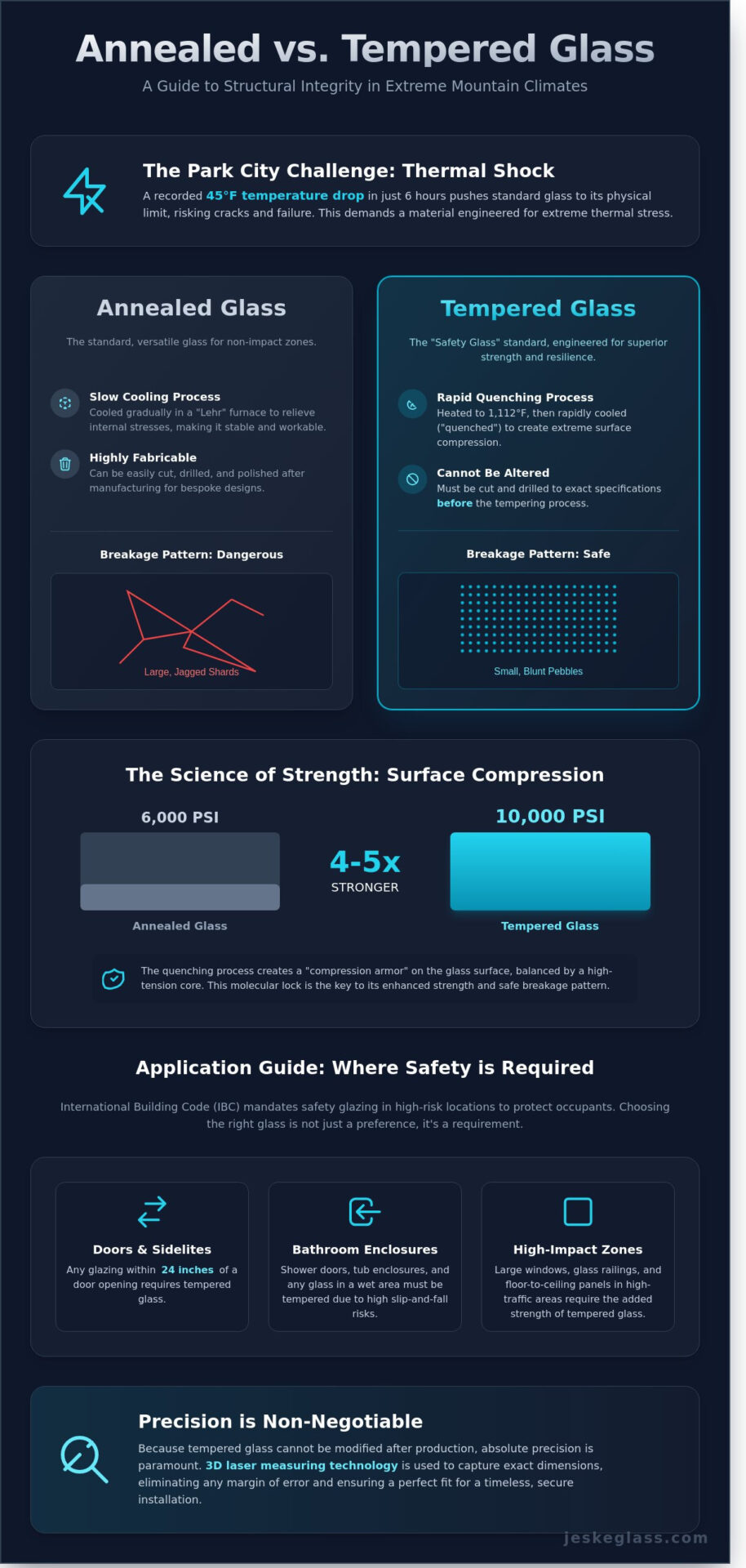
Annealed glass is the standard form of float glass that’s undergone a slow, controlled cooling process to relieve internal stresses. This thermal stability makes it exceptionally easy to fabricate; craftsmen can cut, drill, and polish it with surgical precision after it leaves the lehr. It provides approximately 90% light transmission, making it ideal for high-clarity applications where strength isn’t the primary concern. However, its vulnerability lies in its failure mode. When it breaks, it fractures into large, jagged shards that pose significant laceration risks, which is why it’s restricted to non-impact zones.
What is Tempered Glass?
Tempered glass is a high-performance material treated through extreme thermal processing to achieve superior resilience. By reheating the glass to 1,112°F and then rapidly cooling the exterior surfaces, we create a permanent state of surface compression. This engineering feat makes the glass 4 to 5 times stronger than annealed alternatives. It’s the primary “Safety Glass” used in modern architecture because of its unique failure mechanism. Instead of dangerous shards, it shatters into small, blunt pebbles that rarely cause serious injury. Under the International Building Code (IBC) 2021, this material is mandatory for any glazing within 24 inches of a door or in bathroom enclosures where slip-and-fall risks are elevated. Choosing annealed vs tempered glass in these zones isn’t just a design preference, but a regulatory requirement for occupant safety.
The Science of Strength: How Heat Transforms Glass Performance
Understanding the technical debate of annealed vs tempered glass requires a close look at molecular tension. Glass is naturally resilient under compression but remains vulnerable to tension. During fabrication, we manipulate these internal forces to define the pane’s final character. The manufacturing path chosen determines whether a piece of glass remains a versatile canvas for intricate detailing or becomes a structural powerhouse capable of withstanding extreme environmental loads.
The Controlled Cooling of Annealed Glass
Annealed glass undergoes a meticulous cooling journey within a specialized “Lehr” furnace. This kiln-like environment allows the material to reach room temperature at a glacial pace, effectively neutralizing the internal stresses that occur during the initial molten phase. Because the molecules settle without extreme tension, the resulting pane remains workable for post-production artisan work. Architects often specify annealed glass for bespoke mirrors or intricate cabinetry where 1/16-inch precision in drilling or edge polishing is vital. However, its 6,000 psi surface compression limit makes it unsuitable for high-traffic zones or areas exposed to the 40-degree temperature swings common in Utah winters.
The Thermal Tempering Process for Maximum Durability
To create a safety material, we subject the glass to a rigorous thermal cycle. The process begins by heating the pane to a critical threshold of 1,100 degrees Fahrenheit. Once the glass reaches this plastic state, high-pressure air nozzles perform “quenching,” cooling the outer surfaces instantly while the core remains hot. This creates a permanent state of 10,000 psi compression on the exterior and high tension in the center.
Tempered glass is a pre-stressed safety material designed for high-impact zones.
Once this molecular lock is set, the glass cannot be altered. Any attempt to cut or drill a tempered pane will cause it to shatter into thousands of small, blunt cubes. This reality makes precise measurement and expert technical planning a non-negotiable prerequisite for any Park City installation. While annealed glass might fail at a 100-degree temperature differential, tempered glass withstands shifts of up to 400 degrees. This thermal resistance is essential for south-facing floor-to-ceiling windows that absorb intense high-altitude solar radiation throughout the day.
- Mechanical Strength: Tempered glass offers four to five times the impact resistance of annealed alternatives.
- Safety Protocols: Annealed glass breaks into large, sharp shards; tempered glass disintegrates into relatively harmless granules.
- Thermal Tolerance: Tempering allows glass to survive rapid heating and cooling cycles that would otherwise cause thermal fractures.
Safety and Durability in Utah’s Extreme Mountain Climate
Park City’s geography demands more from architectural glazing than typical low-elevation environments. At 7,000 feet, the atmosphere is significantly thinner, which results in intensified UV radiation and aggressive temperature fluctuations. These environmental factors make the comparison of annealed vs tempered glass a critical discussion regarding structural longevity and occupant safety.
Utah’s mountain climate presents a unique challenge known as thermal shock. This occurs when a single pane of glass experiences a temperature differential of 100 degrees or more between its center and its edges. In a luxury mountain estate, a large window may be exposed to -15°F exterior air while simultaneously absorbing heat from the high-altitude sun. Standard glass lacks the internal tension to manage this uneven expansion, often leading to spontaneous stress fractures that compromise the building envelope.
Shatter Patterns: Pebbles vs. Shards
The failure point of glass reveals its true character. Annealed glass breaks into long, dagger-like shards that can cause life-threatening injuries. Tempered glass functions as a structural crumple zone, absorbing impact energy and disintegrating into small, relatively harmless granules. Because of this safety profile, the International Residential Code (IRC) Section R308 strictly prohibits non-tempered glass in hazardous locations. This includes any glazing within 24 inches of a door or in wet environments like steam showers where slip hazards are high.
Thermal Stress and Snow Loads in Park City
Exterior installations like glass deck railings must endure immense physical pressure. In Summit County, building codes require these structures to support a concentrated load of 200 pounds or a uniform load of 50 pounds per linear foot. When you add the weight of a 12-inch heavy snowfall, the pressure becomes immense. Tempered glass is 400% stronger than its annealed counterpart, making it the only material capable of maintaining transparency without sacrificing structural integrity under Utah’s winter conditions.
- UV Resistance: High-altitude sun accelerates the degradation of inferior sealants, but tempered glass maintains its clarity and strength.
- Wind Resistance: Tempered panels withstand gusts up to 120 mph, which are common along Park City’s ridgelines during winter storms.
- Impact Safety: The pebble-like break pattern of tempered glass minimizes liability in high-traffic residential areas and households with children.
Choosing the correct glazing isn’t just about aesthetics; it’s about engineering a home that stands resilient against the elements. While annealed vs tempered glass might look identical to the untrained eye, their performance during a Park City blizzard tells two very different stories. Professional installation ensures these materials meet the rigorous demands of the Wasatch Back.
Application Guide: Where to Use Each Type in Your Home
Architectural glass selection for a luxury build requires a room-by-room strategy. You don’t need to over-engineer every pane; instead, focus on where strength is mandatory and where clarity is king. The decision between annealed vs tempered glass often dictates the entire visual language of a space. Tempered glass provides a 400% increase in strength compared to standard glass, enabling the bespoke look of massive, frameless glass walls that define modern Park City mountain homes. These structural panels allow for expansive views without the interruption of heavy mullions or visible support frames.
Aesthetic trade-offs remain a critical consideration for designers. Annealed glass offers a level of surface consistency and flatness that tempered glass occasionally lacks due to the heat-treatment process. By using annealed glass in non-hazardous areas, homeowners can reduce material costs by approximately 15% to 25%. This strategic budget allocation ensures more resources are available for the high-performance structural glass required for grand entrances and master suites. Professional glaziers analyze every opening to ensure the glass thickness, which often ranges from 6mm to 19mm in luxury builds, matches both the safety needs and the desired edge profile of the room.
When Tempered Glass is Legally Required
Safety glazing is non-negotiable in specific zones defined by the International Building Code (IBC) and local Park City regulations. In the “Wet Zone,” every frameless shower enclosure must utilize tempered glass to withstand thermal stress and accidental impact. Staircase railings and balcony balustrades require the structural rigidity of tempered panels; these surfaces must support a concentrated load of 200 pounds per square foot. Any glass within 24 inches of a door opening or situated less than 18 inches from the floor must also be tempered to prevent severe injury during a collision. These rules ensure that any breakage results in small, blunt granules rather than dangerous shards.
Ideal Uses for Annealed Glass in Decorative Elements
Annealed glass excels where optical perfection is the primary objective. Custom vanity mirrors and backsplashes benefit from the superior flatness of annealed sheets. The tempering process can introduce subtle “roller wave” distortions, which are unacceptable in high-end mirrors where a 1mm deviation can warp a reflection. High-set decorative windows and interior cabinet doors are perfect candidates for annealed glass. This choice allows for more intricate edge polishing and custom beveling that is difficult to achieve after tempering. It also serves as the premier substrate for high-end laminated mirrors, ensuring the final reflection remains crisp and true to life.
The Jeske Glass Precision: 3D Laser Measuring for High-End Projects
The technical boundary between annealed vs tempered glass is most visible during the final installation phase. While annealed glass offers the flexibility of field-cutting and edge-work, tempered glass is a finished structural component. Once the glass undergoes the thermal tempering process, its internal tension reaches a state of permanent equilibrium. Any attempt to drill, notch, or trim the panel afterward will trigger an immediate and total release of energy, shattering the glass into thousands of small fragments. This creates a zero-margin environment where precision isn’t just a goal; it’s a structural requirement.
Our “No Mistakes” rule dictates that every measurement must be absolute before the glass enters the furnace. In the demanding climate of Park City, where temperature fluctuations and structural settling are common, guessing is never an option. We treat every pane as a bespoke architectural element that must integrate seamlessly with the existing building envelope. This commitment to accuracy ensures that the aesthetic vision of the designer remains uncompromised by unsightly gaps or forced fits.
The Role of 3D Laser Technology in Custom Glass
Park City’s high-end mountain homes often feature complex architecture, including hand-carved timber frames and natural stone masonry. These organic materials rarely produce perfectly plumb walls or square corners. Traditional measurement tools often fail to capture the subtle deviations found in custom builds, leading to delays and wasted material. We utilize advanced 3D laser scanning to create a digital twin of the installation space, capturing every undulation and out-of-plumb surface with a precision of 1/16th of an inch.
This digital precision is the only way to ensure a frameless shower door creates a perfect, watertight seal against a textured tile wall. Jeske Glass uses 3D laser scanning to ensure tempered glass fits perfectly the first time. By mapping the environment digitally, we eliminate the guesswork associated with annealed vs tempered glass transitions, ensuring that every structural glass railing and oversized window fits its opening with surgical accuracy.
Partnering with Jeske Glass for Your Next Project
With over 70 years of combined experience in the Utah glass industry, our team understands the unique technical demands of high-elevation construction. We don’t view ourselves as mere suppliers. We’re technical consultants who bridge the gap between ambitious architectural transparency and rigorous safety standards. Architects and designers in Park City trust our expertise because we prioritize the structural integrity of the glass as much as its visual clarity.
Our process moves from detailed consultation to digital site mapping, ensuring that the final installation is as quiet and effortless as the glass itself. We take pride in solving the engineering challenges that others avoid, providing a level of stability and professional alreadiness that defines the Jeske Glass brand. Whether you’re designing a minimalist glass staircase or a sprawling mountain estate, our team provides the technical foundation your project requires.
Mastering Your Park City Architectural Vision
Selecting between annealed vs tempered glass is a decision that dictates the long-term safety and aesthetic integrity of your mountain residence. In Park City, where seasonal temperature shifts are extreme, the structural resilience of tempered glass is a necessity for expansive views and high-traffic areas. Our craftsmen bring 70 years of combined local Utah expertise to ensure every panel meets rigorous engineering standards. We specialize in high-end frameless shower doors and modern glass railings that require a delicate balance of transparency and strength. Precision is our baseline. To achieve this, we utilize advanced 3D laser measuring technology that eliminates human error and guarantees a perfect fit for every unique opening. This level of technical rigor transforms a simple renovation into a lasting architectural statement. You don’t have to compromise on safety to achieve a sophisticated, light-filled home when you partner with experts who respect the nuances of premium materials.
Elevate your Park City home with custom glass and request a free estimate today.
Your vision deserves the clarity and strength that only master craftsmanship can provide.
Frequently Asked Questions
Is tempered glass more expensive than annealed glass?
Tempered glass typically costs 25% to 40% more than annealed glass due to the additional thermal processing required during manufacturing. This price reflects the specialized cycle where the glass is heated to 1,112 degrees Fahrenheit and rapidly cooled to create internal tension. While the initial investment is higher, the enhanced durability and safety compliance in high-traffic Park City residences justify the cost over the long term.
Can you cut tempered glass if it doesn’t fit during installation?
You cannot cut or drill tempered glass once the toughening process is complete because any alteration will cause the entire pane to shatter into small granules. All measurements and fabrication, including holes for hardware, must be finalized with 1/16th inch precision before the glass enters the tempering furnace. This engineering requirement ensures the structural tension remains balanced, preserving the integrity of the architectural installation.
What happens if annealed glass breaks?
Annealed glass fractures into large, razor-sharp shards that pose a significant laceration risk to occupants. These jagged fragments can reach lengths of 12 inches or more, making them particularly dangerous in residential settings. Because it lacks the internal compressive stress of safety glass, it’s generally restricted to areas where the risk of human impact is minimal according to IBC 2406 safety standards.
How can I tell if the glass in my home is tempered or annealed?
You can identify tempered glass by locating a permanent laser-etched “bug” or monogram in one of the corners, which confirms it meets ANSI Z97.1 standards. If no mark is visible, viewing the pane through polarized sunglasses may reveal a faint pattern of “strain spots” caused by the heat treatment. Understanding the distinction between annealed vs tempered glass is essential for maintaining the safety protocols of your architectural glazing.
Why is tempered glass required for shower doors in Utah?
Utah Building Code R308.4 mandates tempered glass for shower enclosures to prevent life-threatening injuries in slippery environments. Since the glass is four times stronger than standard panes, it withstands accidental impacts that occur in 5% of bathroom slips. In the rare event of failure, the glass breaks into dull cubes rather than sharp slivers, ensuring the highest level of protection for residents.
Does tempered glass look different than annealed glass?
Tempered glass maintains the same 90% light transmission and visual clarity as annealed glass, making them indistinguishable to the untrained eye. Under specific lighting conditions, you might notice a slight “roller wave” distortion of 0.003 inches, which is a natural byproduct of the horizontal tempering process. This minor variance doesn’t compromise the aesthetic elegance or the sophisticated transparency required for premium Park City mountain views.
Can extreme cold in Park City cause glass to break?
Extreme temperature fluctuations in Park City, where winter lows reach -10 degrees Fahrenheit, can cause annealed glass to crack due to thermal stress. When the interior face is heated to 70 degrees while the exterior remains sub-zero, the 80-degree temperature differential creates tension. Choosing annealed vs tempered glass for these conditions is a critical decision, as tempered glass resists thermal shock up to 470 degrees Fahrenheit.
Is laminated glass the same as tempered glass?
Laminated glass consists of two glass layers bonded with a 0.030-inch polyvinyl butyral (PVB) interlayer, whereas tempered glass is a single heat-treated pane. While both are safety-rated, laminated glass remains held in the frame if broken, providing a 99% UV block and superior sound dampening. We often specify a combination of both technologies for high-altitude projects to maximize security and acoustic comfort.