In the high-altitude environments of Park City, where the 2026 residential building standards are becoming increasingly stringent, the choice between annealed versus tempered glass is no longer just a design preference; it is a critical engineering decision that dictates the structural integrity of your home. You likely understand that a luxury mountain residence requires materials that can withstand both the aesthetic demands of modern architecture and the harsh thermal stresses of Utah’s winters. It’s a delicate balance between achieving the transparency of an architectural masterwork and ensuring the absolute safety of every occupant.
This guide will help you master the technical nuances of these glass types so you’ll ensure your renovation aligns with Title 15A of the Utah State Construction and Fire Codes while maintaining the light that defines your space. We’ll examine the specific safety requirements for high-traffic areas, the 25% cost variance between standard and heat-treated options, and how the 7,000-foot elevation of Summit County necessitates unique pressure-equalization strategies for your glass installations. You’ll gain the confidence to select the right material for every architectural feature, from expansive floor-to-ceiling vistas to minimalist structural glass railings.
Key Takeaways
- Understand the fundamental manufacturing distinctions of annealed versus tempered glass to determine which material provides the necessary structural integrity for your specific architectural vision.
- Discover how distinct breakage patterns influence the safety of your living environment and why specialized safety glazing is essential for protecting both family and guests.
- Navigate the complexities of Utah’s building codes to ensure your Park City residence remains compliant and resilient against extreme high-altitude temperature fluctuations.
- Learn to create a strategic material map for your renovation that harmonizes sophisticated aesthetic transparency with the rigorous functional demands of modern safety standards.
- Explore how advanced 3D laser technology and precision engineering eliminate fabrication risks, ensuring flawless execution and long-term durability for luxury glass installations.
Defining the Standard: Annealed versus Tempered Glass for Park City Architecture
In the high-altitude environment of Park City, where elevations often exceed 7,000 feet, the glass in a luxury residence does more than frame a view of the Wasatch Range. It acts as a sophisticated thermal and structural barrier. Choosing between annealed versus tempered glass represents the first critical decision in a project’s engineering phase. This choice dictates how the material responds to the 40-degree Fahrenheit temperature swings common in Utah’s mountain climate. Material selection serves as the foundation of architectural integrity, ensuring that transparency never comes at the expense of performance.
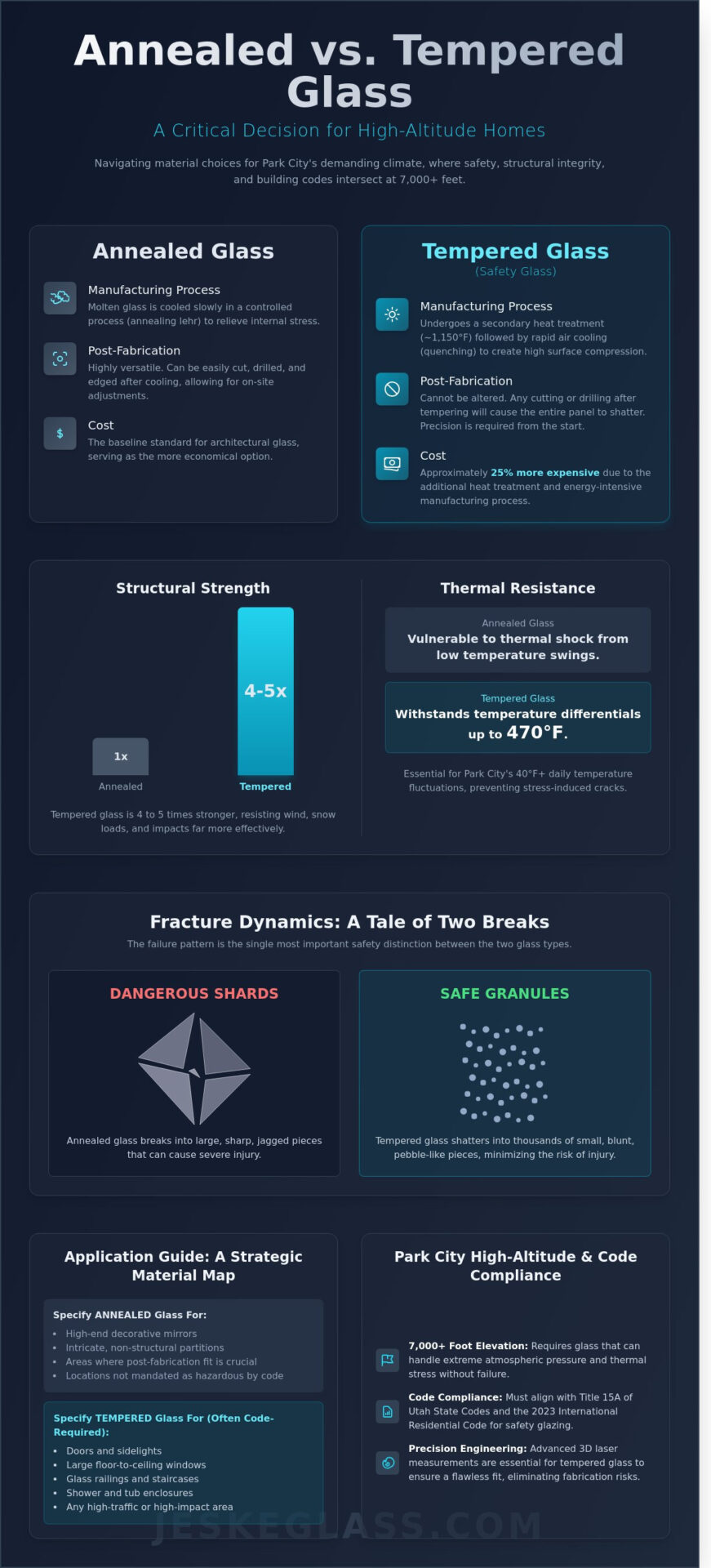
- Thermal Resistance: Tempered glass handles temperature differentials up to 470 degrees Fahrenheit, whereas annealed glass may crack under much lower thermal stress.
- Fracture Pattern: Annealed glass breaks into large, sharp shards; tempered glass disintegrates into small, relatively blunt granules.
- Surface Compression: Tempered glass requires a minimum surface compression of 10,000 psi to meet safety standards.
What is Annealed Glass?
Annealed glass is the foundational state of most architectural glazing. During production, the molten glass undergoes a slow, controlled cooling process within an annealing lehr. This deliberate thermal reduction relieves internal stresses, allowing the material to reach a stable, workable state. Its primary characteristic is versatility. Technicians can cut, drill, or edge-work the panels after they’ve cooled. In bespoke Park City estates, we specify annealed glass for applications where safety glazing isn’t mandated by the 2023 International Residential Code. It’s often the preferred choice for high-end mirrored surfaces or intricate decorative partitions where post-fabrication adjustments are necessary for a precise fit against custom stonework.
What is Tempered Glass?
Tempered glass, categorized as safety glass, undergoes a secondary thermal treatment that fundamentally alters its molecular tension. The glass is reheated to approximately 1,148 degrees Fahrenheit before being subjected to high-pressure air blasts, known as quenching. This rapid cooling leaves the core in tension while the surfaces remain in high compression. The result is a panel four to five times stronger than its annealed counterpart. It’s built to withstand the intense wind loads and heavy snow accumulation characteristic of Deer Valley winters. 10. Precision is the hallmark of this material. Once the tempering process concludes, the glass’s internal balance is permanent. Any attempt to cut or drill the surface will result in the entire panel shattering. This “all-or-nothing” nature requires absolute accuracy during the initial measurement stages. For the expansive floor-to-ceiling vistas required in modern mountain contemporary designs, understanding the properties of annealed versus tempered glass allows architects to utilize larger, heavier spans of glass without compromising the safety of the inhabitants.
Structural Integrity and Breakage Patterns: Why Strength Matters
The structural performance of glass determines both the longevity and the safety of a luxury residence. When evaluating annealed versus tempered glass, the primary distinction lies in the internal tension created during the manufacturing process. Annealed glass is allowed to cool slowly; this minimizes internal stress but leaves the material vulnerable to thermal shock and physical impact. In contrast, tempered glass undergoes a controlled thermal treatment, heating the pane to approximately 620 degrees Celsius before rapid air cooling. This creates a state of permanent compression on the surface, balanced by tension in the core, giving the material its signature resilience.
Fracture Dynamics: Shards vs. Pebbles
The way glass fails is a critical design consideration for high-traffic areas and grand entrances. Annealed glass breaks into large, jagged shards that pose a significant risk of injury. These sharp pieces can cause severe lacerations because they maintain their mass and velocity during a fall. Tempered glass reacts differently. Upon reaching its breaking point, the internal tension causes the entire pane to disintegrate into small, relatively blunt pebbles. This dicing pattern is why tempered glass is classified as safety glazing under the International Building Code (IBC) 2024 standards. For a Park City estate with expansive glass walls, this transition from dangerous shards to harmless granules ensures that a minor accident doesn’t become a medical emergency.
Impact Resistance and Durability
Durability is a non-negotiable requirement for Utah Valley’s demanding climate. Tempered glass offers four to five times the strength of standard annealed panes. While annealed glass might crack under a surface pressure of 3,000 pounds per square inch, tempered variants typically withstand over 10,000 psi. This resilience is vital for structural transparency in modern architecture where glass often serves as a primary barrier against the elements.
- Tempered glass resists thermal stress caused by 50-degree temperature swings common in mountain microclimates.
- Load-bearing limits for tempered glass allow for thinner, more elegant profiles without sacrificing stability.
- Annealed glass remains susceptible to edge damage, which can propagate into full-length cracks during winter freezes.
Architects seeking to push the boundaries of transparency often rely on these technical margins. Achieving a seamless connection between interior spaces and the rugged Wasatch landscape requires a deep understanding of these material limits. If you’re planning a project that demands this level of structural precision and aesthetic clarity, selecting the right glass type is the first step toward an enduring architectural statement. The choice between annealed versus tempered glass isn’t just about meeting code; it’s about engineering peace of mind into the very fabric of the home.
Utah Building Codes and High-Altitude Considerations in Park City
Building a luxury residence at 7,000 feet requires more than just an eye for mountain modern aesthetics; it demands a rigorous adherence to the International Building Code (IBC) standards that govern the Wasatch Back. Achieving a seamless blend of transparency and safety hinges on technical precision. Understanding the structural distinction between annealed versus tempered glass isn’t merely an architectural choice. It’s a legal necessity for homeowners and designers aiming for permit approval in Summit County.
Local building officials enforce strict safety glazing requirements to protect occupants from accidental impact. These regulations are particularly stringent in high-traffic areas and zones where moisture increases the risk of slips. Professional consultation ensures that every glass installation, from expansive floor-to-ceiling vistas to delicate interior partitions, meets the 2021 IBC standards adopted by Utah.
Navigating Safety Glazing Requirements
The IBC Section 2406 identifies “hazardous locations” where annealed glass is strictly prohibited due to its tendency to shatter into sharp shards. In these zones, tempered safety glass is the mandatory standard. For example, any frameless glass shower Utah installations must utilize fully tempered glass to ensure that if a break occurs, the material disintegrates into small, blunt granules. Similar rules apply to glass railings on Park City decks, which must withstand both human impact and specific wind loads defined by local zoning. Any glass within 24 inches of a door or 36 inches of a walking surface typically requires tempering to pass inspection.
Thermal Stress in Mountain Climates
Park City’s environment is uniquely unforgiving for architectural glass. High-altitude UV exposure increases by approximately 4% for every 1,000 feet of elevation gain. This means a home in Deer Valley experiences roughly 28% more solar radiation than a coastal property. This intense energy creates significant thermal gradients across a single pane of glass. When comparing annealed versus tempered glass for mountain use, tempered options are far superior at resisting thermal breakage.
Thermal stress cracks often occur in annealed glass when the center of the pane heats rapidly under direct sunlight while the edges remain cold within the frame. Tempered glass undergoes a specialized heating and cooling process that gives it four times the strength of standard glass, allowing it to endure 40-degree temperature swings in a single afternoon without compromising its structural integrity. For large-scale custom installations, this resilience is the difference between a lasting architectural statement and a costly maintenance failure.
- Wind Load Resistance: Tempered glass handles the high-velocity canyon winds common in the Wasatch Range.
- Snow Load Support: Horizontal glazing or skylights must be engineered to support heavy Utah powder loads, often requiring laminated-tempered hybrids.
- Permit Efficiency: Working with a specialist who understands Park City’s specific amendments to the IBC prevents delays during the final walkthrough.
The integration of high-performance glass into a mountain home is a complex feat of engineering. It’s not enough to simply choose a beautiful product. The selection must account for the physical realities of altitude, climate, and code. Trusting a partner with deep local expertise ensures that your vision remains both breathtaking and compliant with Utah’s rigorous safety standards.
Application Guide: Where to Specify Tempered vs. Annealed Glass
Designing a luxury residence in Park City requires a meticulous material map that balances structural integrity with aesthetic transparency. Every glass surface serves a distinct purpose. The choice between annealed versus tempered glass isn’t merely a line item in a budget; it’s a strategic decision that affects the safety, longevity, and visual clarity of your home. By understanding where to apply each variety, you ensure your architectural vision meets 2026 safety standards without sacrificing the delicate details that define high-end design.
High-Traffic and Impact Zones
Safety codes and liability concerns dictate the use of tempered glass in what the International Building Code (IBC) defines as hazardous locations. Any glass panel within a 24-inch arc of a door’s vertical edge must be tempered to prevent injury during accidental collisions. This rule applies regardless of the pane’s size. For homeowners investing in custom glass railings Salt Lake City designers specify tempered or tempered-laminated glass to provide 400% more impact resistance than standard alternatives. Floor-to-ceiling gym mirrors and partitions also require this treatment. The heat-strengthening process ensures that if a heavy weight or high-velocity impact occurs, the glass disintegrates into small, relatively harmless granules rather than dangerous shards.
Decorative and Low-Risk Installations
Annealed glass remains the preferred medium for bespoke decorative elements where human impact is highly unlikely. Because it lacks the internal tension found in heat-treated panels, it allows for more precise edge-work, intricate bevelling, and complex water-jet cutting. It’s the ideal choice for high-end cabinetry, specialized display cases, and traditional wall-mounted mirrors. In these low-risk zones, the decision between annealed versus tempered glass shifts toward optical perfection. Annealed glass offers a flatter surface with fewer distortions, which is essential for the 100% clarity required in luxury walk-in closets or wine cellar displays. Choosing annealed glass for non-structural partitions also provides a cost-effective solution that redirects your budget toward premium finishes or hardware.
Strategic glass selection defines the safety and sophistication of a modern mountain estate. Our team helps you navigate these technical specifications to ensure every room reflects the highest standards of craftsmanship. Contact Jeske Glass today to request a technical consultation for your Park City renovation project.
Precision Engineering: The Jeske Glass Approach to Material Selection
The choice between annealed versus tempered glass isn’t merely a line item on a specification sheet. It represents the foundation of a home’s structural integrity and visual clarity. At Jeske Glass, we view the fabrication process as a bridge between architectural theory and physical reality. Every panel destined for a Park City estate undergoes a rigorous vetting process that begins long before the glass reaches the tempering furnace. This meticulous preparation ensures that the final product doesn’t just meet building codes but exceeds the aesthetic expectations of the most discerning homeowners.
3D Laser Measuring for Perfect Tempering
Traditional tape measures often fail when faced with the complex, non-linear geometries of modern mountain architecture. A discrepancy of even 2 millimeters can lead to catastrophic failure once glass is tempered, as this material cannot be altered after its thermal treatment. We utilize 3D laser scanners that capture spatial data with 0.5mm precision. These digital twins allow our engineers to identify potential fitment issues in the design phase. This digital accuracy reduces onsite installation lead times by 15% and eliminates the waste associated with re-ordering mismeasured panels. It’s a level of certainty that manual methods simply can’t replicate.
Bespoke Fabrication in Utah Valley
Working with a local custom glass Utah specialist provides distinct advantages for high-altitude projects. Park City homes frequently sit at elevations exceeding 7,000 feet, where atmospheric pressure and intense UV exposure dictate specific material behaviors. We perform all critical fabrication, including edge polishing, notch cutting, and hole drilling, before the glass enters the oven. This sequence is vital because any post-tempering modification would instantly shatter the internal tension of the pane. By handling these processes in our Utah Valley facility, we maintain total control over the cooling rates and edge quality, ensuring every piece meets the dignified standards of Jeske Glass craftsmanship.
We pair these high-performance glass types with premium hardware systems designed for longevity. Our selection includes heavy-duty pivot hinges and structural point-glazing systems that complement the transparency of the glass. By managing the synergy between glass and metal, we ensure that the final installation remains as silent and secure as it was on day one. Our commitment to this level of detail reflects a deep respect for the architectural vision. When you understand the nuances of annealed versus tempered glass, you realize that the difference between a standard build and a luxury masterpiece lies in these precise engineering choices. We don’t just deliver glass; we provide an enduring lens through which you view the world.
Elevating Park City’s Architectural Vision Through Precision Glazing
Park City’s 7,000-foot elevation and extreme thermal shifts demand more than standard glazing. Choosing between annealed versus tempered glass isn’t just a code requirement; it’s a structural necessity for mountain modern luxury. Our team brings 70 years of local Utah experience to ensure every pane survives the 40-degree temperature swings common in Summit County. We utilize proprietary 3D laser technology to achieve tolerances within 1/16th of an inch, eliminating the common gaps that compromise thermal efficiency.
Your residence deserves a partner that views glass as a structural art form. We specialize in the complex engineering required for expansive vistas that meet 2026 Utah building safety standards. Whether you’re specifying high-clarity annealed panels for decorative partitions or heat-strengthened tempered units for floor-to-ceiling facades, the technical execution must be flawless.
Schedule your free 3D laser measurement and consultation with Jeske Glass today to secure your home’s legacy. Your vision for a transparent, light-filled sanctuary is within reach.
Frequently Asked Questions about Architectural Glass
Is tempered glass more expensive than annealed glass in Utah?
Tempered glass typically costs 25% to 40% more than annealed glass in the Utah market. This price difference covers the specialized thermal processing where the glass is heated to 1,100 degrees Fahrenheit and rapidly cooled. While the upfront investment is higher, the increased durability often prevents the need for costly replacements in high-traffic luxury environments.
Can I cut tempered glass if it doesn’t fit my Park City installation?
You can’t cut or drill tempered glass once the thermal strengthening process is finished. Any attempt to alter the dimensions will cause the entire pane to explode into thousands of small, blunt fragments. Every hole, notch, or edge treatment must be completed while the glass is in its annealed state before it enters the furnace for strengthening.
What happens if annealed glass breaks in my home?
Annealed glass breaks into large, razor-sharp shards that can cause severe injury or property damage. These fragments don’t crumble like safety glass; they create dangerous “guillotine” pieces that can exceed 15 inches in length. Because of this failure pattern, we recommend replacing large annealed panes in areas where children or guests might accidentally impact the surface.
How can I tell if the glass in my home is tempered or annealed?
Look for a permanent laser-etched stamp, usually located in one of the bottom corners of the pane. This mark, known as a “bug,” confirms the glass meets CPSC 16 CFR 1201 safety standards. If no mark is visible, a professional can use a polariscope to detect the internal stress patterns that distinguish tempered surfaces from standard annealed ones.
Does Park City building code require tempered glass for all windows?
Park City building codes, based on the 2021 International Residential Code, only require tempered glass in specific hazardous locations. These zones include windows within 24 inches of a door or any glass pane larger than 9 square feet situated less than 18 inches from the floor. Safety glazing is also mandatory for all glass within 60 inches of a bathtub or shower drain.
For homeowners looking to upgrade their home’s overall performance and safety, it can be a good opportunity to explore replacement windows that meet current codes and offer better energy efficiency.
Is tempered glass the same as safety glass?
Tempered glass is a specific type of safety glass, but the category also includes laminated and filmed options. While tempered glass is 4 times stronger than standard panes, safety glass is a broader classification for any glazing designed to reduce injury when broken. For high-end Park City residences, we often combine these technologies to provide both impact resistance and acoustic insulation.
How does high altitude in Park City affect glass durability?
The 7,000-foot elevation in Park City creates a pressure imbalance that can cause standard glass units to bulge or shatter. When evaluating annealed versus tempered glass for mountain climates, tempered glass is the superior choice because it withstands the 10,000 psi of surface compression required to resist these atmospheric forces. We install capillary tubes in most high-altitude units to equalize internal and external pressure.
Can annealed glass be used for frameless shower doors?
Annealed glass is never used for frameless shower doors because it can’t support the structural load of the heavy hardware. Safety regulations and the 2021 IRC require tempered glass for all bathroom enclosures to prevent catastrophic injury. In the context of annealed versus tempered glass, the latter provides the 10-millimeter or 12-millimeter thickness necessary to ensure a stable, self-supporting, and safe shower environment.