
In the world of high-end Utah architecture, there’s no such thing as a truly square room or a perfectly plumb wall. Even the most masterfully crafted spaces possess subtle irregularities that traditional tape measures simply cannot capture, making 3D laser measurement for glass an absolute necessity rather than a luxury. You’ve likely felt that familiar anxiety when ordering custom frameless showers or complex glass railings, fearing that a single manual miscalculation will lead to unsightly gaps or the frustration of a total re-fabrication. When you’re investing in premium materials, “close enough” is never an acceptable standard for a sophisticated finish.
We understand that in luxury design, precision is the silent partner of aesthetics. By utilizing the Flexijet Laser System, we capture data points with an accuracy range of 0.02 mm to 0.1 mm, effectively eliminating the human error that often plagues traditional measurement methods. This article demonstrates how digital scanning ensures seamless glass-to-wall transitions and helps your project meet the rigorous 2024 International Building Code standards for safety and performance. You’ll discover how we transform complex architectural visions into flawless, zero-gap realities through the power of advanced metrology and technical expertise.
Key Takeaways
- Learn how sub-millimeter precision replaces the traditional 1/16th-inch margin of error to eliminate unsightly silicone gaps in luxury installations.
- Understand the process of 3D laser measurement for glass and how it maps thousands of data points to account for non-square architectural realities.
- Discover why digital as-built models are essential for achieving a seamless “floating” aesthetic in complex frameless shower and railing projects.
- See how advanced scanning ensures your custom installation remains fully compliant with Utah’s 2024 safety glazing and structural building codes.
- Find out how the “First-Time Fit” methodology protects your investment by removing the need for costly re-fabrications and manual site adjustments.
The Evolution of Precision: Why 3D Laser Measurement is Essential for Modern Glass
In the pursuit of architectural excellence, the margin for error has narrowed to the point where traditional instruments no longer suffice. For decades, the industry relied on the physical template and the tape measure to bridge the gap between a design and its execution. However, as modern design pushes the boundaries of transparency and structural minimalism, 3D laser measurement for glass has emerged as the definitive standard for high-stakes installations. This technology isn’t merely a convenience; it’s a fundamental shift in how we interpret and master physical space.
In Park City, the “Mountain Modern” aesthetic demands expansive glass partitions and frameless railings that seem to vanish into the surrounding landscape. Achieving this weightless look requires an invisible fit. When measurements are “good enough,” the result is often an over-reliance on thick silicone joints to mask gaps between the glass and the wall. These wide beads of caulk don’t just compromise the visual purity of the project; they can signal underlying structural instability. Precision is the only way to ensure that the glass performs as a structural element while maintaining the clean lines that define luxury architecture.
Beyond the Tape Measure: The Limits of Manual Tools
Every residential wall, regardless of the builder’s skill, exists in a state of “out-of-plumb” reality. A standard level might suggest a wall is straight, but it cannot account for the subtle bows, twists, and crowning inherent in drywall and timber. Manual recording remains the primary cause of glass re-fabrication. A single misread 1/16th of an inch or a slight tilt of a tape measure can render a custom panel useless. By utilizing 3D laser scanning, we replace human guesswork with digital certainty. This provides a level of psychological peace of mind for both the architect and the homeowner, knowing the glass will arrive exactly as the space requires, without the need for messy on-site adjustments.
Defining the Digital Twin for Glass Fabrication
The process begins by creating a digital twin, which is a 1:1 virtual replica of the physical environment captured in real-time. This data doesn’t sit idle. It integrates directly with CNC glass cutting machinery to ensure that every notch, hole, and radius is executed with sub-millimeter accuracy. This workflow eliminates the “measure twice, cut once” mantra because the digital model is inherently perfect from the start. 3D laser measurement for glass serves as the essential bridge between the unpredictable reality of the construction site and the uncompromising precision of the fabrication facility.
How 3D Laser Scanning Captures Architectural Nuance
The transition from architectural theory to physical reality is where the true value of 3D laser measurement for glass becomes visible. This process isn’t a passive recording of a room. It’s an active, high-speed interrogation of the environment. While a manual template might capture a dozen reference points, modern scanners collect data at a rate of 50,000 points per second. This dense “point cloud” creates a comprehensive map that accounts for every dip in a floor or slight bow in a timber header. It ensures that the final glass installation doesn’t just sit in the space; it belongs to it.
Our technicians play a critical role that extends beyond simply operating the equipment. They identify the exact contact points where hardware will meet the substrate, ensuring that structural loads are distributed safely and aesthetically. In Utah’s bright, high-altitude environments, managing light and surface reflectivity is essential. We use specialized targets and adjust the scanner’s sensitivity to ensure that even highly reflective surfaces or deep shadows don’t distort the digital record. This level of technical oversight is what allows Jeske Glass to execute the most demanding architectural visions with absolute certainty.
The Step-by-Step Scanning Process on Site
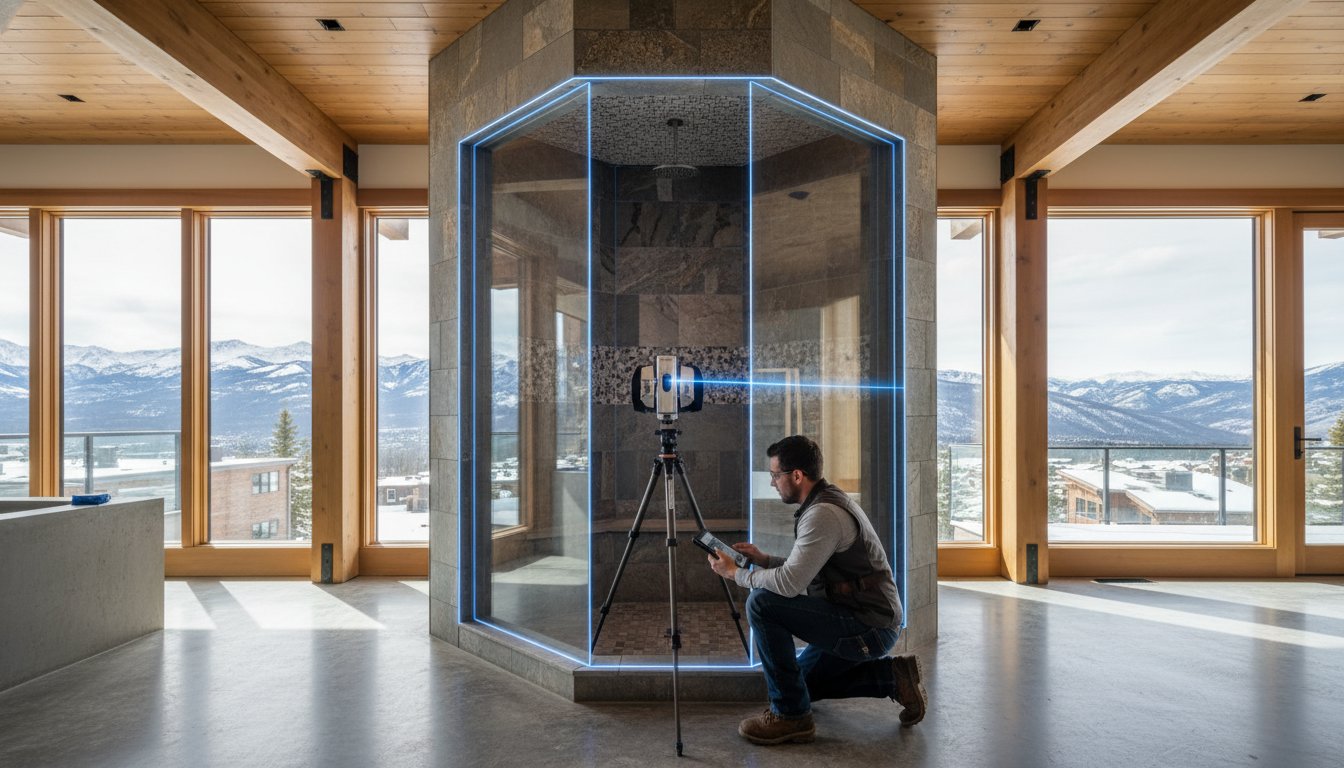
The process begins with the strategic placement of a laser tripod to establish an optimal line-of-sight across the entire project area. The scanner then executes a full 360-degree rotation, projecting a laser beam that measures the distance to every surface it touches. We verify the point cloud data in real-time on a tablet or laptop. This immediate feedback allows us to identify and resolve any “shadows” or obscured areas where the laser couldn’t reach, ensuring a 100% complete digital record before we leave the site.
Translating Point Clouds into CAD Drawings
Once the on-site data is captured, it undergoes a rigorous cleaning process. We strip away the “noise” of the surrounding room to focus exclusively on the path where the glass will be installed. This refined data is used to generate detailed shop drawings that specify exact hardware placements and glass thicknesses. Before a single sheet of glass is cut, we provide a “digital proof” for client approval. This transparent workflow allows architects and designers to visualize the final fit with sub-millimeter accuracy, confirming that the “invisible” transitions they’ve designed will be achieved in the final build.
Digital Precision vs. Manual Templates: Eliminating the Margin for Error
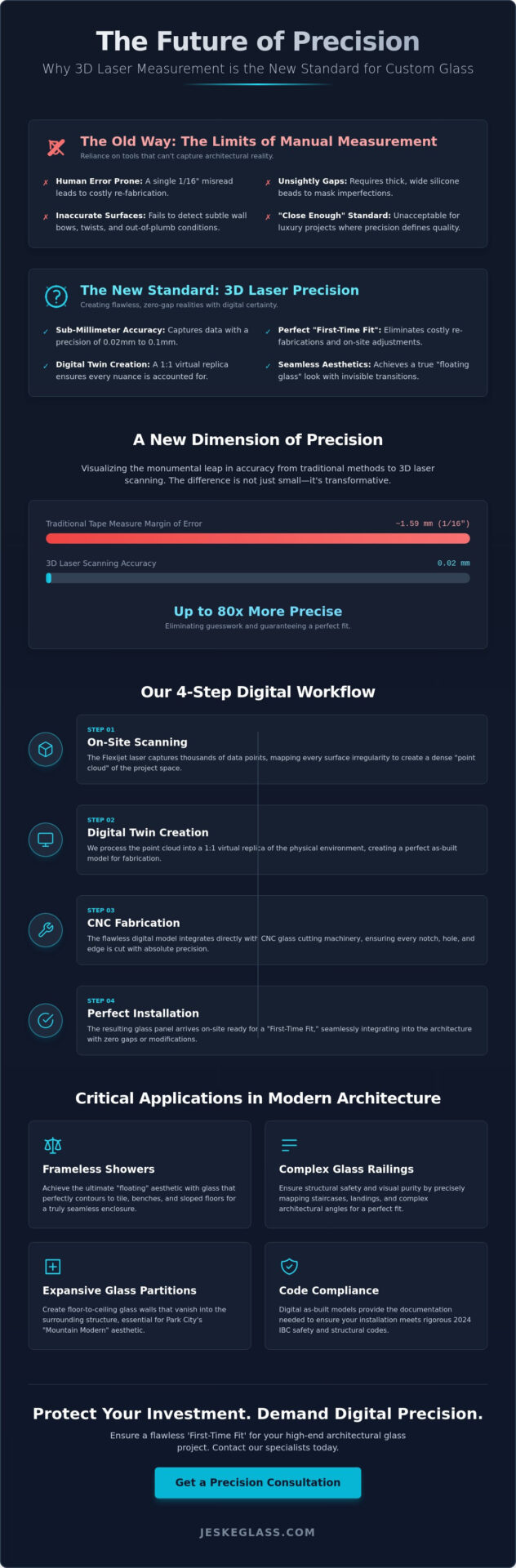
The discrepancy between a human eye and a digital sensor is measured in the success of the final installation. Manual templating, while a time-honored craft, is tethered to a 1/16th-inch margin of error that is simply too wide for modern, high-transparency architecture. In contrast, 3D laser measurement for glass offers sub-millimeter precision, typically within a range of 0.02 mm to 0.1 mm. This technical leap ensures that every panel arrives ready for immediate installation, achieving a “First-Time Fit” rate that manual methods cannot replicate. While some may hesitate at the initial cost of digital scanning, the investment pays for itself by eliminating the expense of second site visits and the catastrophic waste of mis-cut tempered glass.
Efficiency is another defining factor. Measuring a complex, multi-level staircase with traditional wood or cardboard templates can consume several hours of a technician’s day. A 3D scan captures the same volume of data in minutes. This speed doesn’t sacrifice detail; it enhances it by recording the entire structural context in a single digital session. It’s a more sophisticated way to respect the client’s time and the project’s momentum.
The True Cost of Manual Errors
The financial burden of a manual error extends far beyond the price of the glass itself. Tempered glass is a finished product; it cannot be trimmed or adjusted once it leaves the tempering furnace. If a panel is off by even an eighth of an inch, it becomes expensive scrap. In Utah’s fast-moving construction market, a two-week delay for a re-cut can derail final inspections and move-in dates. Beyond the schedule, there is an aesthetic price. Large, uneven caulk joints used to hide gaps are a hallmark of inferior craftsmanship that diminishes the property’s value.
Reliability in Complex Geometric Projects
Projects featuring curved surfaces or intricate angles leave no room for approximation. When designing custom glass railings in Salt Lake City, maintaining a perfectly consistent radius is vital for both visual flow and structural integrity. Digital precision allows us to identify load-bearing points with absolute certainty, ensuring that hardware is anchored into the strongest part of the substrate. This rigorous approach transforms the glass from a decorative addition into a high-performance architectural component that meets the most demanding safety standards.
Critical Applications for Laser-Measured Glass in Utah Architecture
Utah’s high-end residential and commercial spaces present unique challenges that demand more than just standard glass fabrication. The rugged elegance of Mountain Modern homes and the sleek transparency of urban offices require a level of integration that only 3D laser measurement for glass can provide. Whether we’re fitting glass into a rough-hewn stone opening or spanning a 60-foot commercial storefront, the technology ensures the architecture remains the focus, not the hardware or the sealant. This digital foresight allows us to work with materials that are traditionally difficult to measure, such as hand-forged steel or natural stone, with absolute confidence.
Luxury Showers and the ‘Zero-Gap’ Standard
The contemporary bathroom has evolved into a sanctuary of light and texture. For frameless glass showers in Park City, the objective is a “floating” look where the glass appears to emerge directly from the tile. Laser mapping allows us to account for the natural variations in decorative tile patterns and uneven stone surfaces common in luxury mountain estates. By capturing these nuances with sub-millimeter accuracy, we eliminate water leakage through precise glass-to-tile transitions. This ensures that the structural integrity of the shower enclosure is as sound as its aesthetic appeal, even when faced with the most complex geometric layouts or non-plumb walls.
Commercial Installations in Provo and SLC
In the business sector, efficiency and scale are paramount. When managing commercial glass installation in Provo, 3D scanning allows for the seamless coordination of glass with other trades. We map the steel frames, masonry openings, and wood trim before the glass is even ordered. This proactive approach ensures that large-scale panels align perfectly across long spans, which is essential for high-traffic office partitions and storefronts. Coordinating with masonry and steel trades early in the process prevents the costly on-site rework that often plagues large-scale builds, keeping projects on schedule and within their technical specifications.
Beyond these specific areas, we apply this precision to custom mirrors and staircase railings. Fitting full-wall mirrors around existing cabinetry or intricate crown molding requires a level of detail that traditional tools cannot match. Similarly, for staircase railings, we map every tread and riser to ensure a continuous, flowing handrail that meets the strict 2024 International Building Code requirements for safety. This includes ensuring all glass railings use safety glazing that meets Category I (16 CFR 1201) or Class A (ANSI Z97.1) standards. If you’re ready to see how this technology can transform your next project, discuss your custom vision with our specialists today.
The Jeske Glass Standard: Implementing 3D Laser Precision in Park City
At Jeske Glass, we view the integration of 3D laser measurement for glass not as a departure from tradition, but as its ultimate refinement. With over 70 years of heritage in the Utah glass industry, our firm has transitioned through every era of architectural glass, from hand-cut mirrors to the complex structural glazing requirements of 2026. This depth of experience allows us to understand the soul of a building in ways that technology alone cannot. Our “Perfect Fit” guarantee is the culmination of this history; it’s a promise that the dignity of your architectural vision will never be compromised by technical limitations or measurement failures.
Utah’s luxury mountain homes present a unique set of challenges, from heavy timber settling to the extreme thermal expansion of steel frames in high-altitude environments. We don’t simply measure a space; we analyze its structural behavior. By combining our decades of localized knowledge with the most advanced digital scanning tools, we provide a level of stability and aesthetic purity that is unmatched in the region. This commitment to excellence ensures that every installation, whether it’s a massive partition or an intricate grid shower, stands as a testament to both modern innovation and timeless craftsmanship.
A Master Craftsman’s Approach to Technology
The laser is a high-precision instrument, yet its value is determined by the hand that guides it. We treat 3D laser measurement for glass as a tool for artistry, allowing us to execute designs that were previously considered impossible. Our technicians aren’t just equipment operators; they’re trained to interpret site data with a builder’s eye, anticipating how glass will interact with the specific architecture of a home. This holistic perspective ensures our custom glass Utah services remain the benchmark for quality. We don’t just provide a product; we act as your creative partner in solving the most demanding engineering challenges.
Start Your Precision Project Today
The path to a flawless installation begins with a sophisticated consultation. When our team visits your site, we perform a comprehensive digital audit of the space, identifying potential hurdles before they become expensive delays. This digital-first workflow significantly accelerates your project timeline. By moving directly from a 360-degree scan to a finalized CAD file, we bypass the slow, iterative process of manual templating and physical adjustments. Your glass is fabricated with the confidence that it will fit perfectly the moment it arrives on site. Contact our team today to request your free estimate and schedule a precision scan for your next architectural masterpiece.
Mastering the Invisible Fit with Digital Precision
The pursuit of architectural transparency requires more than just high-quality materials; it demands an uncompromising commitment to technical accuracy. By replacing the inherent variability of manual templates with 3D laser measurement for glass, we’ve established a new benchmark for luxury installations across Utah. This digital approach ensures that every frameless shower, custom railing, and commercial storefront integrates seamlessly with the surrounding structure, regardless of the site’s geometric complexities.
At Jeske Glass, we combine over 70 years of local Utah experience with the most advanced 2026 laser technology to provide a “Perfect Fit” guarantee on every project. We don’t believe in “close enough” when it comes to your architectural vision. Our process eliminates the need for unsightly silicone gaps and costly re-fabrications, ensuring your glass performs with the safety and elegance it was designed to deliver. Whether you’re building a modern estate in Park City or a high-traffic office in Salt Lake City, our team is ready to provide the technical expertise your project deserves.
Schedule your free precision estimate with Jeske Glass to experience the difference that sub-millimeter data makes in high-end design. Let’s transform your complex architectural challenges into a flawless, enduring reality.
Frequently Asked Questions
How accurate is 3D laser measurement for glass projects?
Modern 3D laser measurement for glass achieves a high degree of precision, typically ranging between 0.02 mm and 0.1 mm. This sub-millimeter accuracy far exceeds the traditional 1/16th-inch margin of error associated with manual tape measures. By capturing the volumetric reality of a space at this level, we ensure that every custom panel integrates perfectly with the surrounding architecture, even when walls are slightly out of plumb.
Can 3D lasers measure for glass through existing windows or doors?
Lasers generally reflect off or pass through transparent surfaces, which requires a specialized technical approach for measurement. To define the plane of existing glass accurately, our technicians use matte targets or temporary markers that allow the laser to bounce back and record the specific coordinates. This ensures that new installations, such as mirrors or partitions, align perfectly with existing glazed elements without any distortion in the digital model.
Is 3D laser measurement necessary for a standard shower door?
While a “standard” opening might seem straightforward, luxury homes in Utah often feature natural stone or decorative tile with subtle surface variations. 3D laser measurement for glass is essential in these environments because even a 1/8th-inch deviation in tile thickness can cause unsightly gaps or water leakage. Using digital precision for every shower project ensures the “invisible” fit that defines high-end craftsmanship and prevents the need for excessive silicone sealants.
How long does a 3D laser scan take on a typical job site?
A typical on-site scanning session for a residential project, such as a large frameless shower or a custom mirror wall, generally takes between 20 and 45 minutes. This efficiency is a significant improvement over manual templating, which can often require several hours of physical labor. The speed of the scan allows us to capture a complete digital twin of the environment without disrupting the momentum of other trades on the construction site.
What happens if the walls shift after the laser measurement is taken?
The laser scan captures a precise “as-built” digital replica of the space at a specific moment in time. Glass is a rigid material that cannot be adjusted once it’s tempered; therefore, the structural environment must remain stable after the scan is finalized. If significant structural shifting occurs due to settling or secondary construction after our measurements are taken, the glass may no longer fit the altered geometry of the opening.
Does using 3D laser measurement increase the cost of my glass project?
While industry data shows that commercial 3D laser scanning projects can range from $1,000 for a single room to $15,000 for larger facilities, this initial investment significantly reduces overall project costs. Digital precision eliminates the financial waste of re-fabricating mis-cut tempered glass and the labor costs of multiple site visits. It’s a proactive measure that protects your budget by ensuring a flawless installation on the first attempt.
Is the laser safe to use in a home with pets or children present?
We utilize Class 2 laser systems, which are considered eye-safe for accidental or brief exposure. These instruments are similar to the technology used in standard surveying equipment and pose no risk to children or pets during the scanning process. Our technicians maintain a professional, controlled environment while the equipment is active to ensure the safety and comfort of everyone in the home.
Can 3D laser scanning help with curved glass railing installations?
Digital scanning is the only reliable method for mapping the complex radii required for curved glass railings. This technology allows us to verify that every panel meets the safety glazing standards of the 2024 International Building Code, specifically Category I (16 CFR 1201) or Class A (ANSI Z97.1). By mapping the exact path of the staircase or balcony, we ensure that the glass maintains a consistent, flowing aesthetic while providing maximum structural security.