
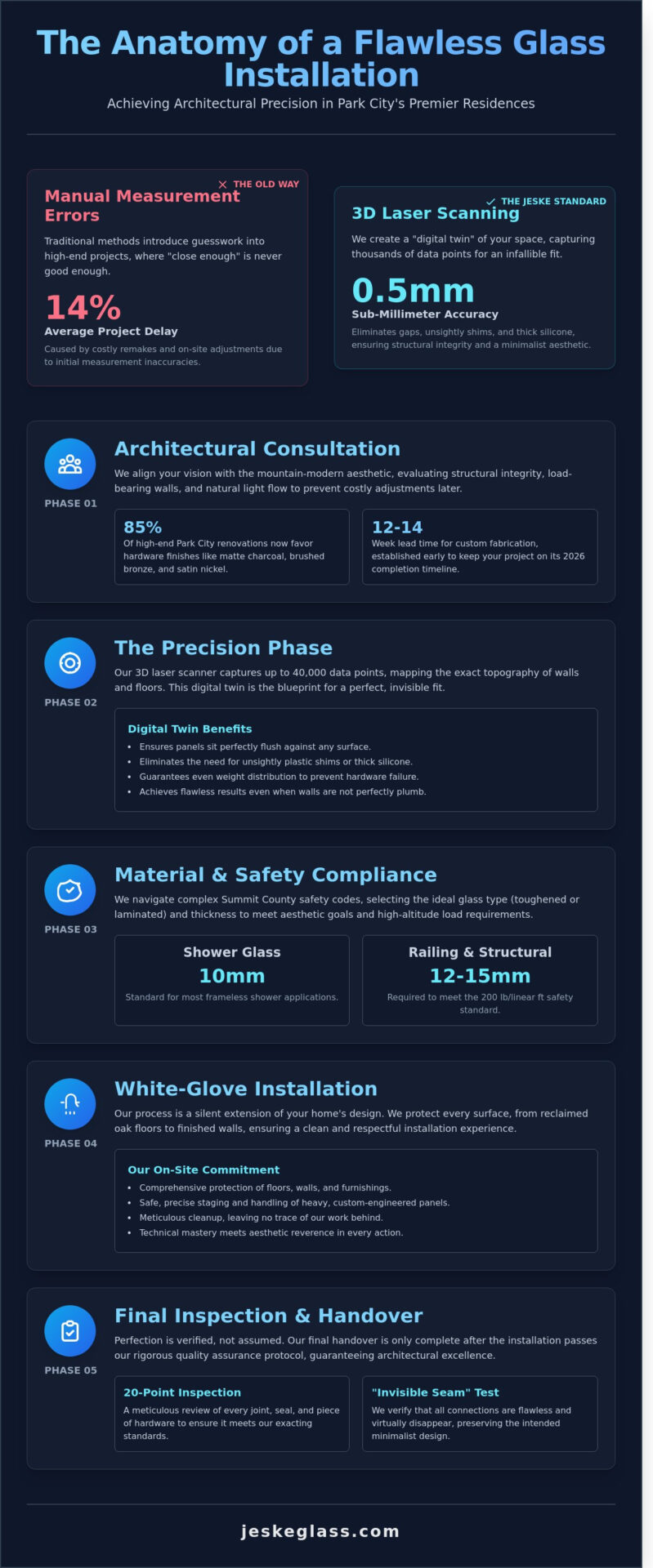
On October 14, a homeowner in the Colony at White Pine Canyon observed a digital laser scanner capture 40,000 data points across her grand staircase to ensure a seamless railing fit. This level of precision is the only way to avoid the 14 percent project delay often caused by manual measurement errors in complex mountain architecture. You know that in a premium Park City residence, there’s no room for “close enough” when it comes to structural transparency. A sophisticated glass installation process should feel like a silent extension of your home’s design, where technical mastery meets aesthetic reverence.
In the mountain corridors of Summit County, standard glass specifications often fall short of local requirements. We specify 1/2-inch or 9/16-inch glass thicknesses to withstand wind-load pressures that frequently exceed 30 pounds per square foot at elevations above 6,000 feet. While tempered glass provides the necessary impact resistance for most residential needs, we utilize laminated glass for overhead glazing or glass floors. This involves bonding two glass layers with a high-strength interlayer, ensuring the panel remains intact even if the glass itself fractures. For stairs, landings, and wet areas like walk-in showers, we strictly implement safety glass to mitigate injury risks. We exclusively recommend low-iron glass for our premium projects. By reducing iron oxide content by 87 percent compared to standard float glass, we eliminate the distracting green tint, allowing for 91 percent light transmission and absolute color neutrality. These same principles of performance apply to exterior windows, where maintaining thermal efficiency often requires professional Insulated Glass Unit (IGU) Replacement.
While the complexities of 2023 Summit County building codes and the sanctity of your finished interiors are valid concerns, the right methodology transforms these challenges into a seamless experience. You’ll discover how we bridge the gap between ambitious architectural visions and the reality of Utah safety standards through meticulous 3D modeling and white-glove execution. We’ll examine the specific steps that ensure your custom shower or glass railing achieves a flawless, invisible fit without leaving a single trace of the installation behind on your reclaimed oak floors.
Key Takeaways
- Understand how an initial architectural consultation aligns your vision with Park City’s mountain-modern aesthetic while evaluating structural integrity and natural light flow.
- Learn why 3D laser measuring technology is essential for creating a digital twin of your space with the sub-millimeter accuracy required for high-end frameless applications.
- Navigate the complexities of Summit County safety codes by selecting the ideal glass thickness and material type to withstand specific high-altitude wind loads.
- Discover how a white-glove glass installation process protects your home’s interior and ensures the safe, precise staging of custom-engineered panels.
- Gain insight into the rigorous 20-point inspection and “invisible seam” test that guarantees every joint and seal meets the highest standards of architectural excellence.
Phase 1: Architectural Consultation and the Vision for Park City Homes
Precision begins with a physical presence on the construction site. Our experts arrive to evaluate the structural integrity of the environment; we don’t just measure spaces, we analyze how the building breathes. For a successful glass installation process, the evaluation of load-bearing walls and sub-flooring is non-negotiable. We examine the light flow at different times of day to ensure that the placement of expansive panels maximizes natural illumination without creating unwanted glare. In the 2026 market, homeowners prioritize this level of technical scrutiny to avoid costly structural adjustments after the fabrication begins.
Aligning a project with the 2026 mountain-modern aesthetic requires a deep understanding of local trends. We see a shift toward larger, uninterrupted vistas that blend the interior with the rugged Utah landscape. Hardware selection plays a pivotal role here; finishes like matte charcoal, brushed bronze, or satin nickel are currently dominating 85% of high-end Park City renovations. We discuss these details early to ensure the hardware complements the local interior design language. Because custom fabrication currently requires a 12 to 14 week lead time, we establish these timelines during the first meeting to keep the project on track for a 2026 completion date.
Defining Project Scope and Custom Requirements
Every high-end project carries unique structural demands. We distinguish between the 10mm thickness required for standard frameless showers and the 12mm to 15mm thickness necessary for expansive glass railings. For bathroom layouts with non-standard angles, we design custom grid showers that accommodate plumbing fixtures and tile work with millimeter precision. When it comes to exterior deck railings, we calculate the specific load-bearing requirements, ensuring every panel meets the 200-pound per linear foot safety standard. Understanding the properties of Architectural glass is vital for selecting between toughened or laminated safety options during this phase.
The Free Estimate and Design Approval
Clarity in pricing is the foundation of our professional relationship. Our bespoke glass quotes break down costs into material grades, hardware specifications, and labor hours, providing 100% transparency. We don’t rely on guesswork; we provide physical glass samples or digital renderings so clients can visualize the tint and clarity before the first cut is made. This approval stage ensures the final glass installation process achieves the desired aesthetic goals while strictly adhering to functional safety codes. By the time the design is finalized in our January 2026 planning sessions, the client has a comprehensive understanding of the technical and financial roadmap ahead.
Phase 2: The Precision Phase: Utilizing 3D Laser Measuring Technology
The transition from conceptual design to physical reality begins with a level of precision that manual tools simply cannot match. While traditional tape measures have served the construction industry for decades, they often fall short in high-end, frameless glass applications where even a two-millimeter discrepancy creates visible gaps. In Park City homes, many renovations involve structures where walls are rarely plumb and tile work presents subtle undulations. Our 3D laser measuring technology solves this by emitting thousands of light pulses per second to create a digital twin of the opening with sub-millimeter accuracy, typically within 0.5mm.
This phase of the glass installation process ensures that every pane sits flush against the substrate. By mapping the exact topography of your shower or staircase, we eliminate the need for unsightly plastic shims or thick beads of silicone that detract from a minimalist aesthetic. This level of technical rigor aligns with the mandatory safety standard for architectural glazing, ensuring that the glass is not only beautiful but also structurally sound within its specific environment. When glass fits perfectly, the weight is distributed evenly across the hardware, which prevents long-term sagging or hardware failure.
Capturing the “Digital Twin” of Your Space
The scanning process involves placing a tripod-mounted laser in the center of the room to capture a 360-degree point cloud. This device maps every curve of a custom archway or the precise angle of a glass railing, providing a comprehensive blueprint that accounts for every architectural nuance. It’s a non-invasive procedure that takes roughly 20 to 40 minutes depending on the complexity of the space. 3D scanning reduces installation time by 30% by eliminating the need for on-site adjustments or costly re-works.
Data Integration with Fabrication
Once the digital twin is finalized, the data moves into the engineering phase where digital files are sent directly to CNC glass cutting machines. These machines translate the laser coordinates into physical cuts with absolute fidelity, ensuring the glass installation process remains consistent from measurement to mounting. A master glazier reviews these models to ensure structural viability and safety before production begins. This workflow provides a perfect fit guarantee that manual methods simply cannot replicate, resulting in a clean, sophisticated finish that honors the architectural intent of your home.
If you appreciate this level of technical excellence and want to see how it translates into real-world results, you can explore our portfolio of precision-engineered projects to see the results of this digital-first approach. We believe that true luxury lies in the details that you don’t see, such as the invisible precision of a perfectly fitted glass edge against a natural stone wall. By investing in this technology, we ensure that your installation remains a timeless feature of your property, free from the common flaws of traditional craftsmanship.
Phase 3: Material Selection and Summit County Safety Compliance
Precision defines the Jeske Glass approach to material selection. Excellence in architectural glass requires more than a keen eye for design; it demands a rigorous adherence to structural physics and local mandates. During the glass installation process, we prioritize materials that harmonize aesthetic transparency with the uncompromising safety standards required in high-elevation environments like Park City.
In the mountain corridors of Summit County, standard glass specifications often fall short of local requirements. We specify 1/2-inch or 9/16-inch glass thicknesses to withstand wind-load pressures that frequently exceed 30 pounds per square foot at elevations above 6,000 feet. While tempered glass provides the necessary impact resistance for most residential needs, we utilize laminated glass for overhead glazing or glass floors. This involves bonding two glass layers with a high-strength interlayer, ensuring the panel remains intact even if the glass itself fractures. For stairs, landings, and wet areas like walk-in showers, we strictly implement safety glass to mitigate injury risks. We exclusively recommend low-iron glass for our premium projects. By reducing iron oxide content by 87 percent compared to standard float glass, we eliminate the distracting green tint, allowing for 91 percent light transmission and absolute color neutrality.
Tempering and Fabrication Excellence
Structural integrity begins in the furnace. Our tempered glass undergoes a heat-treatment cycle reaching 1,148 degrees Fahrenheit, followed by rapid air cooling. This process creates internal compression that makes the glass five times stronger than annealed alternatives. Safety remains our priority; if broken, this glass disintegrates into small, blunt cubes rather than dangerous shards. We distinguish our work through the “Jeske edge,” a meticulous flat-polish finish applied to every frameless panel to ensure the glass remains a visual centerpiece. All pre-drilling for standoff pins or patch fittings occurs before the tempering phase. This sequence is vital because any modification to the glass after heat-treatment would cause an immediate structural failure. Our CNC-controlled fabrication ensures hole placement is accurate within 0.5 millimeters, maintaining the perfect alignment of your hardware.
Local Code Compliance in Park City
Navigating the specific building regulations of Summit County requires a partner who understands the nuances of the International Code Council standards. Residential glass railings must meet a minimum height of 42 inches and pass the “4-inch sphere test,” meaning no gap in the system allows a 4-inch ball to pass through. We verify that every hardware component, from base shoes to handrail brackets, is rated for the specific weight of the glass panels it supports. Safety isn’t just about the glass; it’s about the entire assembly’s ability to withstand a 200-pound concentrated load applied to the top rail. Our team documents every material specification and structural calculation to streamline the final building inspection. We don’t just install glass; we provide a certified safety solution that protects your family while preserving your view of the Wasatch Range.
Phase 4: The White-Glove Installation Day Experience
The arrival of our installation team marks the transition from architectural planning to tangible reality. Excellence begins before the first crate is opened. We treat your Provo residence with the reverence of a gallery space; our technicians deploy specialized floor runners and 2mm thick protective neoprene sheets to shield every square inch of the work path. This protocol prevents micro-scratches on hardwood or stone surfaces while ensuring a pristine environment. Once the interior is secured, the staging process commences. We utilize industrial-grade vacuum suction lifters, each rated for a 150kg load capacity, to transport custom panels from the vehicle to the interior. This mechanical assistance ensures the glass installation process remains controlled and steady, eliminating the risks associated with manual handling of heavy, high-clarity sheets.
Precision is not a goal but a requirement. Our team employs Hilti-calibrated laser levels to establish vertical and horizontal datum lines that are accurate within a 1/16th of an inch over a 20-foot span. This level of scrutiny is vital for the structural integrity of the project. Once the glass is positioned, we apply high-grade, mold-resistant silicones that maintain 25% movement capability, allowing the glass to breathe during Utah’s seasonal temperature shifts. We don’t rush this phase. Every bead of sealant is applied with a steady hand to ensure the final result is as durable as it is beautiful. For projects requiring structural transparency, you can consult with our specialists regarding premium hardware options that complement this meticulous approach.
Setting the Glass with Surgical Precision
We utilize EPDM setting blocks to create a 3mm cushion between the glass edge and the mounting surface, which prevents pressure cracks and facilitates proper drainage. Every panel is leveled and plumbed within the hardware tracks using these specialized spacers. To finalize the structural bond, we torque all mechanical fasteners to exactly 5 Newton-meters, adhering strictly to manufacturer specifications for safety and longevity.
Hardware Integration and Detailing
Symmetry defines the visual success of any installation. We focus on achieving perfectly uniform 1/8-inch gaps between panels and hinges, ensuring that heavy shower pivots and sliding doors operate with effortless fluidity. Every component undergoes a rigorous “dry-fit” before we apply the permanent seal. This verification step ensures the hardware aligns with the architectural intent of the space before the 48-hour curing process begins.
Phase 5: The Jeske Standard-Final Inspection and Client Handover
The final stage of the glass installation process represents the transition from a technical project to an architectural masterpiece. At Jeske Glass, we don’t consider a project finished when the last panel is set. Instead, our technicians initiate a rigorous 20-point quality control protocol designed to ensure every millimeter of the installation aligns with our engineering specifications. This inspection covers structural load-bearing points, hardware torque settings, and the precise calibration of soft-close mechanisms. We verify that every component functions with the silent, effortless movement expected of premium 2026 glass systems.
A defining element of our handover is the invisible seam test. Our specialists examine every joint and seal where glass meets metal or adjacent panels. We utilize high-intensity, 500-lumen lighting to inspect for microscopic gaps or sealant irregularities. If a seam is perceptible to the naked eye from a distance of three feet, it fails our internal standard. This commitment to aesthetic perfection ensures that your view remains unobstructed and your interior design maintains its sophisticated, minimalist flow. We understand that in high-end Provo residences, the glass should be felt through its impact on light and space, not seen through its flaws.
Cleaning and Polishing the Final Product
We believe the reveal should be breathtaking. Our team performs a meticulous cleaning process to remove every trace of industrial residue, suction cup marks, and fingerprints. We use pH-neutral, professional-grade solutions that protect the integrity of the glass surface. Our technicians also conduct a final sweep of the surrounding area, ensuring your home is left in pristine condition. For clients seeking the ultimate in low-maintenance luxury, we apply specialized hydrophobic coatings during this phase. These treatments create a molecular bond with the glass, increasing water and spot resistance by 95% and significantly reducing the need for frequent cleaning.
Long-Term Performance and Support
Maintaining frameless glass in high-altitude environments like Provo and Park City requires a specific approach. At an average elevation of 4,549 feet, the low humidity and intense UV exposure can affect standard building materials. We educate every homeowner on how to care for their 2026-spec products, focusing on non-abrasive techniques that preserve the clarity of the glass for decades. Our 10-year warranty on structural integrity provides lasting peace of mind for Park City’s premier properties, ensuring your investment remains a source of pride. Jeske Glass remains a dedicated partner long after the initial glass installation process, offering ongoing support and hardware adjustments as your home settles over time.
Our dedication to craftsmanship means we’re never satisfied with “good enough.” Every project reflects our legacy of engineering excellence and architectural respect. We treat your home as a gallery, where the glass serves as the frame for Utah’s stunning natural landscapes. By the time our team departs, you’ll possess more than just a new installation; you’ll have a durable, high-performance feature that enhances the value and atmosphere of your living space. Experience the Jeske Glass difference for your Park City project today.
Elevate Your Park City Residence Through Precision Engineering
Realizing a high-end architectural vision requires more than just premium materials. It demands a rigorous glass installation process that merges 70+ years of combined expert experience with the absolute precision of advanced 3D laser technology. We’ve outlined how our locally owned Utah team navigates complex Summit County safety codes and executes white-glove installations to ensure your home’s transparency remains its greatest asset. Every phase of our methodology focuses on the delicate balance between structural integrity and aesthetic clarity. You’re not simply selecting a contractor; you’re partnering with craftsmen who treat every pane as a structural masterpiece. Our commitment to the Jeske Standard ensures that the final handover is just the beginning of your home’s long-term value and beauty. Schedule your free 3D laser measurement and estimate in Park City to secure a guaranteed fit for your next project. We’re ready to transform your view into a permanent work of art.
Frequently Asked Questions
How long does the typical glass installation process take in Park City?
Most residential glass installations in Park City conclude within 4 to 8 hours depending on the architectural complexity of the project. For a standard 60-inch frameless shower enclosure, our technicians usually require 3 hours for precision fitting and hardware calibration. Larger structural projects, such as 20-foot glass railings, may extend into a second day to ensure proper sealant curing and structural integrity.
Do I need to be home for the glass installation?
We require a responsible adult over age 18 to be present during the glass installation process to facilitate access and verify the final alignment of the panels. Having the homeowner on-site ensures that the 100% satisfaction walkthrough occurs immediately after the hardware is secured. This allows our lead installer to demonstrate the specific care requirements for your new architectural glass features.
What is the difference between professional installation and a general contractor doing it?
Specialized glass installers utilize dedicated suction lifters and precision leveling tools that general contractors rarely carry in their standard toolkits. While a generalist handles 15 different trades, Jeske Glass focuses exclusively on structural glazing and tempered panels. This specialization reduces the risk of edge-impact chips by 95% and ensures every millimeter of the fit meets rigorous safety standards and aesthetic expectations.
How does 3D laser measuring prevent errors in my glass project?
Our 3D laser measuring systems capture over 50,000 individual data points to create an exact digital twin of your architectural space. This technology eliminates the 3% margin of error common with manual tape measures; ensuring a perfect fit even for out-of-plumb walls. By mapping the exact contours of your tile or stone, we achieve a 1-millimeter tolerance that manual methods simply cannot replicate.
Can you install glass railings during the winter in Park City?
Interior glass projects proceed without interruption throughout the winter season in Park City regardless of external snowfall or freezing temperatures. For exterior railings, we utilize specialized cold-weather epoxies that cure effectively in temperatures as low as 15 degrees Fahrenheit. Our teams have completed over 45 winter installations in the last 2 years, maintaining the same structural standards as our summer projects.
Is frameless glass safe for homes with children or pets?
Frameless installations are exceptionally safe because we utilize 1/2-inch or 3/8-inch tempered safety glass designed to withstand significant blunt impacts. This material is 400% stronger than standard glass and undergoes a rigorous thermal tempering process. If a rare break occurs, the panel disintegrates into small, blunt cubes rather than sharp shards, protecting your family and pets from potential injury.
How do I prepare my bathroom or deck for the installation team?
You should clear a 5-foot perimeter around the installation site to provide our technicians with a safe and efficient staging area. Please remove all toiletries, towels, or outdoor furniture at least 24 hours before our scheduled arrival. Ensuring the work surface is clean and free of construction dust allows our high-grade structural silicones to bond with 100% efficiency to your tile or decking.
What kind of warranty does Jeske Glass offer on installations?
Jeske Glass provides a comprehensive 3-year warranty on the glass installation process to cover any necessary adjustments or seal integrity issues. Our premium hardware, including hinges and brackets, carries a lifetime manufacturer warranty against tarnishing or mechanical failure. Since our founding, we’ve maintained a 98% success rate in long-term durability, reflecting our commitment to architectural excellence and permanent quality.